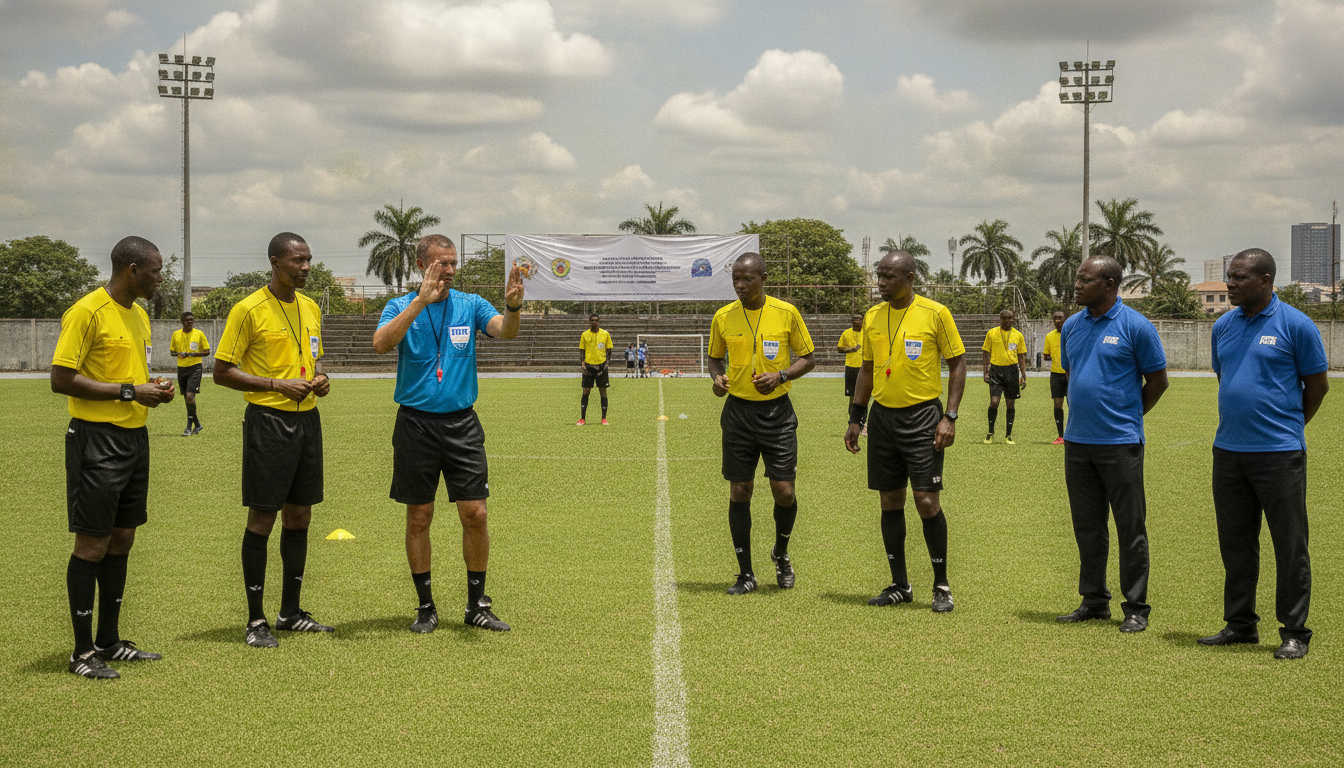
UNIFFAC referees course kicks off in Douala to prepare officials for CAF and FIFA competitions
Thirty-one referees from eight UNIFFAC nations begin a FIFA capacity-building course in Douala to prepare officials for upcoming CAF and FIFA matches.


The UNIFFAC referees course in Douala opened on July 7, 2026, bringing together 31 male and female referees and assistant referees for a four-day FIFA capacity-building programme. The initiative aims to raise officiating standards across Central Africa and to ready officials for forthcoming Confederation of African Football (CAF) and FIFA competitions.
Participants began the programme with physical endurance tests before moving into classroom and technical sessions, with organisers emphasizing a blend of fitness, law interpretation and match management. The course, running through July 10, 2026, mixes newly accredited officials with experienced FIFA-listed referees to ensure peer learning and consistent application of modern officiating protocols.
Course Launch and Opening Ceremony
The course kicked off with physical assessments at Bepanda Omnisports Stadium, where referees completed endurance and agility drills under the supervision of FIFA instructors. Those practical tests were designed to benchmark participants’ fitness ahead of the technical and theoretical classroom phases that followed.
The classroom segment was formally opened by UNIFFAC Executive Director Hassan Bala Korei and René Daniel Louzaya, a senior member of the UNIFFAC Referees Commission. Organisers framed the event as a zonal effort to standardise refereeing practices and to close gaps between member associations’ officiating standards.
Curriculum Focus on Modern Officiating
Training over the four days concentrates on match-critical themes such as handball interpretations, offside decision-making, and incidents inside the penalty area. Sessions combine rule clarification with scenario-based exercises to help referees apply the Laws of the Game consistently under pressure.
Instructors also emphasised match management skills, including positioning, communication with players and assistant referees, and the use of advantage. The programme pairs classroom law seminars with on-pitch simulations so officials can translate theoretical guidance into practical decision-making.
Instructors and Regional Representation
A team of refereeing instructors leads the programme, including Evehe Divine, Jean Gaoussoumou, Brice Letokouzou, Geneviève Lukusa Kajinga and Sandza Meya Louise. The mix of tutors brings refereeing expertise from across the region and supports a collaborative training environment.
Cameroon’s contingent includes FIFA referees Yannick Fodouop and Ntui Ayuk Priscilla, alongside assistant referees Mpande Mpou Gerard Dimitri and Yeppe Rebecca Prisca. Officials from Chad, Congo, DR Congo, Equatorial Guinea, Gabon, the Central African Republic and São Tomé and Príncipe complete the line-up, highlighting UNIFFAC’s eight-member composition.
Pathway to CAF and FIFA Assignments
UNIFFAC leaders framed the course as part of a wider talent pipeline intended to prepare referees for CAF tournaments and international appointments. Organisers stressed that zonal courses are stepping stones: strong performances at this level can lead to continental fixtures and, for the most successful, FIFA assignments.
Officials were reminded that progression requires sustained effort, fitness and the ability to interpret laws consistently in high-pressure matches. The programme cites recent examples of referees who rose from regional initiatives to participate at the 2026 FIFA World Cup, demonstrating the tangible career pathways such capacity-building programmes can create.
Monitoring, Evaluation and Next Steps
Course organisers said participants will undergo continuous assessment during the four days, combining physical benchmarks with video analysis and practical feedback from instructors. Those assessments will inform each association’s referee development plans and may shape selections for upcoming CAF qualifiers and tournaments.
UNIFFAC also indicated plans for follow-up workshops and refresher courses to ensure learning is reinforced beyond Douala. The zonal union intends to track participants’ performance across domestic and regional matches to measure the course’s impact over the coming season.
This week’s programme reflects a concerted effort by UNIFFAC to professionalise officiating standards, strengthen cross-border collaboration and provide a clear ladder to continental and global appointments. The immediate focus in Douala is on practical competence and uniform application of the Laws of the Game, while long-term goals emphasise the production of referees capable of representing Africa on football’s biggest stages.