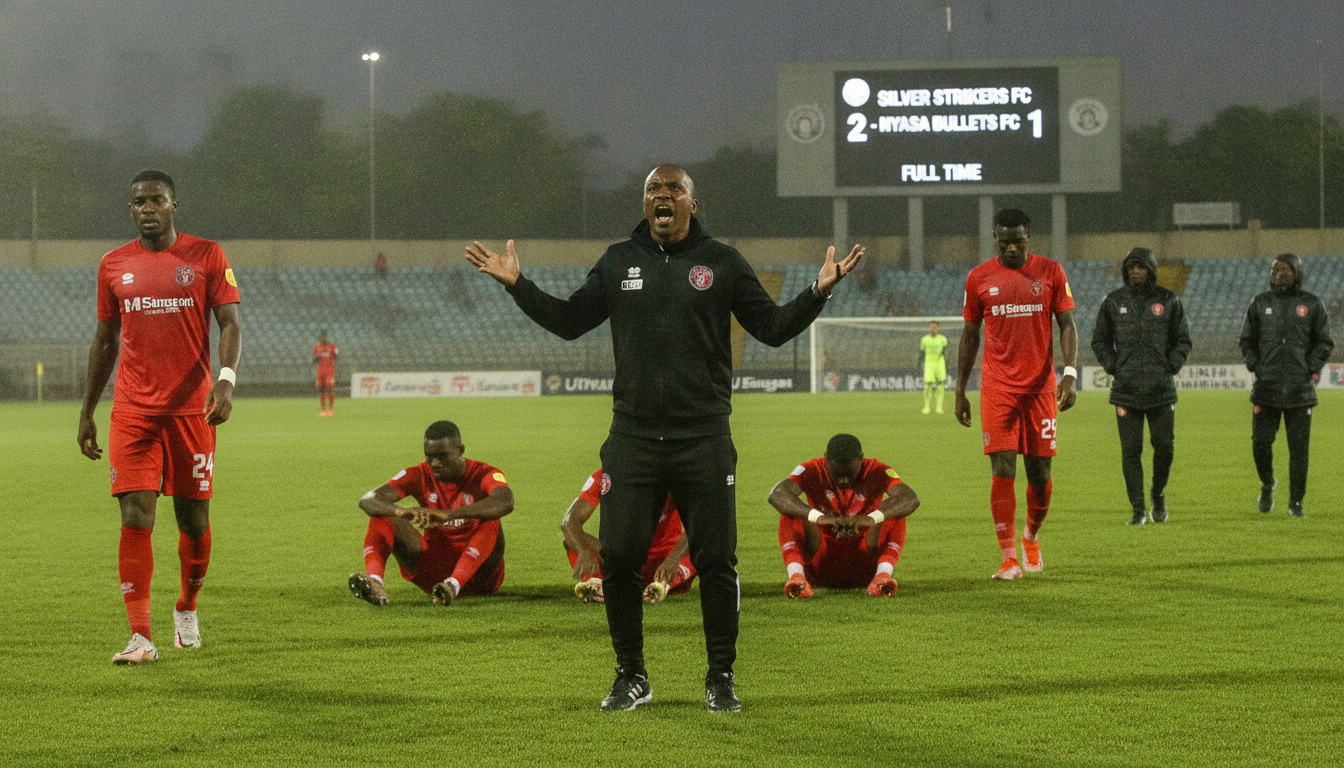
Nyasa Bullets discipline thrust into the spotlight after Airtel Top 8 penalty exit
Nyasa Bullets discipline took center stage as coach Wedson Nyirenda publicly criticised his players following a 1-1 draw and penalty shootout loss to Ekhaya FC in the Airtel Top 8.


Match day turning point
FCB Nyasa Bullets were eliminated from the Airtel Top 8 after a 1-1 draw at Mpira Stadium that went to a tense penalty shootout, which Ekhaya FC won 7-6.
The narrow scoreline masked a more significant fallout, with coach Wedson Nyirenda using the post-match stage to single out issues beyond tactical mistakes.
Nyirenda’s comments immediately reframed the result, shifting attention from the outcome to the state of the squad.
What had been a straightforward knockout exit in sporting terms became, in his account, evidence of deeper problems with discipline and adherence to instructions.
Coach’s accusation and its specifics
In blunt post-match remarks, Nyirenda said his players “did not show up” and suggested many were lost and slow against the opposition.
Most strikingly, he alleged that players failed to follow tactical directions — a heavy claim from a head coach that foregrounds control and internal cohesion.
That specific allegation distinguished this defeat from routine poor performances; it implied either wilful disregard for the game plan or a failure in the coaching process to make instructions stick.
Either interpretation raises different remedial paths and forces the club to confront whether the root cause is attitude, communication, or both.
Tactical execution versus communication breakdown
On the field, poor execution is common: misplaced passes, mistimed runs and defensive lapses occur in every season.
But when a coach insists tactics were not followed, the problem moves into the realm of structure and discipline, suggesting a disconnect between the bench and the players.
A breakdown could mean the match-day plan was not clearly communicated, or that players chose to ignore it under pressure.
Both scenarios carry consequences: one points to coaching and training methods, the other to squad discipline and authority within the team.
Context within recent success
The allegations land awkwardly against a backdrop of recent triumphs, with Bullets having claimed three Zamadolo titles under the same managerial setup.
A settled coaching group and a winning culture would normally argue against sudden collective indiscipline, making Nyirenda’s public critique all the more noteworthy.
Complacency can creep into even successful teams, yet the timing — a knockout match with a trophy at stake — increases the stakes of any perceived lapse.
Observers will judge whether this was an isolated failure on a single night or a symptom of an emerging rift within a title-winning squad.
Club reaction and leadership approach
The club’s acting chief executive, Albert Chigoga, adopted a measured public tone, urging regrouping and a restoration of character without engaging directly with Nyirenda’s discipline claims.
Chigoga’s message emphasised resilience and continuity, signalling a preference for internal resolution rather than public escalation.
That difference in tone between coach and hierarchy is significant: it leaves open whether the club will back the coach’s assessment with concrete measures or seek a quieter internal fix.
How Bullets’ leadership responds — with support, sanctions, or personnel changes — will reveal whether the public criticism was a tactical nudge or the first step toward larger adjustments.
Potential paths forward for Bullets
If Nyirenda’s diagnosis is correct and morale has dipped, rebuilding will require clear-minded interventions: renewed emphasis on training intensity, communication drills and accountability structures.
If the problem is primarily tactical misunderstanding, the coaching staff will need to reassess how plans are conveyed and reinforced during matches.
Alternatively, if certain players are identified as difficult or unresponsive, the club may consider squad rotation or disciplinary measures to re-establish standards.
Any action must balance short-term stability — maintaining competitiveness in domestic competitions — with long-term cohesion and standards.
FCB Nyasa Bullets now face a pivotal period in which the club’s responses will define the season ahead, both on the pitch and within the dressing room.
Whether Nyirenda’s public airing of grievances proves to be a reset button or a signal of deeper unrest will depend on swift, decisive action by the coaching staff and the club hierarchy.