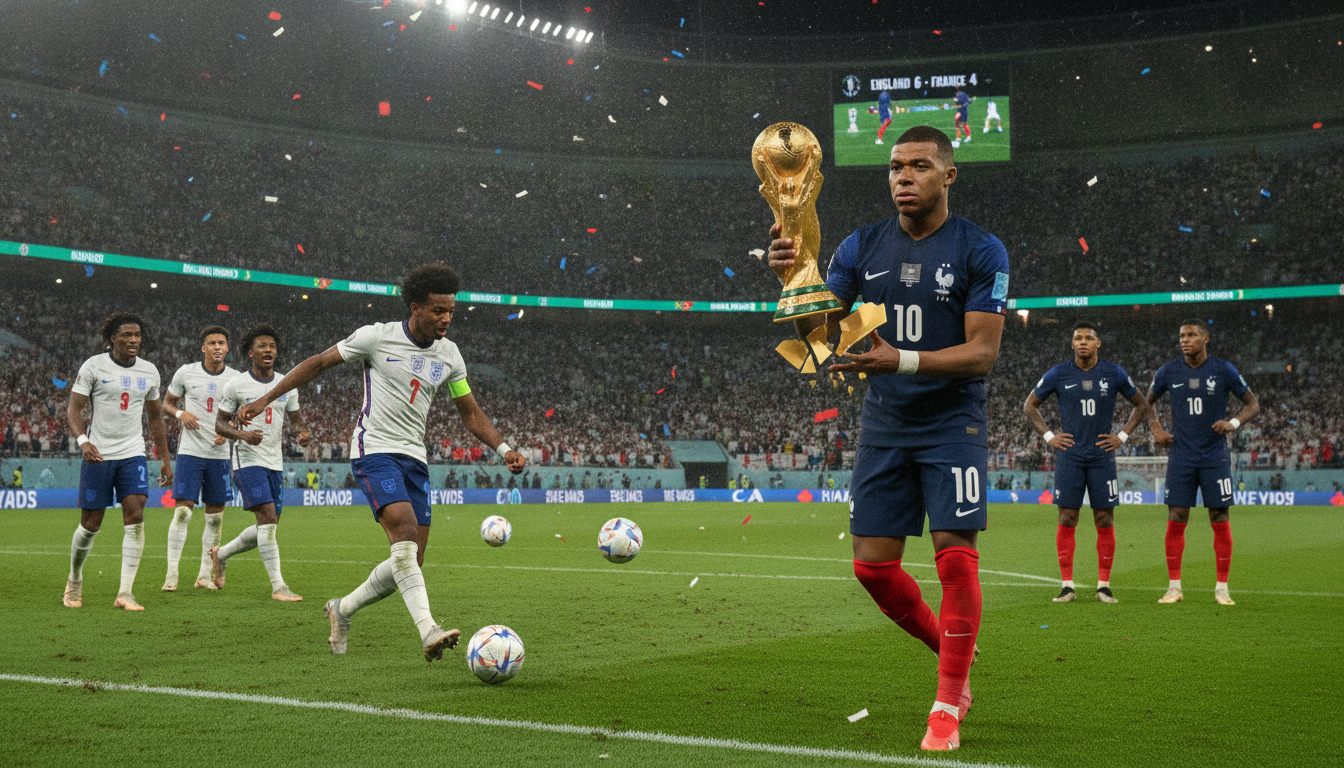
England beat France 6-4 in 10-goal World Cup thriller as Saka takes centre stage and Mbappé sets scoring mark
England beat France 6-4 in a 10-goal World Cup third-place thriller; Bukayo Saka scored a hat-trick and Kylian Mbappé became the tournament’s top scorer.

Kylian Mbappé’s record and Bukayo Saka’s hat-trick framed a wild third-place match in Miami as England beat France 6-4 in a game that produced the most goals in a World Cup fixture since 1982. The contest, played in sweltering conditions, saw England dominate early to open a four-goal lead before France mounted a comeback capped by Mbappé’s strike that extended his international tournament tally. The result left both teams with proud and bittersweet takeaways after a tournament run that ended one step short of a final for different reasons.
Saka hat-trick and England’s blistering first half
Bukayo Saka was the defining figure of the opening 45 minutes, profiting from England’s intensity to score twice before the interval and complete a hat-trick in the second half. England’s attackers combined with sharp pressing and quick transitions to put France under sustained pressure early on, converting that dominance into goals inside the opening quarter-hour and again before halftime. The rapid start allowed England to dictate the tempo and forced France to chase the game in Miami’s taxing heat.
Declan Rice’s opener within minutes set the tone and Ezri Konsa’s header extended the advantage as England struck with clinical efficiency from set pieces and open play. Saka’s movement and finishing supplied the attacking spark that England had lacked at times earlier in the tournament, and his three-goal haul provided the platform for a memorable victory. That combination of defensive solidity in the opening phases and ruthless finishing ensured England could build an improbable cushion against a talented French side.
Mbappé becomes World Cup’s leading scorer amid France fightback
Kylian Mbappé added to his tournament legacy by scoring in Miami to become the leading goal scorer in World Cup history, a milestone reached in a game that was otherwise dominated by England early on. His brace in the second half, including a goal that underscored his clinical ability in the box, sparked a furious French response as Les Bleus sought to overturn a multi-goal deficit. Mbappé’s strike forced the scoreline to remain dangerously close for England, highlighting both his individual brilliance and France’s capacity to threaten when space opened.
Despite Mbappé’s efforts, France could not complete a full comeback, with England’s earlier four-goal cushion ultimately proving decisive even as the contest turned into a shootout of end-to-end football. Mbappé’s record will be one of the enduring narratives from this World Cup, even as questions linger about France’s tactical approach and lineup choices for the fixture. The match therefore served as both a personal triumph for Mbappé and a dramatic coda for a French campaign that finishes without a title.
Tactical changes, big names rested in Miami heat
Both managers made significant changes from their previous lineups, electing to rest several regular starters in what was an unusually rotated third-place game played in oppressive conditions. England’s manager left Harry Kane and Jude Bellingham on the bench at kickoff, while France’s coach omitted attacking options such as Bradley Barcola and Ousmane Dembélé, decisions that shaped the flow and character of the match. Those selections reflected a blend of player management, fatigue mitigation and the unique status of a consolation fixture following extended tournament campaigns.
The rotated squads nevertheless produced a fast, open contest that favored teams willing to press and exploit transitional moments, and England’s bench depth proved influential as substitutes maintained intensity and composure. Players who had not featured heavily earlier in the World Cup seized the opportunity to impact the result and stake claims for future consideration. The managerial gambles, therefore, delivered entertainment and fresh data points about squad depth for both national setups.
Records and historical context
The 10-goal aggregate made this the highest-scoring World Cup match since Hungary’s 10-1 win over El Salvador in 1982 and established a new benchmark for third-place matches. That statistical anomaly places the fixture among some of the most remarkable scorelines in World Cup history and will ensure the Miami game is remembered for its sheer attacking output as much as for individual milestones. The match also provided rare entertainment for neutral spectators, delivering a sequence of goals and momentum swings seldom seen on football’s biggest stage.
Beyond the total goals, individual milestones were prominent: Mbappé’s ascent to the top of the World Cup scoring charts and Saka’s first tournament hat-trick represent contrasting legacies from the same match. For England, the ability to score six against a traditionally robust French defense speaks to tactical adjustments and finishing prowess that had been inconsistent at times earlier in the competition. For France, the game will be catalogued both for Mbappé’s personal landmark and for defensive lapses that need addressing going forward.
Coaches’ futures and post-match repercussions
France’s coach, who announced his decision to step down after a lengthy tenure, fielded a side that reflected both rotation and an awareness of the match’s place in a transitional period for the national team. The selection choices and the eventual outcome will be dissected by federation officials as they plan the next chapter and search for continuity following a long managerial era. For England’s coaching staff, the victory will provide encouragement about squad depth and attacking options, though analysis will also focus on defensive moments that allowed France to stage a comeback.
In both camps, the match offers tangible talking points for summer reviews, player evaluations and tactical planning ahead of upcoming qualifiers and tournaments. Stakeholders will weigh the positives — England’s attacking output and France’s persistent threat through Mbappé — against the negatives, particularly defensive vulnerabilities and stamina in hot conditions. The fixture therefore acts as a microcosm of both nations’ broader project timelines and the immediate decisions that federations must consider.
Implications for player selection and morale
Bukayo Saka’s performance will strengthen his case as a go-to attacking option for England, demonstrating an ability to perform in high-pressure international windows and to combine with teammates in decisive moments. His hat-trick underlines how form, opportunity and tactical trust can align to produce standout individual displays that influence selection debates ahead of competitive fixtures. For younger and fringe players who featured in Miami, the game served as an audition to show their readiness for increased responsibility at senior level.
For France, Mbappé’s record-setting tournament will be a source of pride even as the team faces a period of transition and introspection after the managerial change. Other players who were introduced or given minutes will return with impressions that will inform squad construction and tactical direction. Ultimately, the match’s emotional highs and lows will shape short-term morale while providing clear evidence for technical staff on which performers are best suited to the evolving strategies each federation will adopt.
England finished the tournament with a vibrant attacking demonstration in Miami, and France leave with a mix of individual accolades and unfinished collective business.
The 6-4 scoreline will be recalled for its entertainment value and for the rare convergence of a historic individual record and an eye-catching hat-trick, but both teams now shift focus to rebuilding, reassessment and the competitive calendar that follows.