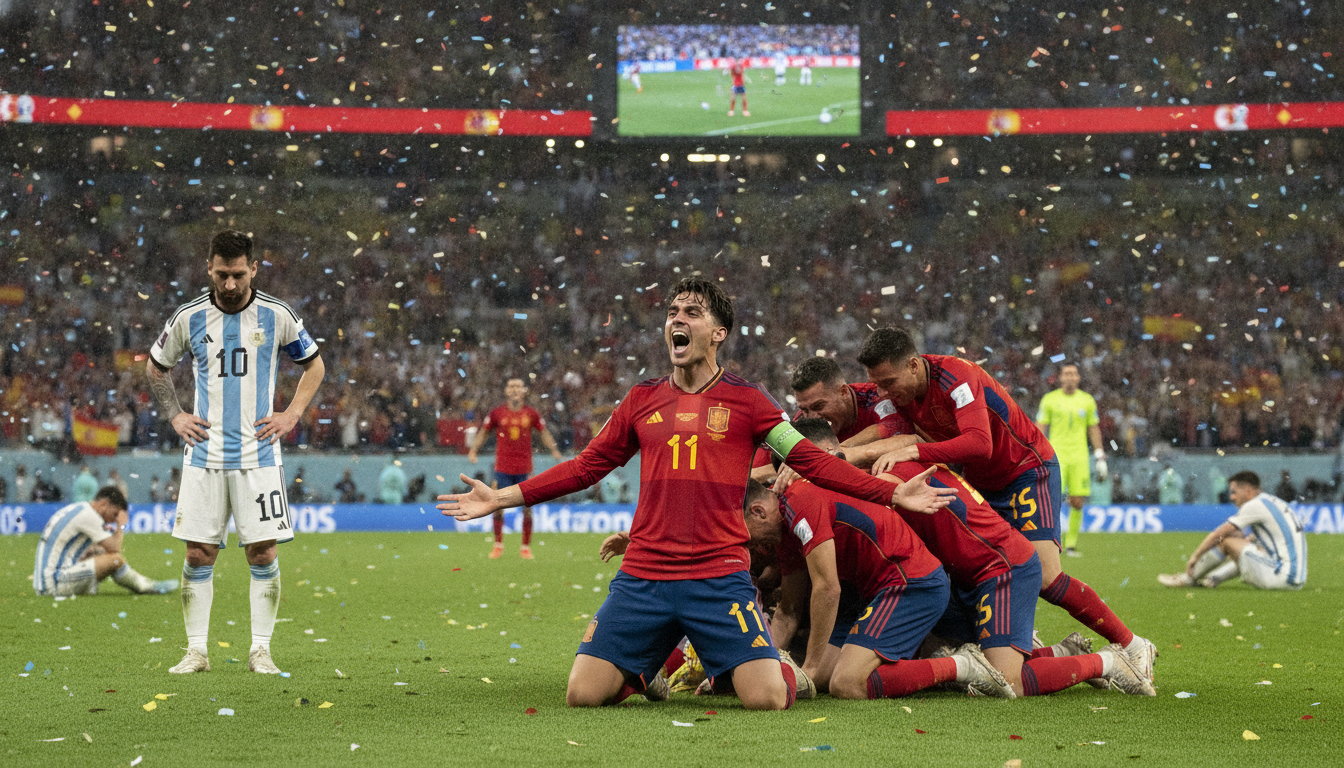
Spain win World Cup as Ferran Torres stuns Argentina with extra-time winner
Spain win World Cup after Ferran Torres strikes in the 106th minute to beat Argentina 1-0, denying Lionel Messi a fairytale final and capping a dominant performance.


Spain win World Cup after Ferran Torres struck a decisive extra-time goal to defeat Argentina 1-0 in a final that saw the Spanish side dominate possession and limit the holders to no shots on target in 120 minutes. Ferran Torres lashed home a powerful finish in the 106th minute, ending Lionel Messi’s hopes of a second World Cup and securing Spain’s triumph before a crowd of 80,663 at MetLife Stadium. The victory was built on intense pressing, structured control through the midfield, and a defensive display that frustrated Argentina throughout the match. Spain’s performance will be remembered as a tactically disciplined display that combined patience with a killer finish at the most decisive moment.
Torres nets extra-time winner
Ferran Torres produced the match-defining moment in the 106th minute when he met a sustained Spanish attack with a thunderous strike that found the net. The goal came after sustained pressure from Spain, who repeatedly forced Argentina to retreat and defend in their own box. Torres’ finish was emphatic and clinical, a clear reward for Spain’s continued probing and tactical patience. That single strike separated the teams and proved decisive in a contest that had remained stubbornly close for long periods.
Spain’s route to the goal was methodical rather than flashy, with the team recycling possession and probing the Argentine backline for openings. The buildup involved patient switches and overlapping runs that eventually created the space for Torres to exploit. His finish provided a dramatic end to extended periods of midfield control by Spain. The timing of the goal—early in extra time—left Argentina limited time to respond and forced them to abandon any plan of cautious containment.
Spain’s sustained control and tactical superiority
From the opening exchanges, Spain asserted itself with a possession-based game that consistently pushed Argentina back into defensive shells. The Spanish midfield dominated territorial play, cycling the ball through short passes and sudden vertical thrusts to unsettle the South American defence. That control limited Argentina’s ability to impose their usual attacking rhythm and deprived Lionel Messi of the space he typically requires. Spain’s approach eroded Argentina’s energy and patience as the game progressed.
Spain’s pressing was coordinated and disciplined, cutting off passing lanes and forcing Argentina into risky clearances rather than composed buildups. The team’s full-backs offered width while central midfielders provided defensive cover, creating balance across the spine of the team. This balance allowed Spain to sustain attacks while remaining secure against counterpressing threats. The result was a match in which Argentina never managed to register a shot on target during regular or extra time, underlining how effectively Spain smothered its rivals.
Messi subdued in likely World Cup swansong
Lionel Messi, widely expected to be playing his final World Cup match, was starved of meaningful involvement and ultimately reduced to a peripheral figure in the decisive moments. The 39-year-old captain struggled to find space or tempo as Spain’s collective pressing repeatedly disrupted Argentina’s attempts to connect through him. Opportunities to influence the game were rare, and when they did arise they were quickly snuffed out by Spanish defenders and midfielders. For a player of Messi’s stature, the evening offered little of the decisive magic that has defined so much of his career.
Messi’s limited impact will be framed against an expectation that he might deliver a fairy-tale finish on football’s biggest stage. Instead, the match unfolded as a demonstration of Spain’s ability to neutralize a single focal point by attacking as a unit. Argentina’s technical quality remained clear, but the lack of meaningful shots and clear chances highlighted how thoroughly Spain contained their threats. Whatever Messi’s legacy, the final will be remembered more for Spain’s tactical execution than any late-career heroics from the Argentine captain.
Discipline and the Enzo Fernández sending off
The match featured several flashpoints of physicality and tactical fouling, culminating in a red card late in the contest when Enzo Fernández was dismissed for a dangerous challenge. The dismissal followed a harsh tackle on Spain defender Pau Cubarsi in added time, a moment that capped a pattern of increasingly cynical fouls by Argentina as frustration mounted. Fernández’s sending off removed any remaining hope of a late Argentine comeback and underlined the tense, often ill-tempered nature of the final stages. Refereeing decisions drew focus as the stakes rose and both teams sought to manage risk in tight quarters.
Argentina’s discipline issues were a double-edged sword: they occasionally disrupted Spain’s flow but also resulted in lost personnel and momentum. Spain, by contrast, managed to maintain composure in critical moments, avoiding the sort of reckless challenges that could have turned the tide against them. The red card was a consequence of a match characterised by high emotion and physical commitment on both sides. In the end, it reinforced the narrative that Spain controlled the proceedings and that Argentina’s reactions grew increasingly desperate.
Crowd, context and the end of a narrative
The final was staged at MetLife Stadium in East Rutherford before a sell-out crowd of 80,663 that included prominent figures from across the political and sporting landscape. The stadium atmosphere was electric as spectators awaited what many had thought would be Lionel Messi’s crowning goodbye to World Cup competition. Instead, Spain turned the evening into a showcase of collective discipline and tactical clarity, delivering a result that reshaped expectations for both teams. The presence of high-profile attendees and the global audience only amplified the scale of Spain’s achievement.
For Spain, the victory represents the culmination of a strategic project that prioritized team structure, pressing and technical fluency over reliance on a single superstar. The win adds another chapter to Spain’s footballing history and will be dissected by coaches and analysts for its detailed execution. For Argentina, the match will prompt reflection on how a side with such attacking pedigree could be stifled so comprehensively. The outcome will resonate beyond this single fixture, affecting narratives around both nations as they transition into their next phases.
Implications for the teams and tournament legacy
Spain’s triumph will alter immediate perceptions of international readiness and squad depth, demonstrating that a well-drilled side can overturn reputations even in the highest-stakes fixtures. The victory gives Spain a benchmark to build on, validating tactical philosophies that emphasize possession, pressure and collective responsibility. Players who contributed across the pitch will gain heightened profiles, while the coaching staff will earn plaudits for preparation and game management. The manner of the win suggests that Spain can be seen as a blueprint for balance between technical ability and defensive organization.
For Argentina, the loss is a bitter close to a World Cup defence that failed to recapture the previous final’s magic. Questions will surface about game plans, substitution timing and the team’s capacity to adapt when a central figure is neutralized. The absence of shots on target across 120 minutes will feature prominently in any post-match analysis as a symptom of deeper tactical problems. Long-term, Argentina will need to assess how to restore attacking potency while maintaining the cohesion that once brought them success.
Spain win World Cup with a blend of tactical precision and timely finishing, while Argentina faces a period of reassessment after a final in which it was unable to muster a single directed shot. The match will be a reference point for how modern international football can be won through collective structure rather than individual moments alone. As fans and analysts debate the finer points, the headline remains clear: a composed Spain delivered when it mattered and walked away with the trophy.
The final image of the night will be Ferran Torres, whose extra-time strike did more than decide a match; it rewrote the ending that many had expected and handed Spain the ultimate prize on football’s biggest stage.