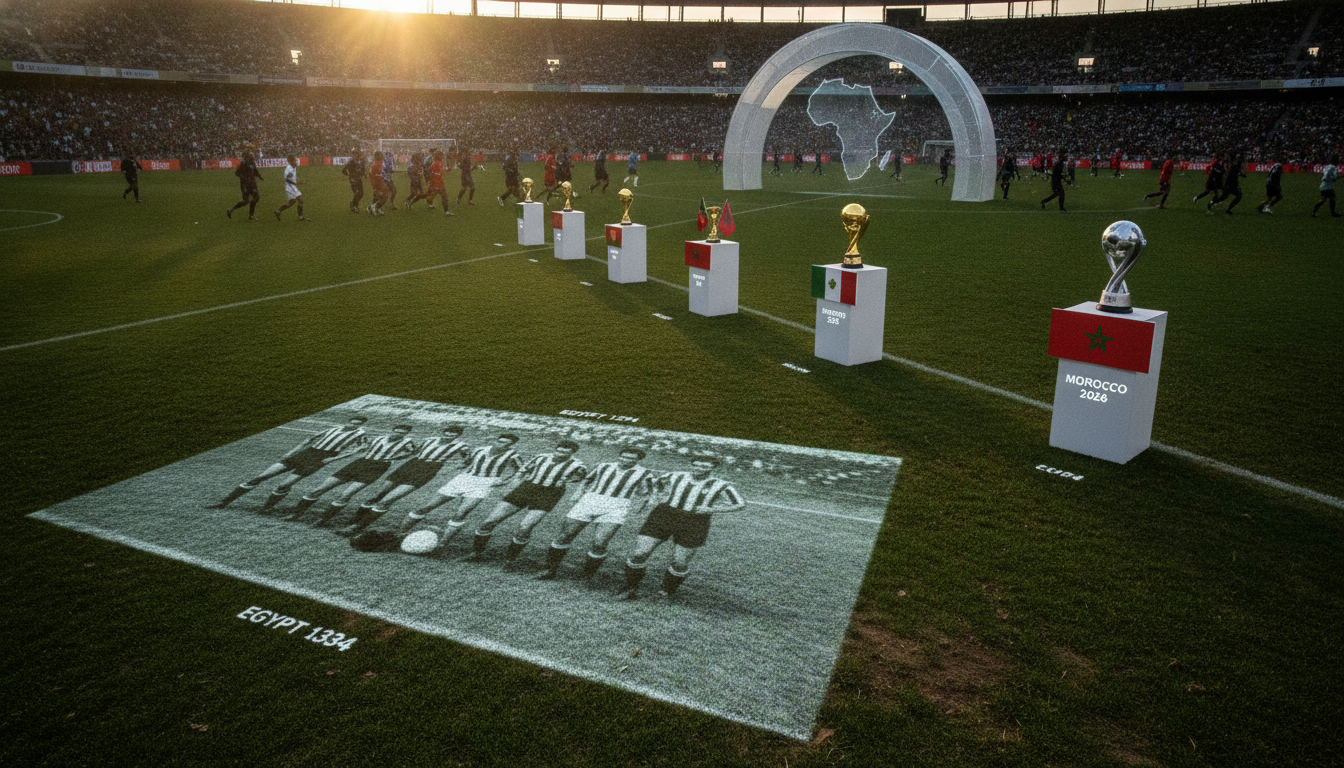
Africa at the World Cup: Ten Defining Moments That Changed Global Football
Africa at the World Cup has been a story of early breakthroughs, landmark victories and a steady dismantling of global football hierarchies, a trend capped by Morocco’s recent runs at consecutive tournaments. The continent’s journey from Egypt’s 1934 debut to Morocco’s showings in 2022 and 2026 maps a century of tactical evolution, cultural expression and growing influence on the world stage. This article recounts ten pivotal moments that reshaped perceptions of African teams and set the stage for the continent’s ambitions at World Cups to come. (fifa.com)


Egypt’s 1934 debut establishes an African presence
Egypt became the first African and Arab nation to appear at the World Cup in 1934, taking a single knockout tie in Italy that introduced the continent to the global tournament. Despite a 4-2 loss to Hungary, Abdelrahman Fawzy scored twice and left a mark as the first African goalscorer at a World Cup finals. That appearance, however brief, proved African teams could qualify and compete on football’s largest stage and provided an early touchstone for continental pride. (fifa.com)
1970s pressure and a boycott reshape qualification politics
The decades after Egypt’s outing were shaped as much by politics as by results, with African federations campaigning for fairer World Cup representation. A continent-wide boycott of the 1966 tournament underscored mounting frustration with limited qualification slots and forced FIFA to reconsider its allocation in subsequent cycles. By 1970 and 1978, African teams were no longer occasional participants but visible competitors demanding competitive parity.
Morocco’s 1970 point and Tunisia’s 1978 breakthrough
Morocco’s draw with Bulgaria in 1970 produced the continent’s first World Cup point and signalled that African sides could hold their own in group phases. That modest but symbolic result helped shift international perceptions and encouraged investment in regional development. Tunisia then delivered Africa’s first World Cup victory in 1978, rallying from a half-time deficit to beat Mexico 3-1 and prompting FIFA to increase Africa’s presence at future tournaments. (fifa.com)
Zaire’s 1974 appearance expands geographic representation
Zaire’s qualification for the 1974 finals in West Germany carried significance beyond the scoreboard, as the first sub-Saharan African nation to reach the event. On-pitch struggles and a heavy loss to Yugoslavia exposed gaps in preparation, but the team’s presence on the global television stage challenged existing assumptions about which regions could produce competitive football. The appearance accelerated conversations about infrastructure, coaching and player pathways across sub-Saharan Africa.
Algeria’s 1982 upset rewires the global outlook
Algeria stunned the football world in Spain in 1982 with a memorable 2-1 victory over West Germany, a result built on rapid passing and tactical audacity. The win is often cited as one of the tournament’s great upsets and forced European teams to recalibrate how they approached African opponents. Though Algeria’s campaign was cut short by a controversial later match between West Germany and Austria, the performance marked a tipping point in respect for African talent. (fifa.com)
Morocco 1986 and the first group-stage advancement
Returning to Mexico in 1986, Morocco achieved what few had expected by advancing out of a tough group that included England, Poland and Portugal. Grounded in disciplined defending and opportunistic attack, the Atlas Lions topped their group before bowing out in the knockout round. That campaign demonstrated that African teams could navigate high-pressure group formats and succeed through organisation and tactical discipline.
Cameroon 1990 and the global imagination
Cameroon’s run to the quarter-finals in Italy 1990 became a defining chapter for African football, propelled by Roger Milla’s late-career resurgence and a string of charismatic performances. The Indomitable Lions opened the tournament with an upset of Argentina and then proceeded to the last eight, where they narrowly lost to England in extra time. Their run popularised African flair and resilience on the global stage and inspired a generation of players across the continent. (fifa.com)
Senegal 2002 and Ghana 2010 renew African promise
Senegal’s dramatic debut at the 2002 World Cup included a shock victory over defending champions France and a quarter-final berth that echoed Cameroon’s achievement. The Teranga Lions combined tactical discipline with counterattacking potency to reach the final eight. Eight years later in South Africa, Ghana carried continental hopes into the quarter-finals of the first World Cup hosted in Africa, reaching the cusp of the semi-finals before a dramatic penalty shootout defeat to Uruguay. Both runs reinforced the idea that African nations could match the game’s traditional powerhouses. (fifa.com)
Morocco’s 2022 semi-final and 2026 follow-up rewrite the record books
Morocco’s 2022 performance in Qatar stands as a watershed moment: the Atlas Lions became the first African and Arab nation to reach a World Cup semi-final after eliminating Spain and Portugal in successive knockout rounds. The team’s compact defence and counter-attacking efficiency captured global attention and altered expectations for African sides at major tournaments. Building on that momentum, Morocco returned in 2026 with another deep run, advancing from a dramatic penalty shootout win over the Netherlands and a convincing 3-0 victory against co-host Canada to reach the quarter-finals for a second consecutive World Cup. Those back-to-back deep runs signalled a new era for North African football and for the continent’s global standing. (fifa.com)
Infrastructure, coaching and player development underpin progress
The on-field gains across these decades are mirrored by off-field developments in academies, coaching education and league professionalism throughout Africa. Investment in youth systems has produced technically proficient players able to adapt to multiple tactical systems, while exposure to European and global club competitions has honed competitive instincts. Federations that have prioritised coaching pathways and domestic league stability now deliver international sides with greater tactical nuance and physical preparation.
From perception to parity: what the milestones mean for the future
Each milestone — from Egypt’s first goals to Morocco’s modern-day breakthroughs — has chipped away at the myth that Africa was peripheral to elite football. The aggregate effect is a shift in recruitment, scouting and tactical planning by clubs and national teams worldwide. As African teams consistently reach latter stages of World Cups, the sport’s centre of gravity becomes demonstrably more inclusive and competitive.
Road to 2030 and the ambitions ahead
With Morocco among the hosts for the 2030 edition, the continent is positioned to capitalise on its growing footballing infrastructure and global profile. Hosting duties will likely accelerate stadium upgrades, youth investment and commercial partnerships that can sustain competitive improvements. The historical arc — from 1934 to the present — suggests that African teams will continue to challenge for deeper tournament runs and, eventually, the title itself.
Africa at the World Cup is no longer a series of rare surprises but a continuous narrative of development, tactical sophistication and cultural celebration that enriches the global game.
The ten moments recounted here map more than individual matches; they chart a progressive dismantling of structural barriers and a steady elevation of African football on meritocratic grounds. As national programs deepen and domestic platforms mature, the continent’s footballing rise appears durable and increasingly central to the story of future World Cups.