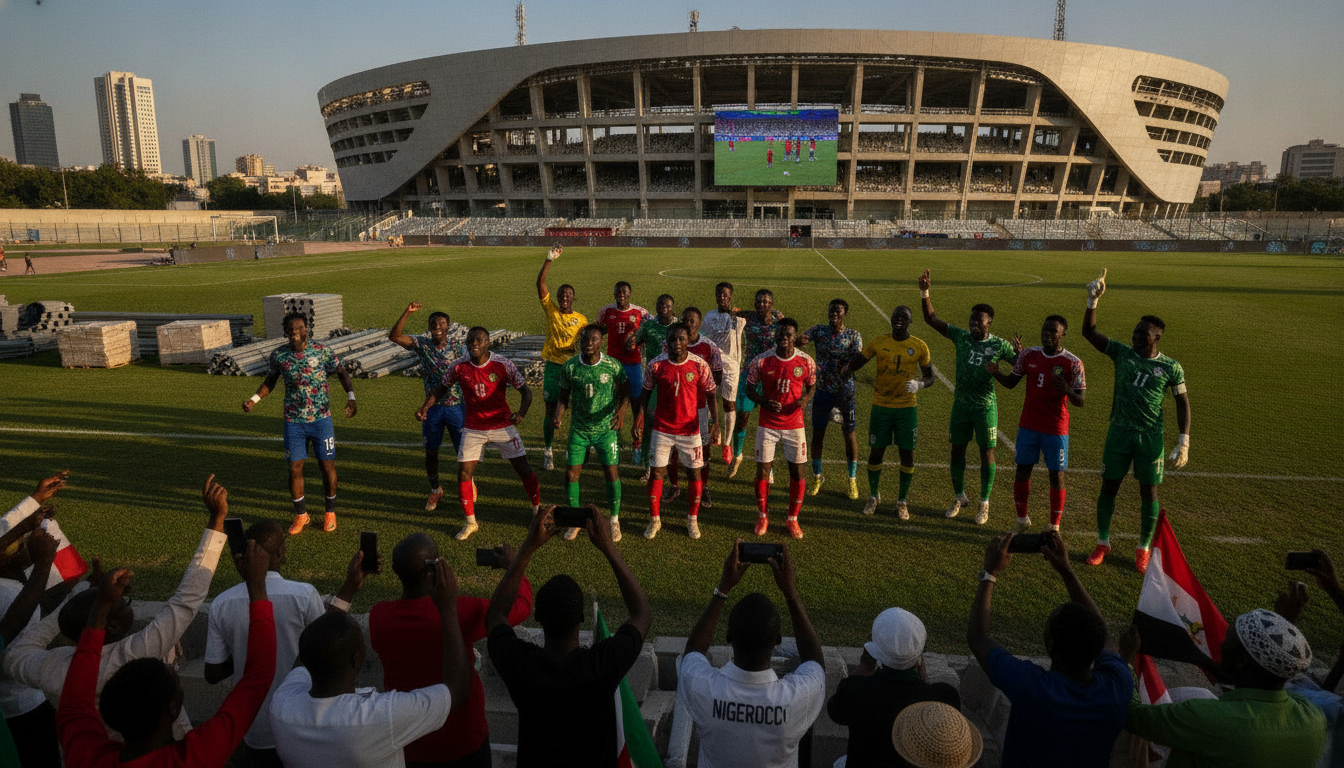
African teams at the 2026 World Cup signal a new era of competitiveness
African teams at the 2026 World Cup are showing sustained competitiveness, with Côte d’Ivoire and DR Congo delivering early statements that suggest deep runs are now plausible.

African teams at the 2026 World Cup have moved beyond one-off surprises to evidence of structural progress in coaching, academies, and investment that is reshaping outcomes on the global stage. Early matches have combined tactical discipline with players embedded in European professional systems, producing performances measured by fine margins rather than flashes of individual brilliance. With a record 10 nations in the expanded 48-team field, the continent’s presence is larger and, increasingly, more consistent.
Côte d’Ivoire nearly topples Germany in Toronto
Côte d’Ivoire delivered a measured, tactically mature performance against four-time champions Germany that changed perceptions of what African teams can achieve. Franck Kessié’s first-half strike capped a display in which the Elephants controlled transitions and limited high-quality chances for a side from one of Europe’s strongest leagues.
Germany’s late response, driven by substitute Deniz Undav’s brace, produced a 2-1 result that obscured the balance of play. Expected goals (xG) figures underscored how close the contest was, with the margins decided by late moments rather than overall dominance. For Côte d’Ivoire, the match offered evidence that sustained preparation and integration of players into elite club systems can yield competitive parity against traditional powers.
DR Congo returns with a historic goal and tactical discipline
DR Congo’s first World Cup appearance since 1974 ended its opening match with a landmark moment when Yoane Wissa struck a stoppage-time equaliser to earn a 1-1 draw with Portugal. The result was notable not only for the scoreline but for the manner in which the Leopards neutralised a technically gifted opponent across long periods of the game.
After conceding early, DR Congo regrouped under Sébastien Desabre’s structure, showing compact defensive organisation and calm in transition. Portugal’s second-half xG fell markedly, reflecting DR Congo’s capacity to limit dangerous opportunities once the team settled into its game plan. The performance signalled that national programmes can quickly rebound when tactical clarity is matched by players who have experience in European professional systems.
Investment and academies are changing the production line
A decade-long increase in funding, the establishment of high-performance academies, and closer links with European clubs are shifting how talent is identified and developed across Africa. Morocco’s Mohammed VI Football Academy stands as the most visible instance of long-term, centrally coordinated investment yielding continental and global results. That model—early identification, sustained coaching, and clear career pathways—has become a template for several nations.
Senegal’s Génération Foot partnership and Ivory Coast’s recent federation-led upgrades show similar private-sector and public-private approaches. These initiatives focus on coaching education, infrastructure, and integration with competitive club football abroad, creating pipelines that professionalise the player-development process. As a result, African national teams increasingly field players who are not only talented but indoctrinated in structured tactical systems and elite training environments.
World Cup expansion amplifies continental impact
The expansion to 48 teams has raised Africa’s representation to 10 nations, multiplying the continent’s footprint at the tournament and exposing more teams to high-level competition. That quantitative increase matters, but its real value lies in the qualitative uplift that comes from repeated exposure to top opponents and diverse tactical challenges.
More participants means increased scouting, broader commercial interest, and a faster feedback loop for federations seeking to measure their development programs. Rather than viewing additional slots as mere opportunity, many African federations have treated them as incentives to accelerate reforms in governance, coaching continuity, and youth structures. The result is a deeper pool of teams capable of influencing group outcomes and, potentially, progressing further into knockout stages.
Structural indicators that predict deeper runs
Several measurable factors now correlate with African teams’ capacity to reach the latter stages of the World Cup. Academy output that reliably feeds professional leagues, continuity in coaching appointments, active partnerships with European clubs, and predictable streams of investment emerge as the primary indicators. Morocco’s semi-final run in 2022 highlighted how these elements combine to produce elite-level performance.
Coaching continuity reduces tactical churn and gives players a stable framework in which to develop international chemistry. Club integration exposes players to higher tempo, tactical nuance, and recovery standards required at the World Cup. Federations that align youth competition formats, scouting networks, and technical development with these demands are more likely to produce teams that can sustain competitiveness across multiple tournaments.
Obstacles to sustaining momentum remain significant
Despite encouraging signs, challenges persist that could limit how many African teams sustain high-level competitiveness. Funding remains uneven across the continent, with a handful of federations making large, consistent investments while others struggle with governance issues, limited domestic league quality, and inadequate training facilities. These disparities create an uneven playing field for talent development.
Domestic leagues often lose their best players early to foreign clubs, which can be beneficial for individual development but weakens local competition and continuity. Political instability and short-term administrative cycles within some federations also hamper long-term planning. Addressing these obstacles requires coordinated policy, improved transparency in governance, and targeted investment in coaches and referees to raise standards across the entire ecosystem.
Early results suggest the continent’s question shifts from whether an African nation can reach a World Cup semi-final to how many might do so in the coming decades. Côte d’Ivoire and DR Congo’s performances illustrate that structured systems, not isolated talent, are now the primary drivers of competitive success. If federations sustain investment in academies, coaching, and international club partnerships, the path to deeper tournament runs will become more traversable.
African teams at the 2026 World Cup are no longer merely participants; they are architects of a changing global order in football. Continued focus on systemic development and governance will determine whether present competitiveness becomes a permanent recalibration of the sport’s balance.