Argentina vs Jordan: Palacios at right-back as Messi, Lo Celso and Martínez seal 3-1 win
Argentina vs Jordan: Palacios fills in at right-back as Argentina beat Jordan 3-1 to close group stage; Messi scores and extends his World Cup scoring streak.


Argentina closed their 2026 World Cup group campaign with a 3-1 victory over debutants Jordan in a match that saw Exequiel Palacios shift to right-back and Lionel Messi continue his remarkable scoring run. Argentina vs Jordan produced a tidy group finale in which set-pieces decided the outcome and rotation by coach Lionel Scaloni highlighted depth across the squad. The win leaves Argentina unbeaten in the group and sets up a Round of 32 meeting with Cape Verde on July 4, while Jordan depart the tournament with goals in every match of their first World Cup appearance. The match underlined Argentina’s reliance on dead-ball proficiency and tactical flexibility as the knockout stage approaches.
Palacios deployed at right-back for Argentina
Exequiel Palacios started and played the full 90 minutes at right-back in an atypical role for the Bayer Leverkusen midfielder. Coach Lionel Scaloni made several changes to his starting lineup for the group finale, and Palacios’s shift was one of the more notable adaptations as Argentina managed minutes for key players. The 26-year-old tracked back diligently, provided passing outlets from deep and showed positional discipline that helped Argentina control wide areas. His performance offered Scaloni another option should injuries or tactical tweaks be required deeper into the tournament.
Palacios’s presence on the flank rarely threatened with overlapping runs, but his distribution helped Argentina transition from defence to attack with composure. He completed multiple key passes and was involved in the build-up to set-piece situations that eventually produced goals. While not a natural full-back, Palacios’s intelligence and familiarity with the national team’s pressing structure smoothed the temporary change of role. The experiment emphasised Argentina’s roster versatility ahead of the knockout rounds.
Set-piece mastery decides group finale
Argentina’s three goals all came from dead-ball situations, underlining a decisive strength for the reigning contenders in this tournament. Giovani Lo Celso opened the scoring with a direct free-kick, bending a low effort beyond the wall and goalkeeper to break the deadlock early. Lautaro Martínez then converted a penalty before half-time, a spot-kick that doubled the lead and stemmed any momentum Jordan might have hoped to find.
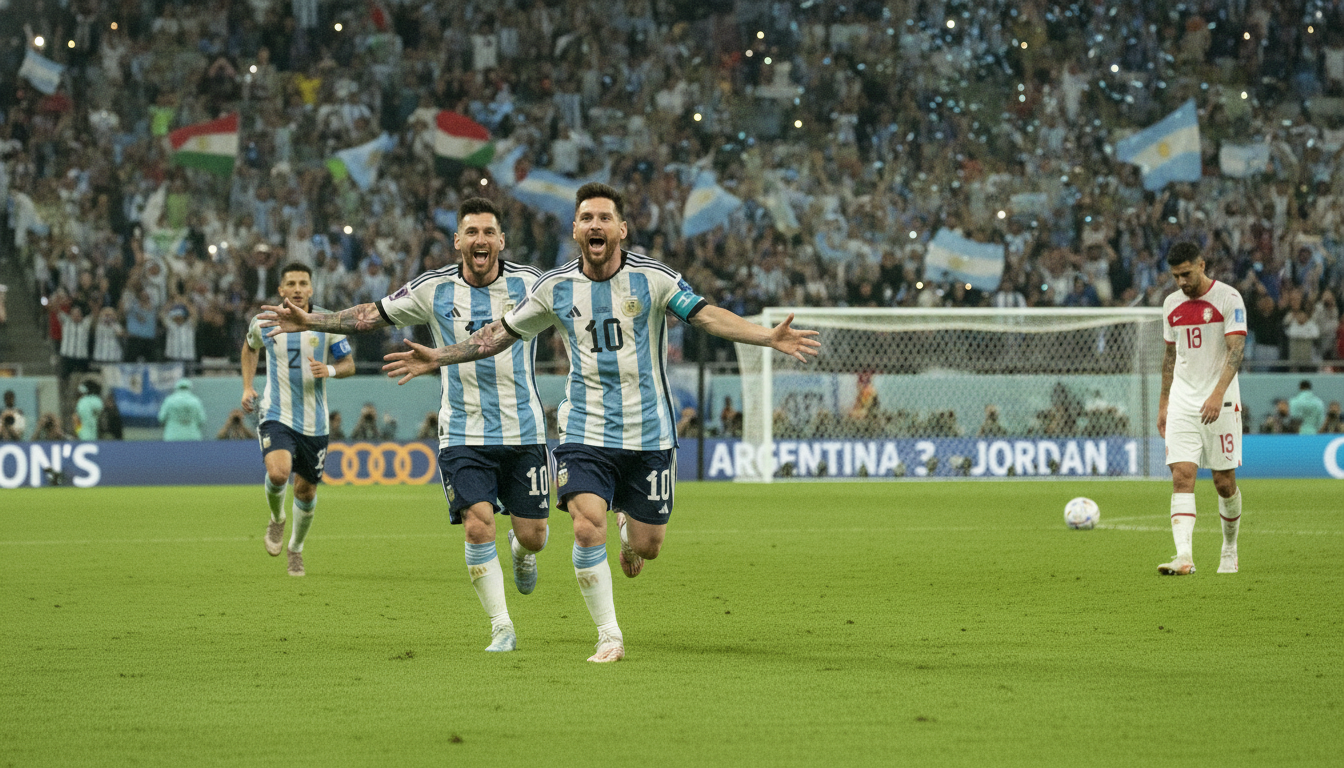
Lionel Messi added Argentina’s third from another direct free-kick after coming off the bench, reinforcing the team’s dominance from dead-ball opportunities. The free-kicks were practised and clinical, and they provided the margin Argentina needed on a night of rotation. Set-piece proficiency has been a recurring theme for Argentina in this World Cup, and the game against Jordan showcased how precision in those moments can carry a match.
Messi extends World Cup scoring streak to seven games
Despite not starting the match, Messi maintained his personal run of form by scoring from a free-kick, reaching a milestone of goals in seven consecutive World Cup appearances. The strike came after he was introduced to provide fresh attacking impetus, and it reaffirmed his capacity to influence tight fixtures even with limited minutes. That sustained contribution across tournaments highlights Messi’s enduring value in pressure moments and his ability to deliver on set pieces.
Messi’s readiness to come off the bench and affect the game speaks to Argentina’s management of his minutes at this stage of the competition. The captain remains the focal point for decisive dead-ball scenarios, and his leadership continued to lift the squad when called upon. For opponents preparing for the knockout phase, Messi’s form from free-kicks represents a tactical threat that demands specific defensive planning.
Jordan score in every match despite group exit
Jordan, making their first appearance at a FIFA World Cup, left the tournament with the consolation of having found the net in each of their group matches. Moussa Al-Taamari, introduced at half-time, pulled one back for the debutants and provided a reminder of Jordan’s attacking potential on the international stage. Although they lost all three group games, Jordan’s ability to score in every outing showed resilience and moments of positive play.
The North African and Middle Eastern angles of Jordan’s performance exposed both promise and clear areas for growth in defence and consistency. They conceded from set-pieces and penalties at crucial moments, but the squad’s willingness to press and seek opportunities offered encouraging signs for the program’s development. Jordan will return home with tangible experience at the sport’s elite level and a handful of competitive lessons from matches against tier-one nations.
Scaloni’s rotation and Argentina’s tournament management
Lionel Scaloni’s decision to rotate his side for the group closer was part of a broader management plan to balance fitness and form ahead of the knockout rounds. Several starters were rested or given reduced minutes, and the lineup alteration tested depth across the pitch while protecting key figures from unnecessary fatigue. The approach yielded mixed tactical rewards but preserved squad freshness and allowed fringe players to stake a claim for future selection.
Argentina’s performance under rotation reflected a clear hierarchy: the team relied on structure and set-piece routines rather than expansive, high-tempo attacking football. When the occasion demanded, the front-line stars were reintroduced to deliver decisive moments, as shown by Messi’s free-kick and Martínez’s penalty. Scaloni will now weigh fitness data, opponent scouting and player readiness as he prepares for the Round of 32, where single-elimination margins compress every decision.
Knockout outlook and Argentina’s path to the title
With the group phase concluded, Argentina join the knockouts as one of the teams with a perfect record alongside France and co-hosts Mexico. Argentina’s next opponent will be Cape Verde on July 4, a fixture that presents different challenges to those seen in the group. The Round of 32 schedule begins with Canada versus South Africa and includes Germany’s matchup with Paraguay the following day, laying out a congested and competitive pathway for the tournament’s contenders.
Argentina will need to blend rotation with tactical clarity to navigate a knockout calendar that intensifies recovery and strategic demands. Their set-piece efficacy makes them a threat in tight, low-scoring affairs, but the team must also demonstrate adaptability when opponents minimise dead-ball opportunities. The coming weeks will test Argentina’s depth, defensive organisation and their ability to extract decisive performances from both starters and substitutes.
Argentina’s 3-1 win over Jordan in the final group fixture highlighted squad flexibility and set-piece quality while allowing key players managed minutes ahead of the knockout rounds.
The team advances to face Cape Verde on July 4 with momentum and a clear template for exploiting dead-ball situations, yet the tournament’s single-elimination format will demand sharper defensive consistency and calculated rotation.