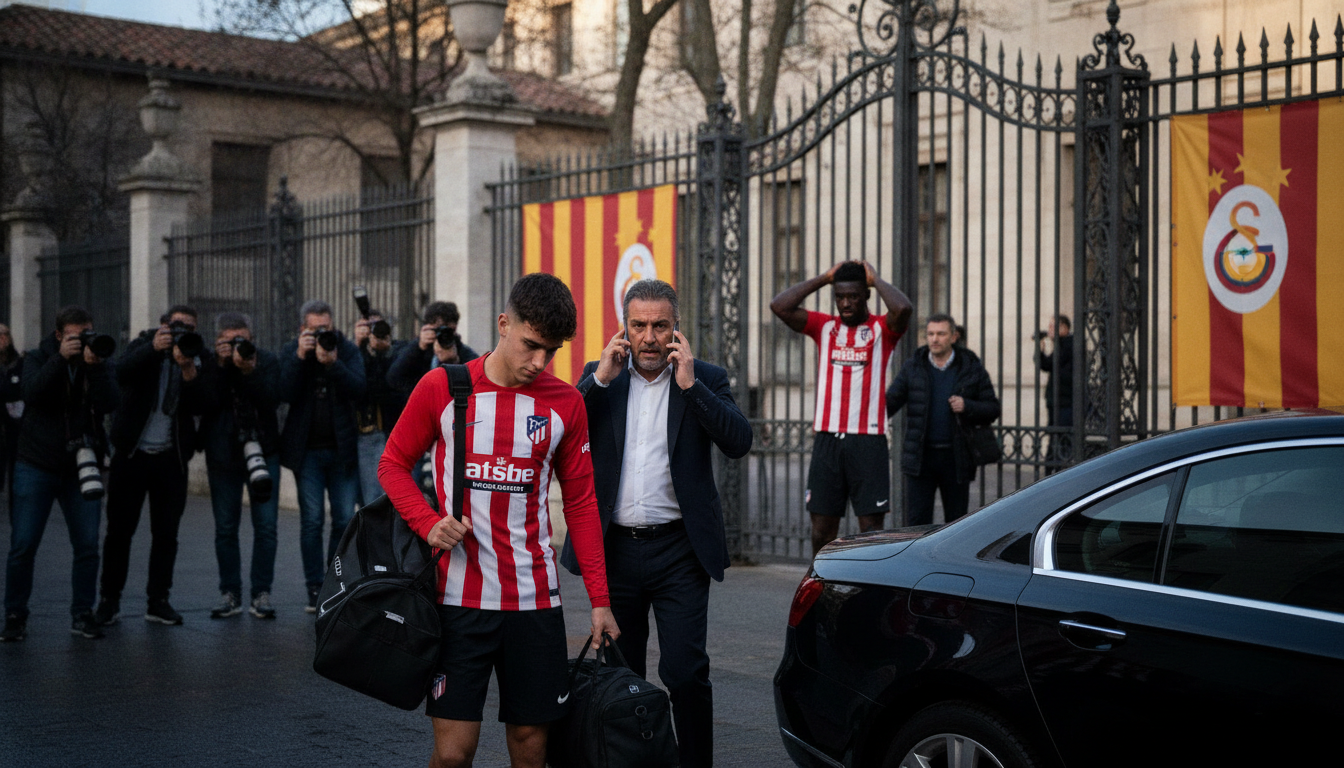
Galatasaray rejects Atletico Madrid approach for Víctor Osimhen, closing a key fallback
Galatasaray has refused Atletico Madrid’s approach for Víctor Osimhen, ruling the Nigerian striker unavailable and removing a major contingency as Atletico navigates uncertainty over Julián Álvarez.


Galatasaray closes the door on Osimhen
Galatasaray president Dursun Özbek has made the club’s stance clear: Víctor Osimhen is not for sale this summer. The declaration ends Atletico Madrid’s pursuit of the 27-year-old and removes a high-profile option from the Spanish club’s list of possible reinforcements.
The Turkish club emphasized Osimhen’s importance to their immediate plans and pointed to the striker’s happiness domestically as a factor in declining any approach. Atletico had treated the contact as a contingency rather than a primary transfer move, but the rejection tightens their off-field options.
Osimhen’s influence since arriving from Napoli
Since joining from Napoli, Osimhen has produced an exceptional goals-to-games ratio that has underlined his value to Galatasaray. The striker’s scoring return has been prolific, and his contributions helped the club secure domestic silverware and maintain a leading offensive presence.
Beyond raw numbers, Osimhen’s profile commands both sporting and commercial attention, making any potential sale costly and complicated. Those dynamics were central to Galatasaray’s decision to retain him despite outside interest.
How the rejection changes Atletico Madrid’s recruitment calculus
Atletico Madrid had viewed Osimhen as a fallback option should pressure mount on their current first-choice forward. The outright refusal means Los Colchoneros must reassess contingency plans and identify alternative targets earlier than anticipated.
The decision reduces Atletico’s margin for maneuver in a transfer window already shaped by tricky choices elsewhere in the squad. With a prominent fallback removed, any approach to strengthen the forward line will require faster action or a change in strategy.
The Julián Álvarez situation and its knock-on effects
Atletico’s broader planning remains dominated by the question of Julián Álvarez, whose market status has generated sustained attention from several top clubs. The Argentine forward is protected by a substantial release clause and a long-term contract, but that has not prevented routine speculation and outside monitoring.
How aggressively rival clubs pursue Álvarez will influence Atletico Madrid’s appetite for investment and their urgency to secure alternative striking options. If the club faces genuine bids that test contractual protections, the need for a replacement or reinforcement becomes acute.
Timing pressure with the transfer window and squad balance
The Spanish transfer window closes on September 1, leaving Atletico a finite period to identify and secure reinforcements. That deadline increases pressure on scouting, negotiations and financial decisions, particularly now that one high-profile option has been shut down.
Internal assessments will weigh squad depth, the fitness and form of existing forwards, and the club’s willingness to reallocate funds if Álvarez attracts serious offers. Atletico must balance short-term cover with long-term squad planning amid a compressed timeline.
Potential alternative targets and strategic responses
With Osimhen off the table, Atletico can pursue several strategic paths: accelerate talks for a different marquee striker, target a lower-cost or younger forward, promote from within, or reconfigure tactics to rely less on an out-and-out number nine. Each option carries distinct sporting and financial trade-offs.
A second-tier market approach could yield a functional replacement at lower cost but without the same immediate impact. Conversely, a high-cost signing would require substantial commitment and could be difficult to secure quickly given market competition.
Financial constraints and market realities for Atletico Madrid
Atletico Madrid will need to reconcile ambition with economic prudence when plotting next moves. Transfer fees for top strikers remain elevated, and the club must consider wage structure, amortization, and potential departures elsewhere in the squad to free space.
Decisions on reinforcements will likely be influenced by how the club values continuity versus disruption, and whether leadership prefers to wait for clearer developments around Álvarez before committing significant resources. The loss of Osimhen as an option narrows flexibility and raises the cost of late-market corrections.
Scouting priorities and player profile Atletico may now seek
If Atletico opts to move quickly, scouting will center on forwards who combine adaptability with immediate output, whether through finishing, movement, or hold-up play. The club’s historical preference for hardworking, tactically disciplined strikers will guide recruitment profiles and shortlist creation.
Younger prospects with sell-on potential could align with a medium-term plan, while experienced forwards with proven records would address urgent needs but at higher cost. Atletico’s final choice will reflect the balance between immediate pressure and strategic squad construction.
Competition from other clubs and the wider transfer landscape
Market competition complicates Atletico’s search for replacements, as clubs across Europe circulate in search of attacking reinforcements of varying profiles. Interest from wealthy teams can push prices higher and shorten negotiation windows for suitors like Atletico.
The club must move decisively where value and fit align, but not at the expense of destabilizing wage structures or long-term sporting coherence. The interplay of rival bids and timing constraints will shape which targets are realistically attainable.
Tactical adjustments if the club delays a signing
Should Atletico delay securing a new forward, managerial adjustments become likely as a short-term remedy. The coaching staff may retool attacking patterns, deploy different player combinations, or rely more on wing play and midfield runs to offset the absence of a marquee striker.
Such tactical shifts can preserve competitiveness but require time for players to adapt, and they may not fully replicate the attributes of a dedicated central striker. The club will weigh these compromises against the risk and cost of a hurried transfer.
Managerial communication and fan expectations
How Atletico communicates its transfer strategy will influence fan sentiment and internal stability. Clear messaging about priorities and constraints can temper expectations, while a lack of transparency risks fueling speculation and dissatisfaction.
Supporter patience may hinge on visible intent and credible steps toward addressing the forward line. An early, well-executed signing would calm debate, whereas extended uncertainty could escalate pressure on both management and the coaching staff.
Short-term benchmarks Atletico will monitor
In the coming weeks Atletico will track several indicators to guide action: the intensity of external interest in Julián Álvarez, availability and valuation of alternate forwards, and the club’s own financial room to maneuver. Each benchmark will inform a decision point ahead of the transfer deadline.
The club’s ability to convert scouting assessments into timely negotiations will be decisive, especially with a high-profile fallback removed. Atletico’s leadership must balance speed with due diligence to avoid costly missteps.
Wider implications for Galatasaray and Osimhen
Galatasaray’s firm stance strengthens their sporting continuity and sends a message on the club’s ambition to retain core players. Keeping Osimhen maintains the attacking identity that has underpinned recent success and preserves a major competitive asset.
For Osimhen personally, remaining in Istanbul offers continuity of role and form, though media speculation around large clubs is likely to persist. The rejection of Atletico’s approach reduces immediate transfer uncertainty for the player and his current employers.
Atletico Madrid must now recalibrate quickly: with Víctor Osimhen unavailable, the club faces a narrower set of realistic options ahead of the September deadline, and decisions in the coming weeks will shape its 2026/27 attacking profile.