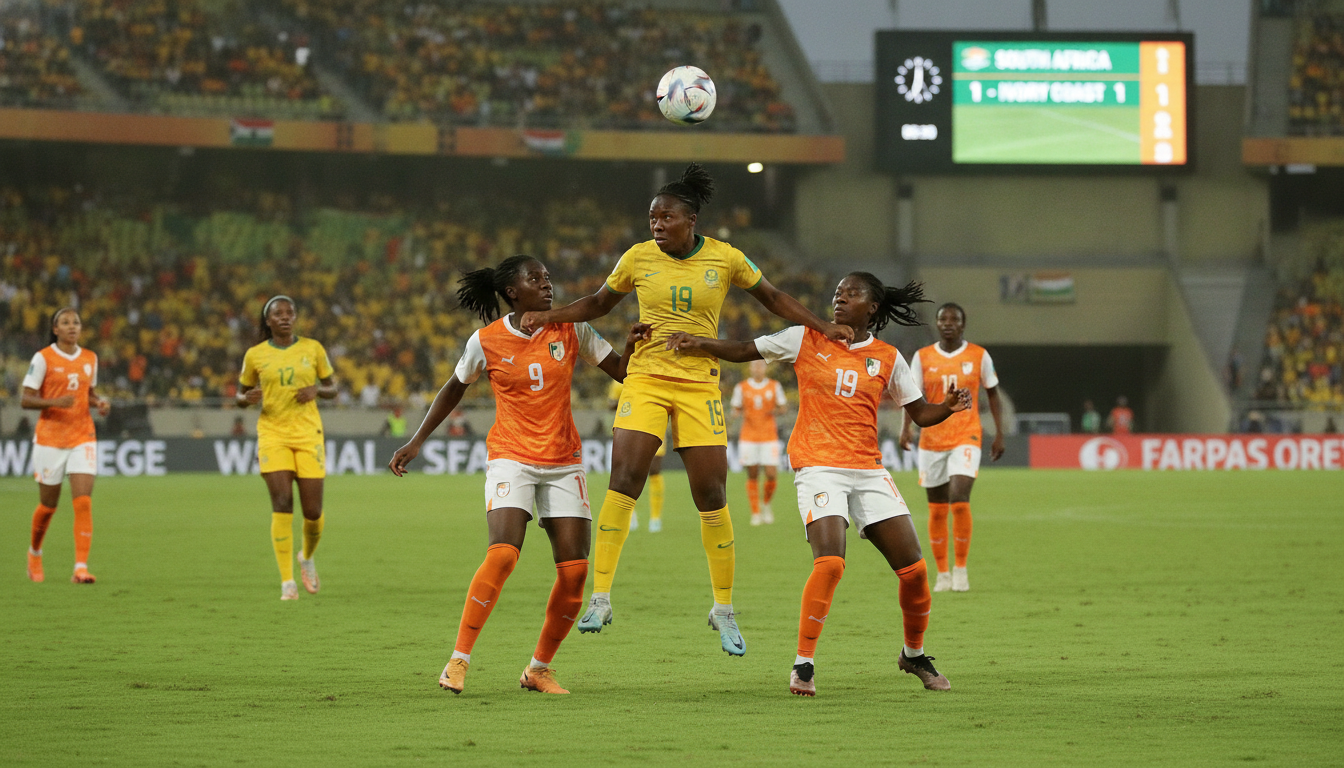
Banyana Banyana face Ivory Coast in must-win WAFCON clash in Casablanca
South Africa must beat Ivory Coast on July 31 to keep Banyana Banyana’s 2026 Women’s Africa Cup of Nations campaign alive after a shock opening loss to Tanzania.


South Africa face do-or-die game in Casablanca
South Africa enter Friday’s match at the Moulay Rachid Stadium in Casablanca under immediate pressure following their 2-1 defeat to Tanzania. Only a victory against Ivory Coast will guarantee Banyana Banyana remain in the Morocco-hosted Women’s Africa Cup of Nations. Coach Desiree Ellis and her squad will be acutely aware that margins are thin in a group where early results have already reshaped expectations.
The match kicks off at 7pm local time and represents the second Group B fixture for both teams in the tournament. The outcome will have immediate implications for qualification and the mood within both camps. South Africa must convert opportunity into points if they are to recover from a shaky start.
Ivory Coast buoyed by emphatic opening win
Ivory Coast arrive in Casablanca having defeated Burkina Faso 4-1 in their opening match, a result that handed them early control of Group B. The Lady Elephants’ performance delivered not only goals but a confident team display, underscoring their belief after a return to WAFCON following a 12-year absence. That victory gives the Ivorians momentum and a psychological edge heading into the meeting with South Africa.
Their 2026 campaign marks Ivory Coast’s first appearance at the tournament since 2014, when they recorded memorable results including a third-place finish. That history, combined with the convincing win in the opener, has reinforced expectations that they can be competitive in this edition. The team will seek to maintain attacking tempo while protecting the defensive structure that served them well against Burkina Faso.
Tanzania defeat highlights finishing problems for Banyana
South Africa created numerous openings against Tanzania but failed to finish with the clinical edge required at this level, allowing the Twiga Stars to claim a 2-1 win. The lack of composure in the final third and missed chances proved costly, with Banyana Banyana unable to turn dominance into points. Those inefficiencies will be scrutinized by the coaching staff ahead of the Ivory Coast fixture.
The defeat exposed vulnerabilities in transition and set-piece situations that opponents can exploit if not corrected. Opposing teams will study tape from the opener and apply pressure in areas where South Africa struggled to recover possession. For Ellis, addressing both psychological and tactical aspects will be crucial in ensuring a different outcome on Friday.
Ellis under pressure to rejig attacking structure
Desiree Ellis faces immediate calls to adjust her attacking approach to extract goals from the chances her side creates, including potential changes to personnel and formation. Options include introducing fresh legs to increase tempo, deploying a more direct focal point in attack, or varying wide play to stretch opposing defences. Any alteration must preserve balance, however, as overcommitment could invite counterattacks from a confident Ivory Coast side.
Set pieces and dead-ball routines are likely to receive added emphasis in training sessions ahead of the match, given their value in tight knockout-style group contests. The coaching staff will also consider rotation to protect players who carried heavy workloads in the opener. Ultimately, the chosen plan must restore efficiency in front of goal without sacrificing midfield control.
Group B permutations and what a win delivers
A South African victory would alter Group B dynamics by guaranteeing Banyana Banyana remain in the tournament and placing them back into contention for a top-two finish. For Ivory Coast, a win would consolidate their lead and increase the pressure on the other teams in the section. A draw, meanwhile, would leave South Africa in a precarious position and likely force them into must-win territory in their final group game.
The tournament’s short group phase means that every point and every goal can be decisive, with tie-breakers often coming into play when teams finish level. Consequently, both teams must be mindful not only of the result but also of goal margin and discipline. This match is therefore as much about tactical pragmatism as it is about attacking ambition.
Match logistics, atmosphere and broader context
Casablanca’s Moulay Rachid Stadium will provide the stage for a contest expected to draw a lively crowd and amplified media attention, given the high stakes for South Africa. Morocco’s role as host has seen multiple venues deliver strong atmospheres that can influence match rhythm and intensity. Fans and delegations from both countries are likely to be highly visible, adding to the occasion’s profile.
Beyond the immediate group implications, the match carries significance for the longer-term trajectory of both programmes. A positive result for Banyana Banyana would salvage early momentum and reaffirm their status among contenders, while a continued run of results for Ivory Coast could signal the emergence of a revived West African force in women’s football. National federations will be watching closely.
Tactical matchups and players to watch
South Africa will need clinical forwards and midfielders who can both create and finish chances, while the goalkeeper must be alert to quick transitions and set-piece threats. Ivory Coast’s attacking balance, which yielded four goals in their opener, suggests that their forward players and supporting midfield will be key figures. The duel between South Africa’s creative outlets and Ivory Coast’s defensive organization will be a decisive tactical subplot.
Bench strength may also determine the outcome, particularly in the later stages as fatigue sets in under tournament conditions. Coaches who manage substitutions effectively and adapt to in-game developments stand to gain an advantage. Attention to fitness, recovery and match management will be tested under the compressed WAFCON schedule.
South Africa must deliver a controlled, sharp performance to convert chances into goals and avoid the kind of lapses that cost them against Tanzania.
A win would give Banyana Banyana a clear path forward, while anything less will leave the team needing favorable results and a stronger response in their final group match.