Barcelona midfielder search accelerates after Frenkie de Jong MCL tear
Barcelona seek a new central midfielder after Frenkie de Jong’s MCL tear, exploring Javi Guerra and alternatives while Rodri remains a distant dream now.


De Jong injury forces Barcelona midfielder search
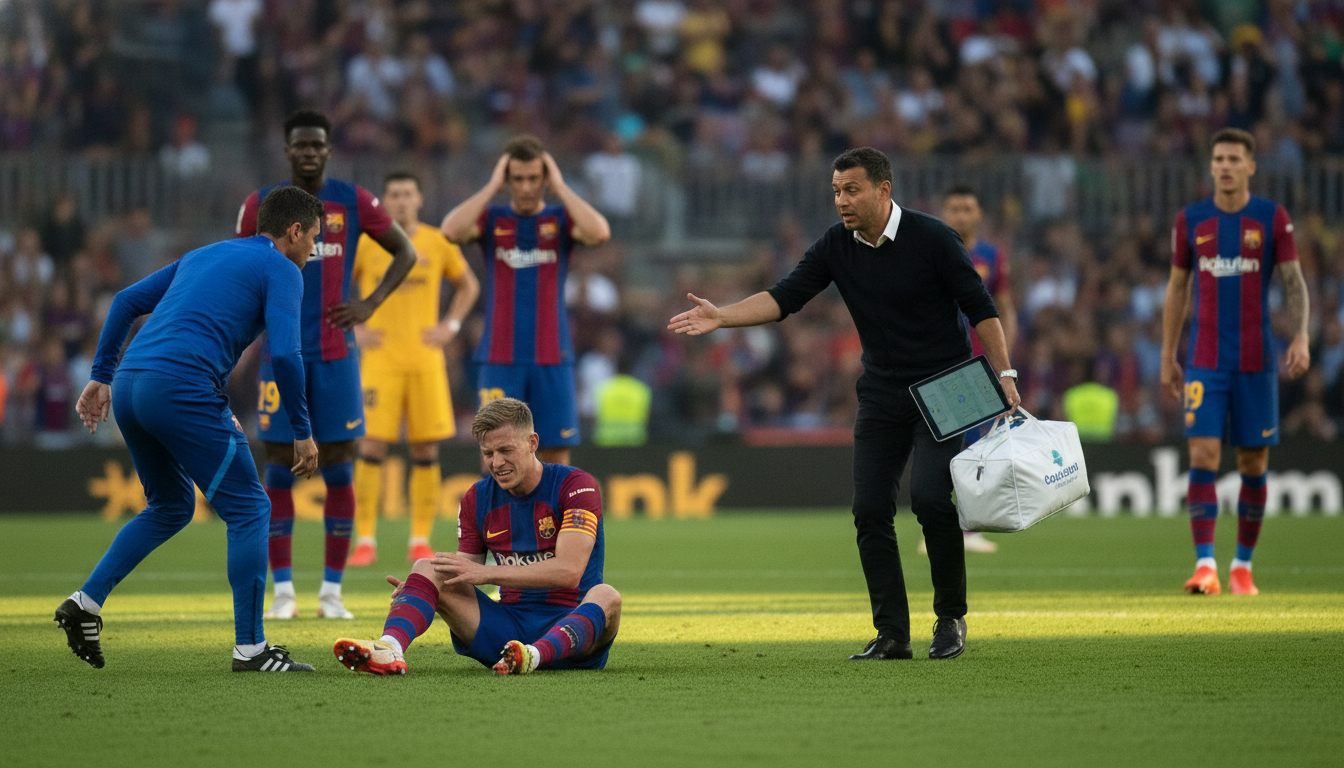
Barcelona have opened a transfer search for a central midfielder after Frenkie de Jong was ruled out long-term with a medial collateral ligament tear suffered during the World Cup. The injury removes a key presence from Hansi Flick’s squad just as the new LaLiga season approaches, prompting an urgent reassessment of midfield depth. Club sources and transfer experts have signalled that the immediate priority is securing reliable cover to stabilize the middle of the park. The decision to enter the market reflects both the scale of de Jong’s absence and the timing with transfer windows still active.
The injury is significant enough that short-term reinforcements are under consideration alongside longer-term planning for the midfield. Flick’s tactical setup, which relied on de Jong’s ball progression and positional intelligence, will need modifications in training and match selection. With competitive fixtures approaching, Barcelona cannot afford a prolonged period of uncertainty at the base of midfield. That has increased the club’s appetite to identify players who can integrate quickly and perform consistently.
Strained relationship complicates squad plans
Complicating the medical emergency is a reported deterioration in the working relationship between de Jong and manager Hansi Flick. Sources familiar with internal discussions say friction had already placed de Jong’s long-term role under scrutiny before the injury was confirmed. The interplay of an enforced absence and a strained player-coach dynamic raises questions about whether any incoming signing would be temporary cover or part of a broader midfield realignment. Club decision-makers now must weigh medical realities alongside personnel strategy when prioritising targets.
The possibility that Barcelona will not simply wait for de Jong’s recovery has implications for contract decisions and playing time distribution across the squad. If the club opts to recruit a central midfielder with a long-term profile, it could alter summer plans already in motion. That scenario would also affect younger midfielders pushing for minutes and the club’s transfer budget allocation. The choice between immediate stop-gap signings and a permanent reshaping of the midfield is central to Barcelona’s next moves.
Internal options and Casadó’s status
Barcelona’s internal options have been discussed as potential short-term solutions, but none appear to offer a straightforward fix. Marc Casadó, recently promoted into the first-team environment, is a candidate for increased minutes but reports indicate he is not currently central to Flick’s plans. Further reports suggest the club has placed an asking price on Casadó and are open to listening to offers, a sign that the academy midfielder may not be treated as the primary emergency option. That leaves the coaching staff reliant on a mix of experienced squad members and tactical adjustments.
Other senior midfielders are available to step into deeper roles, but fitness, form and suitability for Flick’s preferred system are factors that could limit those choices. The coaching team will need to evaluate combinations that maintain defensive balance while preserving Barcelona’s ball-oriented approach. Training sessions in the coming days are likely to feature experiments with personnel and formation to mitigate de Jong’s absence. If those trials do not yield a settled solution, the club’s activity in the transfer market will increase accordingly.
Transfer targets: Javi Guerra, Rodri and other names
Reports identify several targets being considered by Barcelona, with Valencia’s Javi Guerra highlighted as a concrete option available on a tight timeline. The club has reportedly been given a window to complete a deal for Guerra, a situation that has added urgency to negotiations and internal decision-making. Meanwhile, Manchester City and Spain midfielder Rodri remains a high-profile name linked to Barcelona in supporter wish lists, though his acquisition is widely regarded as a major challenge both financially and competitively. City’s valuation and the player’s status make Rodri a long-shot rather than a practical expectation at present.
Beyond Guerra and Rodri, other players have been mentioned in transfer discussions, but few are advanced publicly and details remain scarce. A potential move for Junior Kroupi reportedly stalled after Bournemouth indicated a reluctance to sell, and subsequent reports have suggested Kroupi faces a foot injury ruling him out for several months. The Julián Álvarez situation, which has featured in earlier speculation involving Barcelona and Atlético Madrid, is described as complicated with multiple resolution paths, none of which appear straightforward. Those developments underline that Barcelona’s shortlist contains a mix of urgent, plausible and aspirational targets.
While some options are emergent and time-sensitive, scouts and recruitment staff are also evaluating players who could fit Flick’s system in the medium term. The club’s recruitment brief is understood to prioritise positional intelligence, ball retention, defensive discipline and the ability to press in transition. Market availability, transfer fees and wage expectations will influence which proposals are progressed. Barcelona’s sporting directors must balance immediate needs with sustainable squad construction.
Negotiation dynamics and deadline pressure
The reported deadline tied to a potential Javi Guerra transfer introduces a clear timeframe for Barcelona to act or to pivot to other plans. With the weekend cut-off for that option, the club faces a compressed window for medical checks, contract terms and potential departures needed to balance the books. That temporal pressure could accelerate decision-making and force compromises that would not exist in a more relaxed market. How Barcelona address those constraints will indicate whether the club treats the move as an injury-driven stop-gap or as part of a deliberate midfield overhaul.
Financial considerations are central to that calculus, particularly given Barcelona’s recent history of balancing spending against LaLiga’s financial regulations. Any incoming fee and wage package must align with the club’s broader economic strategy while also satisfying the manager’s tactical demands. The recruitment team will need to coordinate closely with the board to secure necessary approvals within the deadline. If the Guerra option fails, Barcelona will need contingency plans and clear prioritisation among alternative targets.
Tactical implications for Flick’s system
Hansi Flick will be required to adapt his midfield blueprint in light of de Jong’s absence and the possibility of a new arrival. The manager’s choices will determine both short-term formations and the style of play Barcelona deploy in early-season matches. Flick has options ranging from a deeper-lying pivot paired with creative midfielders to a more conservative use of two holding midfielders to shield the defence. Each approach carries trade-offs in attacking fluidity and defensive security, and the choice will influence who the club targets in the transfer market.
If Barcelona pursue a player with Rodri-like attributes, the aim would be to replicate high-level defensive coverage and ball circulation, but those profiles are rare and expensive. Alternatively, the club could recruit a younger, adaptable midfielder capable of growing into the role while an experienced head manages immediate responsibilities. Tactical flexibility may become a defining feature of Barcelona’s early-season matches as the squad integrates new personnel and adjusts to the reshaped midfield dynamic.
The coaching staff will also consider workload management for remaining midfielders to prevent injury and fatigue over a congested calendar. Rotation, specific training regimes and match-by-match tactical tweaks are all likely to feature as the club navigates this period. Clear communication between the medical, coaching and recruitment departments will be essential to align on who can step in and how quickly new signings can contribute.
Barcelona now face a sequence of decisions that will shape the campaign’s opening months and potentially the club’s medium-term structure. The balance between immediate cover and strategic recruitment is delicate, and the coming days will reveal the club’s priorities.
The club must move swiftly to stabilise a key area of the pitch while preserving longer-term ambition and financial discipline.