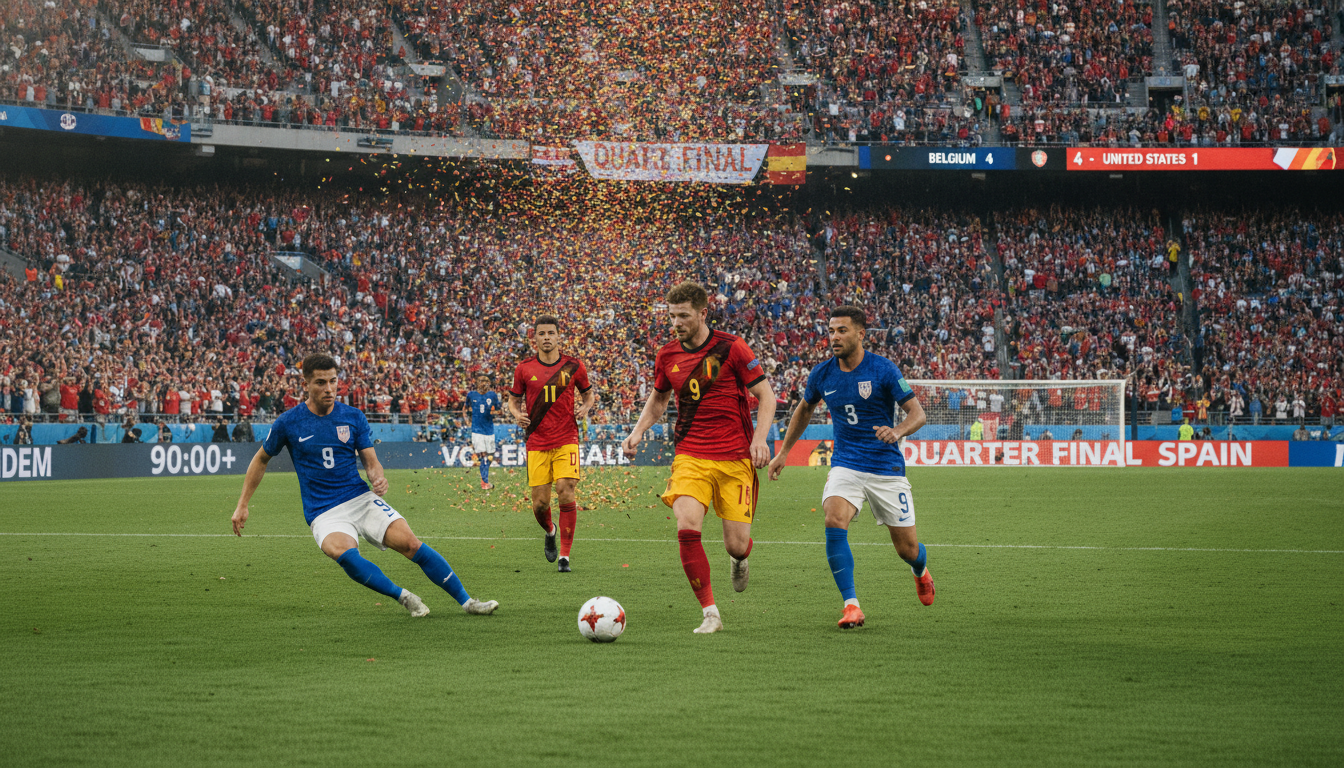
Belgium vs United States: De Ketelaere Double Sends Hosts Crashing as Belgium Win 4-1
Belgium vs United States World Cup shock: De Ketelaere scored twice as Belgium defeated the United States 4-1 in Seattle, ending US hopes and setting up a quarter-final with Spain.
Belgium dominate Seattle last-16 tie
Belgium ended the United States’ run at the World Cup with a comprehensive 4-1 victory at Lumen Field, cutting short home support and optimistic expectations.
Charles De Ketelaere struck early and again before half-time, while Hans Vanaken and substitute Romelu Lukaku added late finishes to seal a decisive win.
The result sends Belgium into a quarter-final against Spain and denies the hosts their deepest World Cup progression in 24 years.
A pre-match controversy over US striker Folarin Balogun added off-field drama, but it was Belgium’s on-field intensity that defined the tie.
De Ketelaere’s double sets the tone
Charles De Ketelaere opened the scoring inside nine minutes with a composed finish that exposed defensive gaps in the US backline.
His second, a headed effort just after Malik Tillman’s equaliser, restored Belgium’s lead and shifted momentum back to the visitors.
De Ketelaere’s movement and link-up play repeatedly troubled the United States’ defenders, creating space for teammates and drawing key markers away.
His two-goal performance was the decisive attacking edge Belgium needed to control the match and force the US into errors.
Balogun controversy overshadowed but did not impact result
The fixture had been clouded by the uproar surrounding US forward Folarin Balogun, who started after FIFA lifted a one-game suspension following lobbying by US President Donald Trump.
Balogun was largely peripheral during the match, unable to influence play in the final third or provide the cutting finish the hosts required.
That pre-match narrative drew wide attention but had little bearing on the outcome as Belgium’s tactical superiority took center stage.
The spotlight quickly shifted from the off-field debate to the on-field execution that saw Belgium control key phases of the game.
Key moments that decided the tie
Malik Tillman’s deflected free-kick produced a temporary equaliser in the 31st minute and offered the hosts a glimpse of a comeback.
Yet the advantage was short-lived; De Ketelaere’s header two minutes later reasserted Belgium’s lead and quelled growing home momentum.
The contest turned further in Belgium’s favor when US goalkeeper Matt Freese rushed from his area and was dispossessed, allowing Hans Vanaken to convert into an empty net in the 57th minute.
Romelu Lukaku, introduced from the bench, completed the scoring to make it 4-1 and underline Belgium’s clinical approach in the closing stages.
Tactics and control: how Belgium outworked the hosts
Belgium combined compact defending with rapid transitions, offering balanced pressure without leaving themselves exposed on the break.
Their midfield rotations gave De Ketelaere space between the lines, while wide players stretched the US defensive shape and created crossing opportunities.
The United States struggled to sustain pressing sequences and repeatedly ceded initiative, inviting Belgium to control possession in dangerous areas.
Belgium’s bench management, including the timely introduction of Lukaku, preserved energy up front and delivered a finishing touch that completed the visitors’ tactical plan.
Implications ahead of the Spain quarter-final
With this result Belgium advance to face Spain in the last eight, a matchup that will test their defensive cohesion and attacking fluency against one of the tournament favorites.
The victory offers Belgium momentum and a clearer pathway if they can reproduce the control and finishing shown in Seattle.
Spain will present different challenges — possession dominance and intricate passing — requiring Belgium to adapt with disciplined pressing and swift counter transitions.
Belgium’s coaching staff will likely refine set-piece assignments and defensive cover to guard against Spain’s technical midfield threats.
US exit and questions for the future
For the United States, the defeat is a bitter conclusion to a campaign that excited domestic supporters and raised expectations across the country.
The team leaves the tournament with questions to address about squad depth, goalkeeper decision-making, and the ability to adapt when under sustained pressure.
Matt Freese’s error proved costly and will naturally prompt scrutiny over personnel choices, while the attacking line-up will be examined for its inability to convert positive sequences into goals.
Coaching and administrative reviews appear likely as the federation considers lessons from a tournament that promised more for the hosts.
Belgium’s emphatic 4-1 victory in Seattle ends the United States’ hopes and advances a confident Belgian side into a highly anticipated quarter-final with Spain.