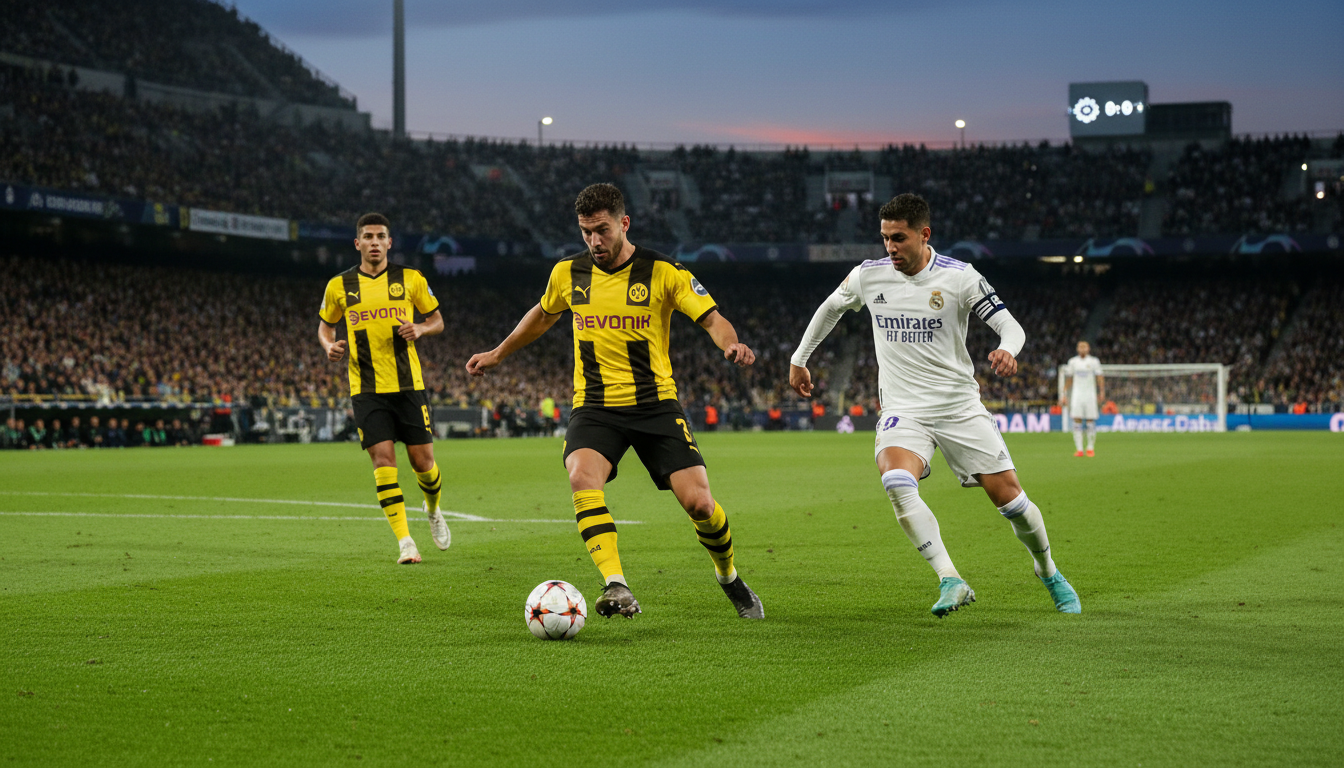
Premier League International Cup final — Borussia Dortmund II to face Real Madrid Castilla at Adams Park
Borussia Dortmund II face Real Madrid Castilla in the Premier League International Cup final at Adams Park on May 12, 2026 — team news and tactical preview.


Borussia Dortmund II and Real Madrid Castilla meet at Wycombe Wanderers’ Adams Park on Tuesday, May 12, 2026, with the Premier League International Cup final on the line. Dortmund II arrive after topping their group and beating Everton and Real Sociedad in the knockouts, while Castilla remain unbeaten but have been taken to extra time in recent rounds. The match represents a rare cross-border youth final between two of Europe’s most productive development systems.
Dortmund II and Castilla meet at Adams Park
Borussia Dortmund II will line up against Real Madrid Castilla in a showpiece U21 final staged at Adams Park in High Wycombe. The neutral venue offers a compact pitch and an atmosphere that tends to favour energetic, press-oriented sides.
This final is scheduled for Tuesday and will cap a 32-team tournament that has become a regular fixture for elite academy sides across Europe. Both clubs will view the game as a development milestone and a trophy opportunity for emerging talent.
Paths to the final for Dortmund II and Castilla
Dortmund II navigated their group with consistent form before dispatching Everton and Real Sociedad in the knockout stages, demonstrating balance between youthful energy and tactical discipline. Their route combined controlled possession in midfield with incisive moments from quick attackers, particularly in the last-16 and quarter-final ties.
Real Madrid Castilla advanced through the tournament without a defeat but required extra time to overcome Manchester United and Dinamo Zagreb in successive rounds. Those demanding victories underline Castilla’s resilience and fitness, and they also suggest matches could be decided late if the final proves tight.
Coaching changes shape Castilla’s campaign
Real Madrid’s youth side began the competition under Álvaro Arbeloa, who managed the four group matches before being promoted to the first-team set-up in January. Julián López de Lerma assumed responsibility thereafter and has overseen the squad through the knockout rounds.
The mid-season coaching switch has not disrupted Castilla’s results, but it has added a narrative about continuity and adaptation within Madrid’s academy. The management transition will be watched closely by scouts and opponents in terms of tactical tweaks and player usage.
Dortmund II squad makeup and selection concerns
Daniel Ríos heads Dortmund II as coach, supported by Marcel Schmelzer, who has announced he will step away from his staff role at the end of the season. Dortmund’s matchday selection for the final blends U19 and U23 players, reflecting the club’s emphasis on integrating younger prospects into competitive senior settings.
The average age differential between the sides is notable, with Castilla’s matchday average around 21 years and Dortmund II’s roughly 18.7 years in the semi-final. Dortmund will be without Luca Reggiani and Samuele Inácio after both started in the club’s Bundesliga fixture against Eintracht Frankfurt, but Almugera Kabar and Filippo Mane are included after gaining first-team minutes.
Aaron Held, Julien Froese, Almugera Kabar, Filippo Mane, Elias Benkara, Danylo Krevsun, Luke Fahrenhorst, Enzo Duarte dos Santos, Miguel Adje, Tony Reitz, Ayman Azhil, Justin Hoy, Fadi Zarqelain, Tom Faust, Mathis Albert, Bennedikt Wüstenhagen, Arne Wessels, and Taycan Etcibasi have all been involved across the campaign and are available to Ríos. The depth and variety of that list allow Dortmund to choose between physical presence and technical mobility depending on match demands.
Tournament context and historical perspective
This season’s edition carried 32 teams from across Europe, including German sides Borussia Mönchengladbach and RB Leipzig, both of which exited at the group stage. Nottingham Forest entered as the defending champions but were also eliminated early, underscoring the competition’s unpredictability.
German clubs have had limited success historically, with Bayern Munich the only German winner of the tournament in 2018–19. Porto remain the competition’s most successful team, having won twice, and the event has served as a platform for young players to gain international exposure and experience in knockout football.
Tactical matchup and key players to watch
Tactically, Dortmund II are likely to lean on pace and pressing from their younger cohort, seeking to unsettle Castilla with quick transitions and aggressive wing play. Their mix of U19 and U23 personnel provides options to switch tempo and introduce physically mature players if the match requires control in central areas.
Castilla’s route, marked by two extra-time victories, suggests stamina and late-game composure will be central to their approach. Observers should monitor midfield runners who can break lines and wide forwards who can exploit space behind Dortmund’s defense. Set pieces may prove decisive given the tight margins typical of finals.
What the trophy would mean for both clubs
A win for Dortmund II would be a major boost to Borussia Dortmund’s youth policy, offering a tangible reward for a pathway that increasingly fast-tracks young talents into the first team. For the players involved, the final is an opportunity to showcase readiness for senior football under pressure and to attract attention from national youth team selectors.
For Real Madrid Castilla, lifting the Premier League International Cup would reinforce the academy’s reputation for producing competitive, tournament-ready squads and underline Castilla’s continuity despite coaching changes. The victory would also add a rare international cup to a youth résumé frequently focused on domestic success.
The Premier League International Cup final promises a clash of contrasting development models and playing styles, with Dortmund II’s youthful verve facing Castilla’s experienced academy unit. Both sides have reasons to believe they can claim the trophy, and the outcome could influence player pathways and staffing decisions at the clubs.