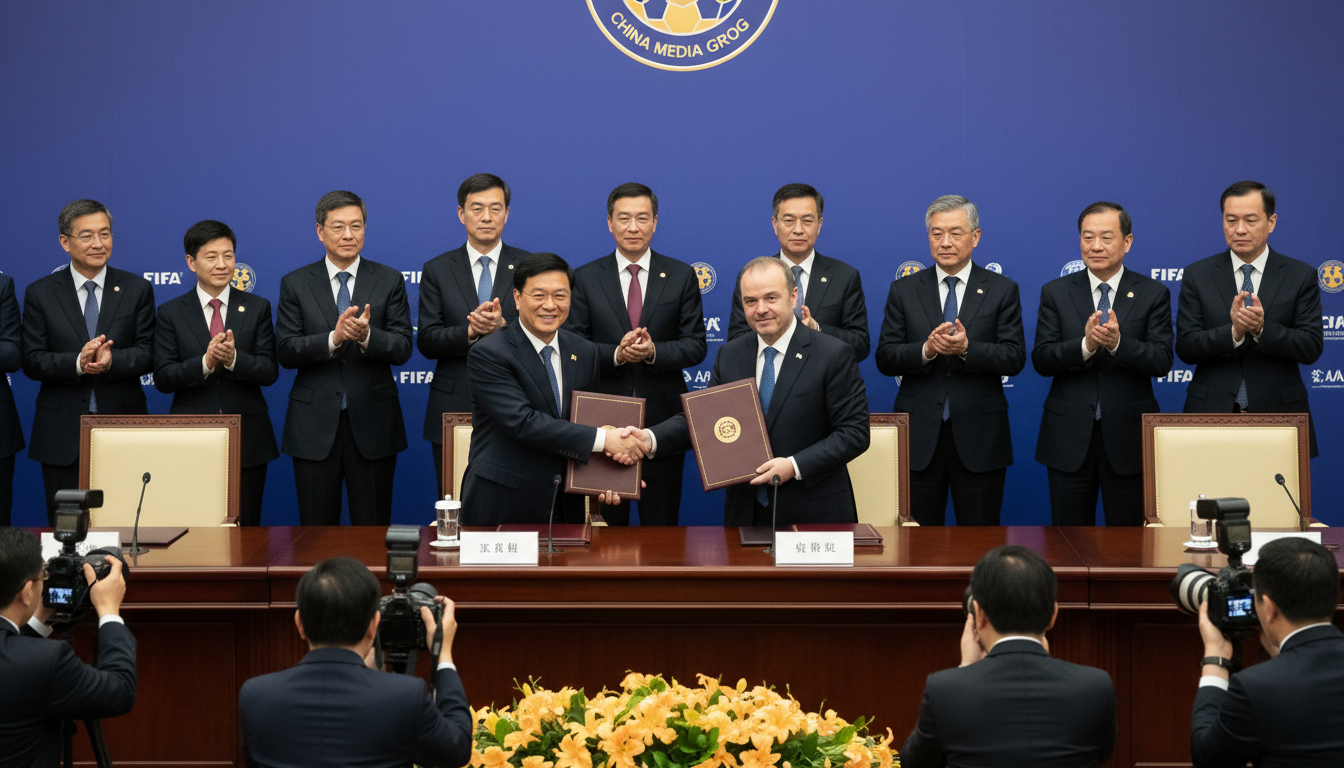
China Media Group Secures Exclusive World Cup Broadcast Rights Through 2031
China Media Group has signed an exclusive deal with FIFA to hold mainland China broadcast rights through 2031, covering the men’s 2026 and 2030 tournaments and the women’s 2027 and 2031 World Cups.


China Media Group has agreed with FIFA to acquire exclusive mainland China media rights and sublicensing privileges for four upcoming World Cups, the broadcaster announced on May 15, 2026. The package includes the 2026 men’s tournament in Canada, Mexico and the United States, the 2030 men’s event, and the women’s competitions in 2027 and 2031. The agreement gives CMG control of free-to-air television, pay-TV, internet and mobile distribution in mainland China across the period.
Deal secures four World Cups for China Media Group
China Media Group’s arrangement with FIFA runs until the end of 2031, bringing multiple global tournaments under a single national-rights holder for mainland China. The contract covers two men’s World Cups and two women’s editions, a block that gives the broadcaster long-term certainty for the marquee international fixtures. FIFA and CMG said the pact continues a longstanding cooperation between the organizations that dates back to the late 1970s.
The package structure positions CMG to manage exhibition, production and commercial exploitation of matches on every platform within mainland China. That continuity may simplify sponsorship and advertising planning for brands seeking multi-tournament exposure in the Chinese market. CMG’s hold on sublicensing rights also allows it to negotiate distribution partnerships with domestic platforms and regional carriers.
Exclusive mainland rights and multi-platform sublicensing
Under the terms announced, China Media Group secured exclusive mainland China media rights and the ability to sublicense across free-to-air, pay-TV, internet and mobile devices. The exclusivity covers broadcast and digital windows within mainland China, meaning CMG will control who can show matches and on which platforms. Sublicensing options give the state broadcaster flexibility to deploy content across linear channels and streaming services while retaining overall control.
CMG’s statement emphasized an intent to use its "all-media communication matrix" and production capabilities to present the tournaments to Chinese viewers. That suggests the broadcaster will both produce domestic feeds and package international signals for local consumption, potentially adjusting language and commentary, studio programming and ancillary content to suit mainland audiences. The deal therefore covers rights, distribution mechanics and production responsibilities.
Timing and context of the announcement
The agreement was made public on May 15, 2026, less than a month before the 2026 World Cup begins this summer, according to the announcement. The timing resolves uncertainty over how the event would be shown to mainland audiences after protracted negotiations between rights holders and Chinese broadcasters. For fans and advertisers alike, the announcement provides clarity ahead of the tournament period.
FIFA and CMG framed the timing as part of an ongoing partnership, underlining past collaboration while stressing readiness for the upcoming schedules. The late spring announcement gives CMG a condensed window to finalize sublicensing, production crews and promotional plans before the first matches, increasing the operational emphasis in the weeks that follow.
Financial terms and market reporting
China Media Group did not disclose the financial details of the multi-tournament agreement in its official statement. Local media reports circulating after the announcement put the value for the 2026 package at approximately US$60 million, though that figure has not been confirmed by CMG or FIFA. Without an official breakdown, it is unclear whether the reported number refers solely to 2026 rights or is part of a broader multi-year valuation.
Sports-rights valuations in China have fluctuated in recent years amid changing advertising markets and the rise of digital platforms. The ability to sublicense across multiple channels can materially affect the economic return for a primary rights holder, as downstream deals with domestic streaming services, regional broadcasters and commercial partners generate additional revenue streams. Observers will be watching for how CMG structures its sublicensing agreements and whether the broadcaster seeks to recoup costs quickly through major platform partnerships.
FIFA relationship and the visit by secretary general Mattias Grafström
FIFA secretary general Mattias Grafström was present in China this week as part of discussions around cooperation and rights, an appearance noted by state media outlets. The organizations highlighted their long-standing relationship, citing joint work since 1978 as a foundation for the latest agreement. FIFA’s engagement at senior levels underscores the federation’s interest in securing stable, high-reach distribution in one of the game’s largest potential markets.
CMG framed the deal as a partnership that will leverage its production and broadcasting capabilities to deliver a "thrilling football spectacle" for mainland audiences. The involvement of top FIFA officials and state broadcaster executives points to a coordinated approach that combines international event management with domestic media infrastructure. Such coordination is intended to ensure broad coverage and high production standards across television and online platforms.
Implications for viewers and the domestic rights market
For Chinese viewers, the agreement means the 2026 World Cup and subsequent tournaments will be available under a single rights umbrella, potentially simplifying access to matches and related programming. Fans can expect a mixture of free-to-air and pay options, along with enhanced online coverage, studio shows and localized commentary prepared by CMG’s teams. How the broadcaster distributes premium fixtures between pay and free windows will shape audience reach and commercial income.
The move also affects the domestic rights market by consolidating primary control with a state-owned entity that can either withhold or sublicense content to commercial platforms. Streaming services and pay-TV operators in China may pursue sublicensing deals to carry live matches, highlight packages and supplementary content. The outcome will influence advertising rates, subscription incentives and cross-platform promotion tied to the World Cup cycle.
Production, distribution and potential sublicensing strategies
CMG’s stated emphasis on world-class production suggests investment in live-match coverage, studio analysis and digital presentation. The corporation has the technical and editorial resources to create bespoke feeds for mainland viewers while aligning with FIFA’s international broadcast standards. Integration of augmented graphics, multi-camera setups and expanded pre- and post-match programming are likely components of CMG’s production plan.
Sublicensing offers CMG routes to extend reach through partnerships with commercial streaming platforms, regional broadcasters and mobile carriers. These downstream agreements could take multiple forms, from wholesale sublicenses of full match rights to curated highlight packages and short-form digital content. Such flexibility would allow CMG to tailor offerings to different audience segments while retaining primary oversight of transmission and monetization.
Final paragraph
The CMG–FIFA agreement formalizes a long-term broadcast relationship that will guide World Cup coverage in mainland China through 2031 and shapes how millions of viewers will experience football’s global showcase. With exclusive rights secured, CMG faces the practical work of production, sublicensing and promotion ahead of the 2026 tournament, and the choices it makes will influence the Chinese market for major international sports rights in the years to come.