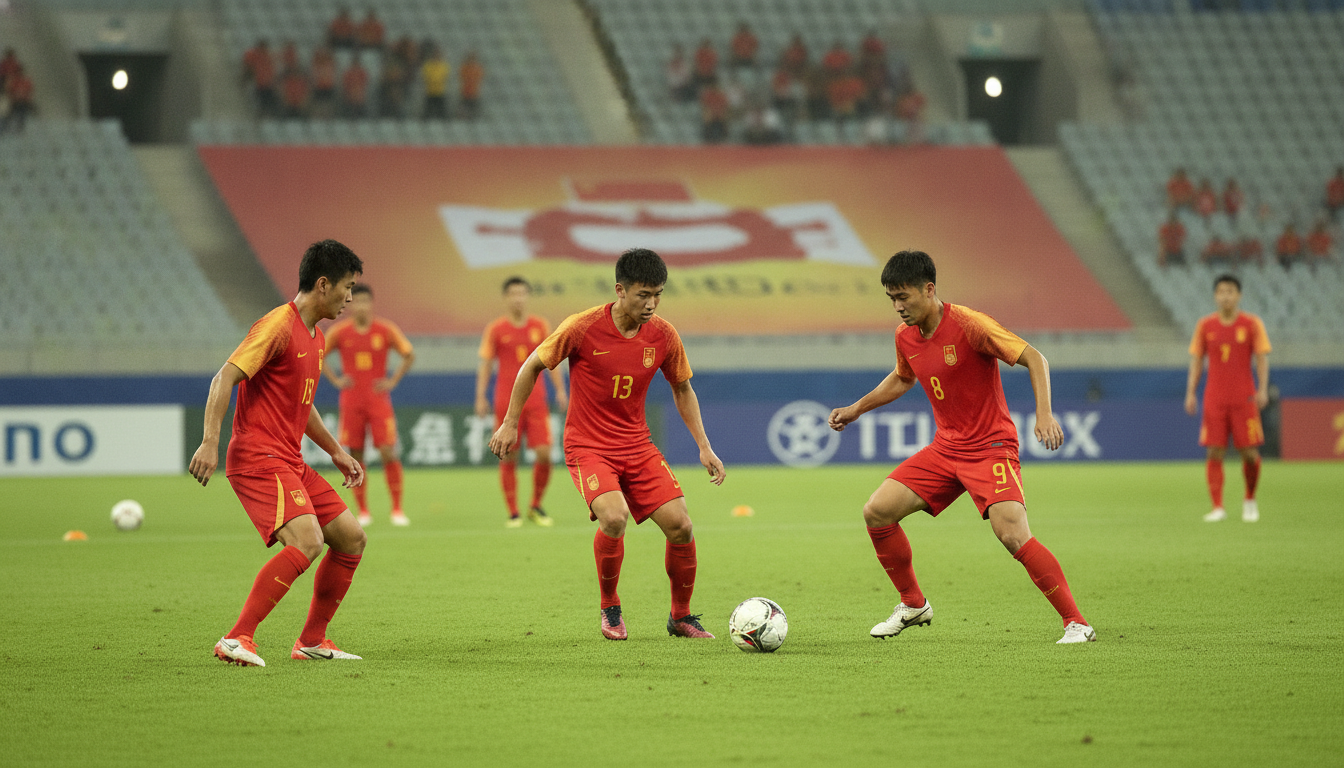
China national team skips inaugural Fifa Asean Cup, opts for Chongqing Asian Cup warm-ups
China national team will skip the inaugural FIFA Asean Cup, staging September–October warm-ups in Chongqing ahead of the 2027 Asian Cup and 2030 World Cup.


Senior squad withdraws from Fifa Asean Cup
China’s senior men’s team will not participate in the newly created Fifa Asean Cup this September, the Chinese Football Association has confirmed.
Instead, the national side will assemble for a five-team warm-up tournament in Chongqing as part of preparations for the 2027 Asian Cup in Saudi Arabia.
The decision prioritises controlled, competitive fixtures tailored to the coaching staff’s tactical objectives rather than entry into the regional Asean competition.
Officials said the Chongqing series offers specific opponents whose styles and levels of play are judged to be more relevant to the challenges China expects to face at the Asian Cup.
Chongqing warm-up details and opponents
The September–October window will see China host a round-robin event featuring Uzbekistan, North Korea, Tajikistan and Palestine alongside the hosts.
Those four opponents were selected to provide a mix of tactical tests, competitive intensity and differing match tempos in advance of the Saudi tournament.
The format gives China multiple matches in a short period, allowing the coaching staff to rotate players and trial systems under competitive pressure.
Organisers believe the concentrated schedule will offer a clearer measure of squad depth and tactical readiness than a single friendly or a regional cup appearance.
Recent results framed as developmental steps
China have pursued a proactive schedule earlier this year to sharpen international experience and exposure to varied playing styles.
In March’s Fifa Series 2026 in Australia the national team beat World Cup debutants Curacao 2-0, then suffered a 2-0 defeat to Cameroon that highlighted areas needing improvement.
In June the side claimed a 2-1 victory over Singapore and played out a 0-0 draw with Thailand, results that the coaching staff described as useful benchmarks.
Those matches exposed the team to contrasting tactical approaches and provided players with live-game scenarios the staff intend to replicate or counter in Chongqing.
Tactical rationale behind opponent selection
The selection of Uzbekistan, North Korea, Tajikistan and Palestine reflects a deliberate pursuit of oppositions that present differing defensive structures and transition patterns.
Uzbekistan typically tests teams with technical midfield play and quick transitions, while North Korea is known for defensive organisation and physical resilience — both valuable rehearsals for the Asian Cup.
Tajikistan’s compact midfield and disciplined shape will probe combinations and movement between China’s lines, and Palestine offers an unpredictable, combative challenge that can reveal individual and collective discipline.
Collectively, these opponents allow China to rehearse pressing triggers, defensive compactness and attack-build sequences in a way that mirrors the diversity they will meet in Saudi Arabia.
Women’s and U23 commitments at the Asian Games
While the senior men skip the Asean Cup, China’s senior women and the men’s under-23 side will travel to Japan to compete at the Asian Games.
Both squads are set to face regional opponents, including Hong Kong’s representative teams, as part of multi-sport continental competition that doubles as high-level international exposure.
The Asian Games assignments are being treated as priority tournaments for player development and squad evaluation at age-group and senior-women levels.
The schedule gives younger players and female internationals a platform to gain tournament minutes and to press their cases for future senior call-ups or expanded roles.
Implications for the 2027 Asian Cup and 2030 World Cup push
The Chongqing series is being framed internally as a litmus test for China’s prospects at the 2027 Asian Cup in Saudi Arabia and as an early step in building towards 2030 World Cup qualification.
Match results, player form and tactical cohesion from September and October will feed directly into selection and strategy decisions for next year’s continental finals.
A concentrated run of competitive fixtures offers the coaching staff a realistic assessment of which players can tolerate tournament intensity and which tactical combinations perform under repeated opposition.
For a national program intent on climbing the Asian pecking order, the short-term exchange of controlled, varied tests is meant to accelerate progress more reliably than participation in one-off regional events.
Crowd, logistics and domestic staging considerations
Hosting the warm-up tournament in Chongqing allows the Chinese Football Association to control logistical variables such as travel, training facilities and medical support.
A domestic bubble reduces travel fatigue and simplifies matchday protocols, which can be particularly important when a coaching staff seeks to trial numerous personnel and formation changes.
Staging matches at home will also give younger or fringe players an opportunity to perform in front of domestic crowds, strengthening local engagement with the national project.
Officials have signalled that stadium choices and timetables will aim to balance competitive realism with the practicalities of player recovery and preparation for the Asian Cup cycle.
Assessment and next steps for the national programme
The coming months will be decisive in showing whether China’s strategy of bespoke warm-ups and targeted opponent selection delivers measurable improvement.
If the team shows tactical flexibility, clearer defensive organisation and an ability to convert chances against these varied rivals, the scheme will be judged to have worked.
Conversely, any recurring weaknesses exposed in Chongqing will demand recalibration of selection policies and possibly a reorientation of training emphasis before the Saudi tournament.
The Chinese Football Association has framed these fixtures as an essential evaluation phase rather than merely exhibition matches.
China’s national team enters the autumn with an explicit blueprint: use high-intensity, varied opposition to sharpen tactical identity and assess squad depth ahead of major competitions.
The results and lessons from Chongqing will inform selection, tactics and player development choices through 2027 and into the start of the 2030 World Cup qualifying cycle.