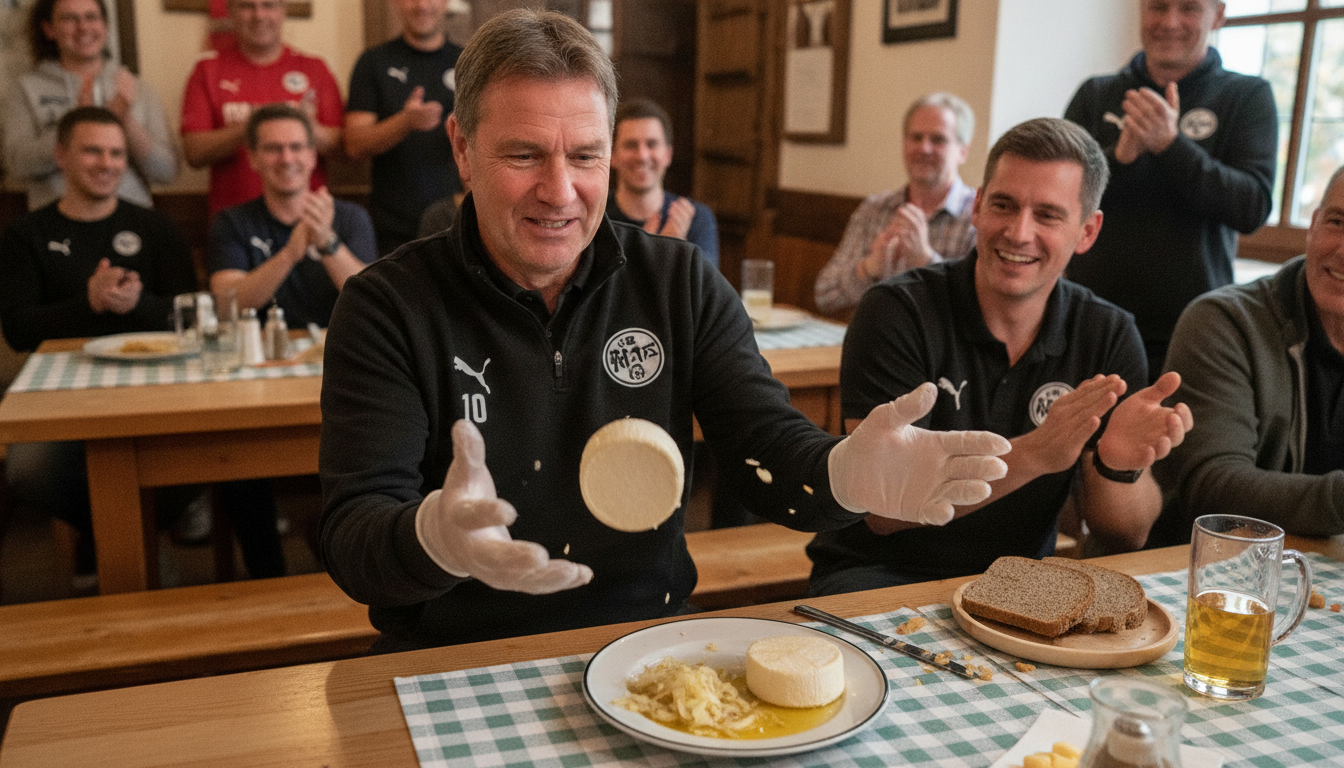
Adi Hütter’s Handkäse Slip at Eintracht Frankfurt Breakfast Draws Laughs and Goodwill
Adi Hütter made a small cultural misstep at Eintracht Frankfurt’s Handkäse Frühstück, eating the regional cheese with the wrong utensil before correcting himself to applause.


Adi Hütter arrived at Eintracht Frankfurt’s traditional Handkäse Frühstück event and briefly faltered when he ate the region’s famed Handkäse with a fork instead of the customary knife, prompting gentle corrections from fans and a quick, good-natured recovery. The newly installed head coach was attending a promotional morning that introduced recent signings and offered a rare, informal moment between the club and its supporters. The incident was lighthearted, but it underlined how small cultural gestures can matter in a coach’s early days back at a club. Hütter’s prompt response and the crowd’s forgiving reaction framed the episode as a bonding moment rather than a controversy.
Hütter makes cultural misstep at Handkäse Frühstück
A crowd gathered for Eintracht’s traditional Handkäse Frühstück, where local culinary customs are on full display and club figures meet supporters in a relaxed setting. Among the attendees were new signings and sporting director Timmo Hardung, who took part in the morning’s introductions and photos. When Adi Hütter took his turn at the table, he ordered a portion without onions and sampled the cheese with a fork, drawing amused comments from fans and onlookers. After a brief exchange he accepted the correction, used his knife on the next piece, and the atmosphere remained convivial.
The moment highlighted the informal scrutiny that accompanies high-profile appointments in clubs with passionate local followings. Hütter’s status as a returning coach added texture to the exchange, because supporters measure gestures against both current expectations and past associations. A local reporter covering the event noted the episode with a light touch, signaling that fans had taken it as part of the day’s banter rather than a serious gaffe. The episode played out on the margins of Eintracht’s promotional calendar, but it quickly became one of the morning’s most talked-about moments.
What is Hessian Handkäse and the ‘Musik’ tradition
Handkäse is a compact, sour-milk cheese with strong aroma and tangy flavor, a staple of Hesse and especially associated with the Frankfurt and Rhine-Main region. Traditionally made from low-fat quark, the cheese ripens to a translucent yellow and is often served with a vinegar-onion dressing that contributes to its signature pungency. Locals commonly refer to “Handkäse mit Musik,” a wry nod to the digestive effects that the onion dressing can have and to the lively sounds that sometimes accompany its preparation.
Understanding the regional ritual around Handkäse helps explain why utensil choice and dressing preferences can feel like symbolic markers of belonging for locals. For many fans, such culinary customs are lighthearted yet meaningful shorthand for regional identity and hospitality. The breakfast event itself is designed to celebrate those local traditions while integrating the club into the community calendar.
Fan reaction and Hütter’s quick recovery won local goodwill
Fans at the event reacted with humor rather than hostility when Hütter used the wrong utensil, offering correction in a friendly tone and reassuring him that many guests were unfamiliar with the custom. The coach’s willingness to accept the guidance immediately and adapt his behavior on the spot defused any awkwardness. That quick, public adjustment resonated because it displayed humility and an openness to learn — qualities supporters often welcome in a figure returning to lead their team.
The exchange also demonstrated the social capital of small gestures in modern football management. For a coach newly reintroduced to a club community, a moment of visible listening can translate into broader goodwill. Supporters noted the episode as evidence that Hütter was making an effort to reconnect, and those impressions are likely to be recalled alongside his early tactical decisions and preseason preparations.
Club context: returns, new signings and preseason messaging
The Handkäse Frühstück formed part of Eintracht’s public outreach as the club transitions into a new coaching era and introduces recent additions to the squad. Among those present were Jean-Matteo Bahoya, Nnamdi Collins and new signing Noël Aséko, who were photographed and greeted fans during the event. Sporting director Timmo Hardung participated in the morning’s program, underscoring the club’s intent to set a tone of accessibility and community engagement in the lead-up to the competitive season.
For Hütter, the breakfast offered a low-stakes environment to begin rebuilding ties with supporters and to present the squad’s human side ahead of match preparations. Preseason events like this one are increasingly used by clubs to shape narratives beyond results and training fields. In that light, the Handkäse slip and its resolution became part of Eintracht’s early-season story rather than an isolated anecdote.
How local customs shape fan-coach relationships
Regional customs can operate as informal litmus tests for how a coach will fit into a club’s cultural fabric, especially at teams with deep local identities. Small acts — using the right utensil, speaking a few words of the local dialect, or showing familiarity with ritual foods — are read as signals of respect and an interest in integration. For returning coaches like Hütter, who have prior history with a club, those signals carry extra weight in how quickly trust and rapport are re-established.
The Handkäse incident underlined that social fluency and on-field competence are both part of modern managerial expectations. Fans and club officials often treat personable public appearances as complementary to tactical acumen, particularly during the early days of a new tenure. Hütter’s prompt correction and the amused, forgiving audience response suggested the coach recognized that balance and was prepared to meet it.
Media and supporter narratives after the breakfast
Local reporters captured the scene with a mix of humor and context, noting both the ceremonial nature of the meal and the public interactions between players, directors and supporters. The episode provided media outlets with a human-interest angle to accompany coverage of signings and tactical planning. For supporters on social platforms and in the stadium, the moment translated into social media commentary and talking points ahead of the season.
Critically, the narrative that emerged was one of reconciliation rather than controversy, as many observers framed the exchange as evidence of mutual goodwill. Hütter’s willingness to adapt in a public setting became the central takeaway, and that framing will likely influence early fan sentiment as training accelerates and competitive matches approach.
The morning also illustrated how club rituals can be repurposed as soft power in communications strategies, allowing sporting directors and coaching staff to present a cohesive image. For Eintracht, the breakfast functioned as both a cultural touchpoint and a controlled environment to preview the club’s personality for the months ahead.
Fans and officials seemed to agree after the event that small, respectful gestures can smooth the path during managerial transitions. Hütter’s correction was read as a sign that he is attentive to the community that supports the team, and that responsiveness may earn him latitude while he rebuilds and sets his competitive agenda.
In the weeks ahead, the focus will shift from these community moments to training, tactical implementation and results on the pitch. For now, though, the Handkäse breakfast provided an early, public example of how Hütter is navigating the social side of his role at Eintracht Frankfurt.
The episode was small in scale but revealing in tone: a coach ready to learn local ways, a fan base willing to forgive an honest mistake, and a club using regional tradition to reinforce ties between team and city as the season approaches.