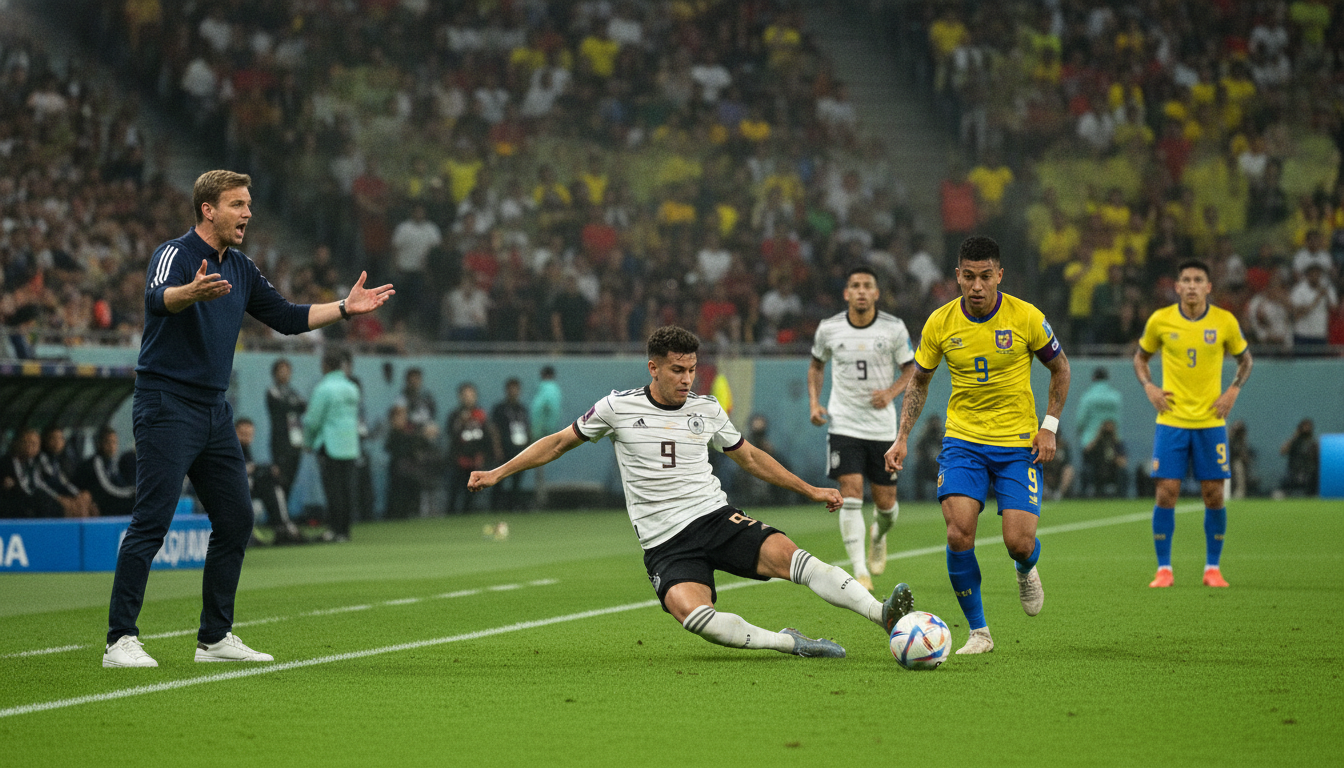
Germany vs Ecuador 2026: Nagelsmann’s Side Exposed in 2-1 World Cup Defeat
Germany’s 2-1 loss to Ecuador at the 2026 World Cup leaves Nagelsmann with tactical questions and a fragile attacking identity ahead of the Round of 32.


Germany’s shock 2-1 defeat to Ecuador at the 2026 World Cup on Saturday exposed worrying tactical and psychological cracks in Julian Nagelsmann’s side. The result, which followed convincing group wins over Curaçao and Ivory Coast, highlighted a team whose attack has struggled for cohesion against stronger opposition. With a Round of 32 tie against Paraguay looming, the performance intensified scrutiny of Nagelsmann’s selection choices and the squad’s collective resolve.
Nagelsmann’s attack choices under scrutiny
Nagelsmann started the same forward combinations that had produced goals earlier in the group, but those options failed to unlock Ecuador’s organized defence. The opening half saw Germany sustain possession without creating clear-cut opportunities inside the box. When Germany did fashion chances, they were fragmented and predictable rather than the sustained pressure expected of a top-tier side.
The pattern of the bench providing more momentum than the starting XI became obvious as substitutions injected tempo and unpredictability. That dynamic has occurred in previous fixtures this tournament, suggesting that personnel and perhaps the tactical setup from kick-off are not delivering. If Nagelsmann intends to preserve a fluid attack, he may need to reconsider his initial selection and tactical approach before the knockout match.
The broader concern is whether the manager’s trust in established combinations is preventing necessary adaptation. Tournament football rewards timely tweaks and bold interventions, and Germany’s reluctance to change failing patterns could be costly against teams that do not cede space.
Substitutions brought energy but not answers
Substitutes altered the tone of the match, providing more directness and urgency in the final third than the starters managed. Those changes showed that Germany possess attacking talent beyond the first XI, yet they also underscored the coach’s dilemma—why rely on that spark only later in games? The timing and nature of those introductions will be debated as supporters and analysts search for explanations.
Ecuador’s structure forced German attackers into wide positions and low-probability shots rather than central penetration and high-quality chances. When replacements began probing different angles, the threat increased but not sufficiently to overturn the scoreline. The recurring reliance on late-game variations hints at a deeper issue with pre-match planning and the team’s starting identity.
If Germany are to salvage momentum heading into the knockout rounds, finding a way to harness that bench energy earlier and to translate it into coherent attacking patterns will be essential. Otherwise the side risks repeating a stop-start template against opponents with stronger defensive discipline.
Contrasting reactions from coach and dressing room
In the immediate aftermath, a clear divide emerged between the coach’s public assessment and private sentiments within the squad. Nagelsmann framed the match as one in which his team had tried to win and had been unfortunate with the result. Several players, speaking more candidly, acknowledged that Ecuador appeared more determined and that Germany’s hunger had been insufficient at critical moments.
Such mixed messaging matters in a short tournament where unity of purpose and clarity of belief are vital. If the dressing room and the coaching staff are not aligned on the reasons for defeat, it complicates the recovery process and can slow the rectification of tactical issues. A calibrated and consistent response from the management team will be necessary to restore confidence.
The players’ willingness to admit shortcomings can be constructive if followed by decisive corrective measures. But without a coherent plan shared visibly between coach and squad, doubts about mentality and preparation can fester as pressure increases.
Defensive balance and identity remain unsettled
Beyond the attack, Germany showed vulnerabilities in defensive transitions that Ecuador exploited. At times the backline looked stretched when the team pushed forward, and midfield cover was inconsistent on the break. Those moments of imbalance exposed a lack of a settled collective identity—whether to dominate possession, press high, or sit and counter—leaving gaps opponents could exploit.
Part of the issue stems from insufficient tactical clarity in midfield roles, which left Brazil-like rhythmic control absent and, instead, sporadic bursts of possession that lacked follow-through. Defensive duties appeared to shift unpredictably among players, creating space for Ecuador’s quickest attackers to operate. Restoring a coherent defensive framework will be as important as finding a reliable source of goals.
Nagelsmann will have to decide whether to simplify roles to improve defensive sturdiness or to accept fluidity in exchange for attacking creativity. The former offers greater security but risks bluntness; the latter preserves dynamism but requires sharper in-game management.
Leadership question: Kimmich stands out, but others must step up
Joshua Kimmich remained a consistent presence, setting standards through intensity and responsibility in midfield. His leadership qualities were evident, both in organization and in efforts to rally teammates during a difficult spell. Yet beyond Kimmich there was a noticeable absence of the dominant voices and match-defining personalities that have typified past German tournament sides.
International success often depends on a small cluster of players who can impose themselves physically and mentally in decisive moments. This Germany team features talent across the pitch but, at present, lacks the palpable on-field authority that converts close contests into wins. Identifying who can shoulder those responsibilities and encouraging clearer leadership distribution will be central as the knockout rounds approach.
If emerging leaders can pair tactical clarity with emotional control, Germany could still forge a clearer identity. Failing that, their run may stall at a stage where mentality, as much as tactics, decides matches.
Round of 32 with Paraguay presents immediate test
Germany’s next competitive step is a Round of 32 meeting with Paraguay, a match that will quickly reveal whether lessons have been learned from the Ecuador defeat. Paraguay will not be an opponent to underestimate; their structure and desire in knockout football can punish teams that arrive underprepared. Nagelsmann must balance the need for quick tactical fixes with the requirement to preserve player fitness and confidence.
A sharper starting plan, earlier use of game-changing substitutions, and a clearer defensive template will be priorities against Paraguay. The time between fixtures is limited, so practical training that targets specific deficiencies—pressing triggers, transitional shape, and finishing sequences—may provide the fastest route to improvement. How Germany approach this window will speak volumes about their ambition and adaptability.
Expectations should remain measured; implementing significant changes in a short turnaround is challenging. Nonetheless, incremental adjustments that address glaring flaws could be enough for Germany to reassert control and progress.
Comparisons to past World Cup adaptability
Historically, German World Cup victories have often hinged on timely tactical pivots and decisive management calls under pressure. A notable example is the 2014 tournament where a strategic positional change helped rebalance the side and catalyze a successful run. That precedent underscores the importance of flexibility and hard decision-making in tournament football.
Nagelsmann’s situation now demands a similar appetite for boldness—whether through formation tweaks, player role changes, or a different rhythm from the outset. Fans and pundits will watch to see if the coach can summon the willingness to modify long-trusted patterns in favor of results. The contrast between historical adaptability and current hesitancy will be a recurring theme in assessments of Germany’s campaign.
If Nagelsmann can combine recognition of problems with swift corrective action, Germany’s potential remains intact. If not, their trajectory could feel limited to a capable but not championship-ready side.
Germany’s defeat by Ecuador served as a stark reminder that talent alone does not carry a team through the World Cup; coherence, tactical elasticity and collective hunger are essential. With Paraguay next on the schedule, the coming days will determine whether the squad responds with a refined plan and renewed focus, or whether this loss becomes the inflection point that defines their tournament.