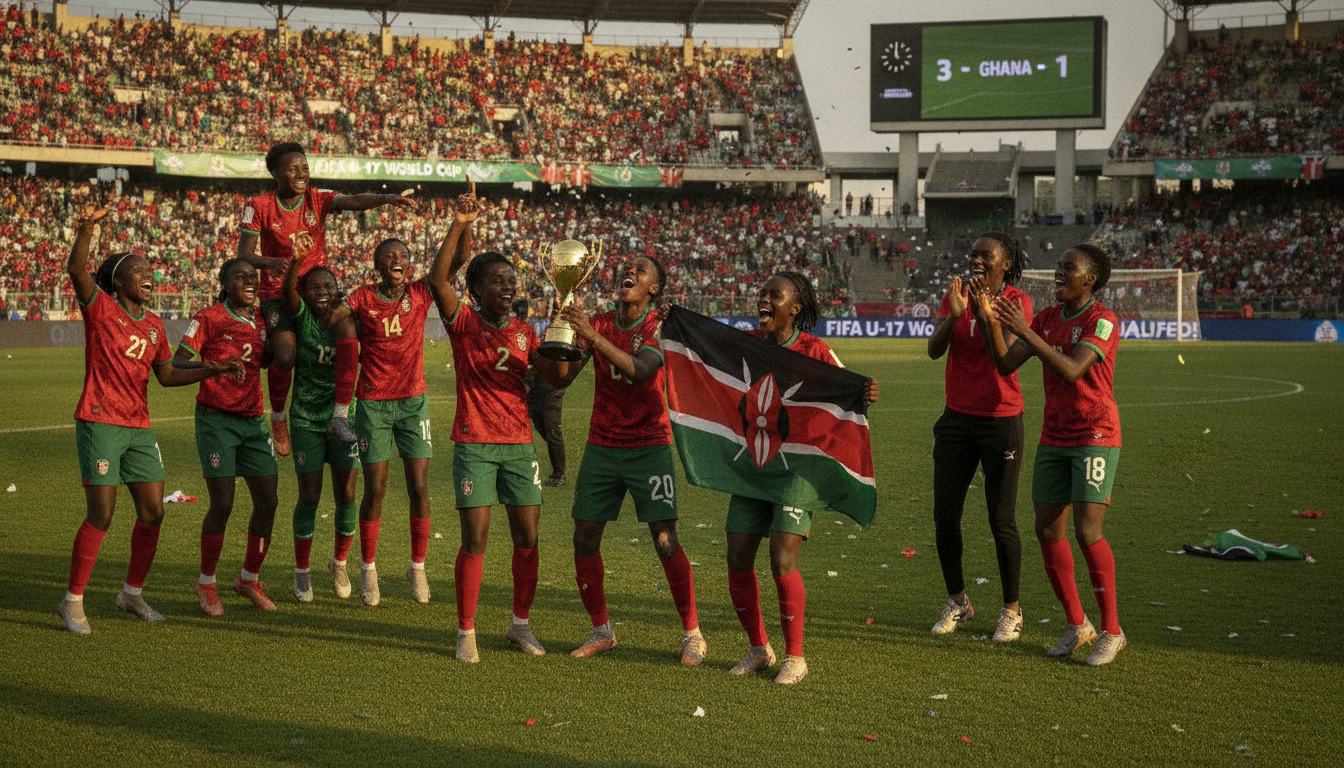
Kenya’s Junior Starlets qualify for FIFA U-17 World Cup after 3-1 win over South Africa
Kenya’s Junior Starlets sealed qualification for the FIFA U-17 World Cup with a 3-1 victory over South Africa at a packed Nyayo National Stadium, overturning an early deficit to win 5-1 on aggregate and book a second straight World Cup appearance.


The sell-out crowd in Nairobi witnessed a dramatic second-half turnaround as the Junior Starlets recovered from an early goal to score three times after the break, completing a comeback that confirmed their place at the tournament in Morocco. The result capped a strong two-legged tie in which Kenya had won the away first leg 2-0 the previous weekend, leaving coach Mildred Cheche’s side needing only to avoid defeat at home.
Packed Nyayo National Stadium backs home side
Nyayo National Stadium provided a capacity atmosphere that amplified the stakes of the return leg, with thousands in attendance to support the Junior Starlets. The crowd’s presence appeared to unsettle the young home side early on, but it ultimately became a driving force behind the comeback during the second half. Stadium noise and visible support played a clear role in shifting momentum as Kenya pressed for a result.
Fans packed the stands in the hours before kick-off, creating a tournament-style environment more commonly seen at senior internationals. The turnout underscored growing interest in youth women’s football in Kenya and offered a potent reminder of the sport’s expanding domestic profile.
Early setback as South Africa strikes inside five minutes
The match began disastrously for the hosts when Katlebo Malehana capitalized on a defensive lapse to score inside five minutes, putting South Africa in control and threatening to overturn Kenya’s first-leg advantage. The early goal forced the Junior Starlets into a patient, pressing response as they sought to regain composure without exposing themselves to further counterattacks. Despite the setback, the home team managed to steady the game and saw out the remainder of the first half without conceding again.
Kenya adjusted their shape to protect space in the final third while probing for openings, but South Africa remained organized and intent on preserving their lead. The manner in which Kenya absorbed pressure in those early stages set the foundation for the more aggressive second-half approach that followed.
Second-half surge and decisive substitutions
The second half saw a clear change in tempo as Kenya opened up with greater attacking intent, looking to break down a disciplined South African defense. Gaudancia Makokha restored parity in the 70th minute, powering a header past the goalkeeper after a dipping cross beat the keeper’s jump, and suddenly the momentum swung decisively in favor of the hosts. The equalizer lifted the stadium and injected urgency into Kenya’s play.
Coach Cheche’s tactical use of substitutes played a pivotal role in turning the tie. Elizabeth Opiyo came off the bench and immediately unsettled the opposition in the final third, forcing a penalty in the 86th minute that Brenda Awuor converted with composure. Opiyo then completed the scoring with a swift counterattack goal, finished after a feed from Brenda Achieng, sealing a 3-1 victory that felt comfortable by the final whistle.
Aggregate 5-1 secures second World Cup berth
Combined with the 2-0 away win from the first leg, the 3-1 home victory produced a 5-1 aggregate scoreline that guaranteed Kenya’s qualification for the FIFA U-17 World Cup for the second time in the nation’s history. The milestone continues an upward trajectory for the Junior Starlets, who made their tournament debut in the 2024 edition in the Dominican Republic. This successive qualification marks sustained progress at youth level and raises expectations for future international campaigns.
The result offers concrete evidence that long-term investments in youth coaching and talent identification are producing returns on the continental stage. For the players involved, the World Cup berth provides a global platform to showcase individual ability while contributing to the national program’s development objectives.
Coach Mildred Cheche praises resilience and sets targets for Morocco
After the match, coach Mildred Cheche highlighted the team’s belief, discipline and the work that has gone into reaching this point, saying she was delighted for the players, technical staff and the nation. She acknowledged the early nerves and admitted the side had displayed stage fright in the opening phases, but said the halftime message focused the players on seizing the moment at home. Cheche’s remarks emphasized the mental growth the squad displayed over two legs.
Looking ahead, Cheche was candid about raising the bar for the next stage, urging thorough preparation with the aim of progressing beyond the group stage in Morocco. She stressed the need to convert experience into better results on football’s biggest youth stage, underscoring both ambition and realism as Kenya prepares for a more demanding international calendar.
Key players and tactical takeaways from the tie
Gaudancia Makokha’s headed equalizer and Elizabeth Opiyo’s game-changing introduction emerged as pivotal contributions in the second leg, with both players providing decisive moments in transition and the box. Brenda Awuor’s calm penalty finish under pressure and Brenda Achieng’s assist for the third goal also illustrated Kenya’s depth and ability to influence games from the bench. Those individual performances reflect a blend of technical quality and composure.
Tactically, Kenya’s shift to a more attack-oriented second-half approach, combined with compact defensive organization before the break, allowed them to control phases of play and exploit space behind the South African full-backs. The match highlighted the effectiveness of in-game adjustments and the value of experienced coaching guidance at youth level.
Implications for Kenyan women’s football and development pathway
The Junior Starlets’ second consecutive World Cup qualification underlines the strengthening pipeline for women’s football in Kenya and spotlights a cohort of players who could feed senior national teams in years to come. Success at youth tournaments tends to catalyze increased investment, improved scouting structures and greater visibility for promising players, which in turn can bolster domestic leagues and coaching systems. The current achievement may accelerate those processes.
Beyond development structures, the qualification is likely to inspire young girls across the country, creating role models and tangible proof that international pathways are accessible. It also presents an opportunity for national stakeholders and private partners to align around strategic support that sustains momentum from grassroots to elite levels.
Kenya’s Junior Starlets will now enter a preparatory phase focused on building physical conditioning, tactical cohesion and international experience ahead of the FIFA U-17 World Cup in Morocco, with the coaching staff outlining targeted camps and friendly fixtures to sharpen the squad. The team’s ability to translate the confidence gained from this qualifying campaign into consistent performances on the global stage will be closely watched by fans and analysts alike.