Kimmich Defends Leroy Sané After Germany’s 7-1 Win as Kicker Poll Questions Starting Role
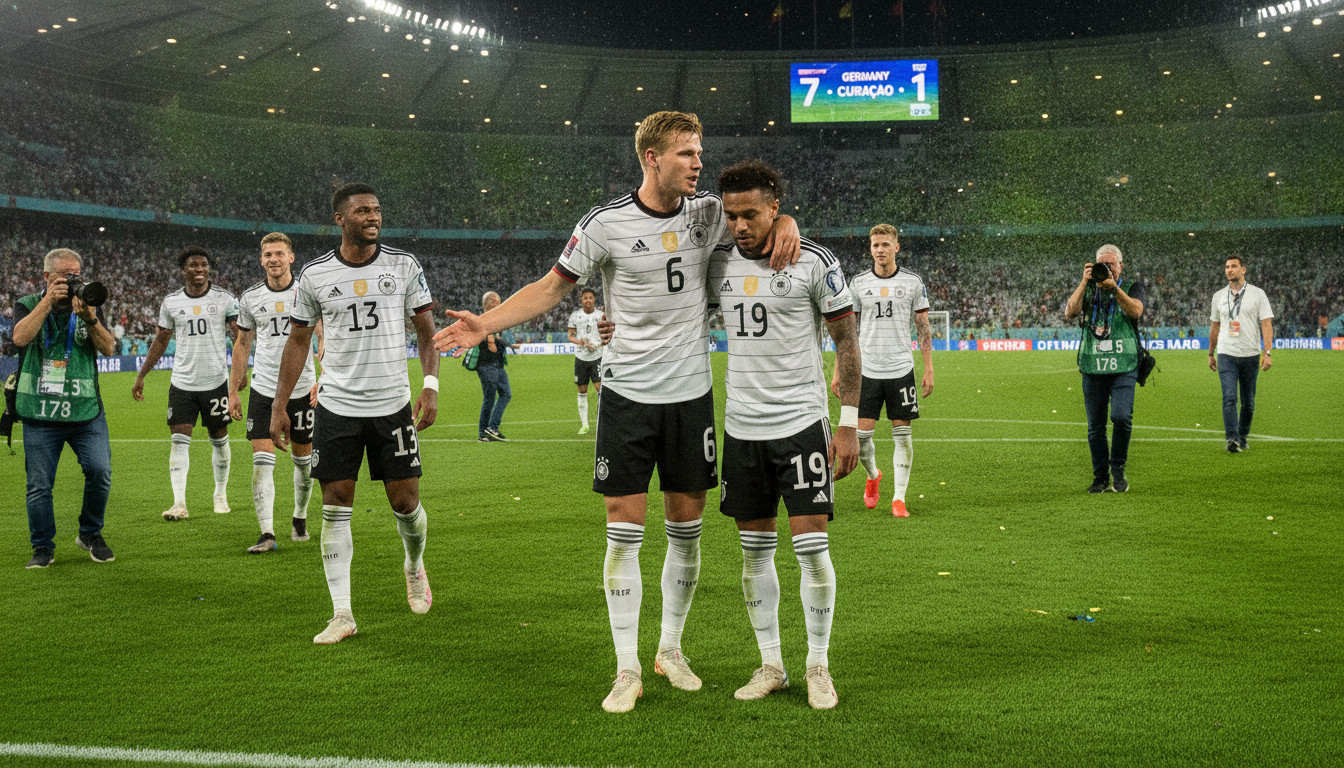
Joshua Kimmich defends Leroy Sané after Germany’s 7-1 victory over Curaçao on June 15, 2026, rejecting public criticism and a Kicker poll that questions Sané’s place in the XI.

Germany captain Joshua Kimmich on June 16, 2026, pushed back against criticism of Leroy Sané’s performance in the 7-1 victory over Curaçao, saying the winger’s work off the ball and team-first attitude merited support. Kimmich described Sané as committed and reliable in transition, arguing that scoring alone should not be the sole measure of an attacking player’s contribution. The intervention comes after a Kicker poll showed 77% of respondents believed Sané should not start in the upcoming match against Ivory Coast, intensifying debate around the squad’s forward options.
Kimmich’s Press Conference Response
Joshua Kimmich addressed reporters on Tuesday and framed Sané’s display as illustrative of team values rather than individual statistics.
Kimmich said he saw strong defensive contribution from Sané, noting repeated efforts to track back and cover counter situations that helped stabilize Germany’s transitions. He questioned the logic of singling out a player after a comprehensive team win and emphasized that internal assessments are more nuanced than public opinion polls.
The captain pointed to body language and engagement in moments of celebration as signs of Sané’s commitment to the collective objective. Kimmich also highlighted that the coaching staff assess players on multiple dimensions, not solely on goals or assists in a single match.
Public Reaction and the Kicker Poll
A widely-discussed Kicker online poll registered 64,221 votes, with 77% of respondents indicating Leroy Sané should not start the next game against Ivory Coast.
That result crystallized a social-media conversation in which supporters debated form, finishing, and tactical fit rather than outright fitness or availability. Polls of this nature reflect fan sentiment at a moment in time and can amplify pressure on selection decisions, though they do not determine the coach’s approach.
Some commentators and supporters proposed alternatives such as Deniz Undav and Jamie Leweling as potential starters, arguing for fresh attacking combinations. Those suggestions underscore the depth Germany can call on, but also underscore the distinction between supporter preference and coaching evaluations.
Assessing Sané’s Performance Beyond Goals
While Sané did not score in the 7-1 victory, Germany’s internal metrics and captain’s observations highlighted other valuable contributions.
Sané’s defensive sprints, pressing triggers and positioning during counters impressed teammates, according to Kimmich, and helped the team control transitional moments. Modern attacking roles often require such hybrid output, where involvement in build-up, chance creation, and defensive recovery matter alongside finishing.
Analysts tracking the game noted his involvement in sequences that led to goals or sustained pressure, even if he was not the final touch. That broader view aligns with Kimmich’s assertion that judgement should factor in team play and role execution.
Implications for Selection Against Ivory Coast
The debate over Sané’s place in the starting XI adds a tactical consideration for Germany ahead of the Ivory Coast fixture.
If the coaching staff prioritize defensive stability and counter-cover on the flanks, Sané’s work rate could weigh in his favor despite the poll numbers. Conversely, a desire for a different attacking profile — more direct finishing or varied aerial threat — might prompt a change to names suggested by supporters and pundits.
Coaches frequently balance form, fitness and opposition analysis when naming lineups, and Germany’s management will also consider match rhythm, training observations and specific tactical plans for Ivory Coast. Any decision on the right flank will aim to optimize the team’s collective balance rather than respond solely to external pressure.
Team Dynamics and Internal Assessment
Kimmich’s public defence of Sané signals a broader locker-room stance on solidarity and internal evaluation.
Team captains and senior players often use the media to defuse narratives they view as unhelpful, reinforcing that selection and assessment are managed within the squad framework. Kimmich’s remarks emphasized that visible enthusiasm and unselfish play are valued traits that contribute to squad harmony and performance.
Maintaining a unified public front can help minimize distractions ahead of important fixtures and preserve focus on tactical preparation. Germany’s staff and players will want to channel the energy from a 7-1 result into consistent, measured preparations for the next challenge.
The squad now faces the immediate task of converting a dominant victory into continued momentum, while coaching staff weigh the best combination to start against Ivory Coast on the scheduled match day.