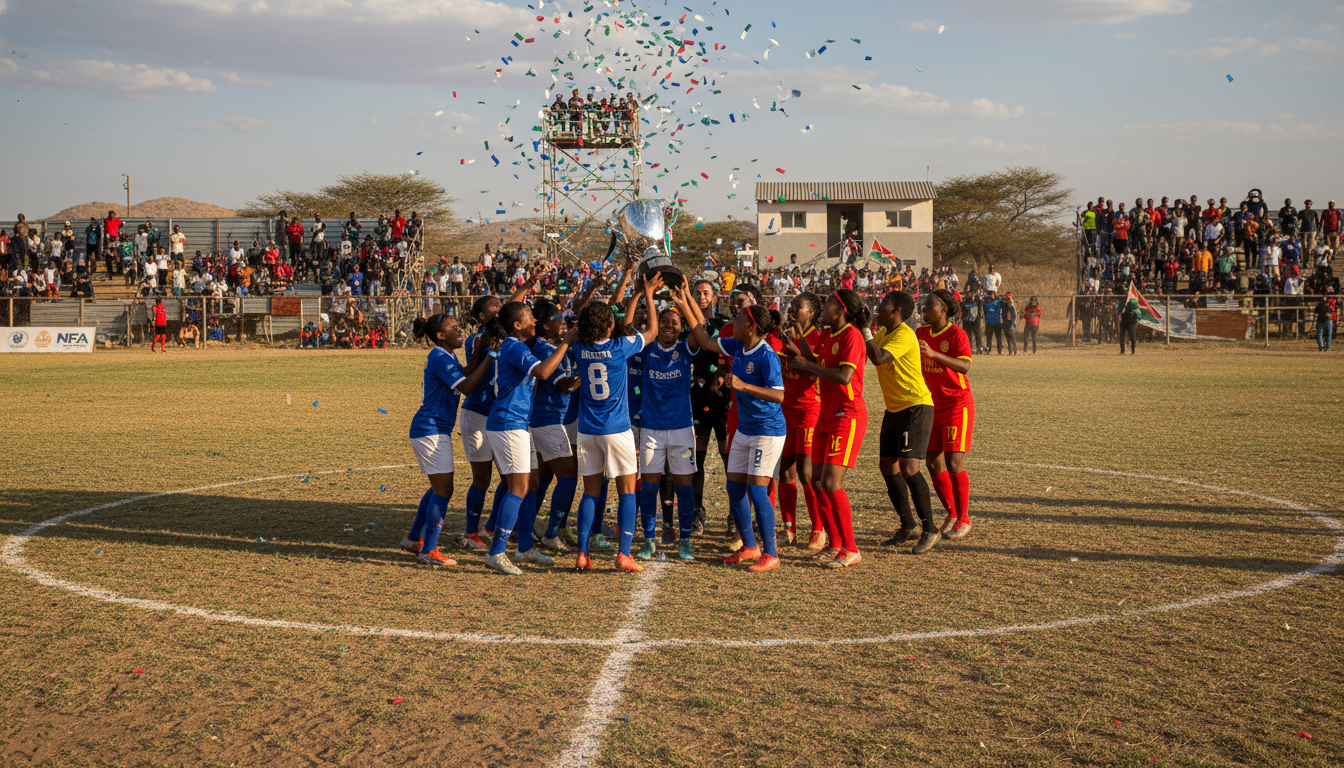
Desert Queens and Girls Football Academy Triumph in Inaugural NFA Cup Women’s Regional League
Desert Queens and Girls Football Academy won regional titles in the inaugural NFA Cup women’s regional league, underscoring growth and challenges in Namibia.


The inaugural NFA Cup women’s regional league concluded with regional champions emerging from across Namibia, highlighting the rapid expansion of the women’s game in the country. Desert Queens FC from Erongo and Khomas-based Girls Football Academy were among the headline winners as the tournament produced a string of competitive displays and fresh talent. The NFA Cup women’s regional league served as a platform for clubs outside the top tier to showcase progress in structures, coaching and player development.
Desert Queens and Girls Football Academy Lift Regional Crowns
Desert Queens FC were crowned Erongo regional champions after a sustained run of results that reflected disciplined team play and physical preparation. Coach Michael Pengeyo described the title as a defining moment for the club and for women’s football in the province, noting the sacrifices players made to be ready on short notice. In Khomas, Girls Football Academy won a hard-fought title with a squad built through years of development, a fact that coach Keshii Nghipandwa said made the victory especially meaningful.
Both clubs highlighted that the NFA Cup women’s regional league provided opportunities for players who train outside the Women’s Super League to test themselves in competitive conditions. Several players reportedly traveled significant distances to attend training sessions in the weeks before the competition, underscoring commitment at grassroots and regional levels. The wins are being framed by coaches and administrators as evidence that investment in youth and consistent coaching pathways is beginning to yield tangible results.
Regional Winners Across Namibia
The competition produced a wide geographic spread of champions, signaling growth beyond traditional football centers. Kanaan United FC clinched the Omaheke regional crown while Okalumbu Desert Rollers topped Oshikoto. Future Ogongo Queens won in Omusati as Hope FC emerged victorious in Oshana. Rundu Chiefs Smart Ladies took the Kavango East title and Greenside Queens FC were crowned in Ohangwena. These results reflect a deepening pool of clubs capable of organizing, preparing and competing at a higher level.
Tournament organizers and local officials pointed to the diversity of winners as evidence that the NFA Cup women’s regional league is fulfilling its objective to expand competitive opportunities. Each region produced its own narratives of preparation, setbacks and standout performers, with matches often decided by narrow margins. The breadth of champions also raises questions about how to create stronger inter-regional competition and pathways that allow standout teams to face Women’s Super League opposition.
Preparation, Sacrifice and Tactical Work
Coaching staffs at several clubs emphasized the role of preparation and mentality in their success, especially when the competition was announced with limited lead time. Pengeyo said his side had been preparing for months and used concentrated fitness and tactical sessions to ensure readiness, while Nghipandwa credited long-term academy work and continuity for the Khomas triumph. Both coaches described players who prioritized training over personal plans, including canceled holidays and extended travel to join group sessions.
Teams reported that tactical discipline and cohesion were decisive in several knockout moments during the NFA Cup women’s regional league. Coaches adopted game plans that prioritised compact defensive structure and rapid transitions, reflecting pragmatic approaches suited to the tight timelines and varied playing conditions. The emphasis on mentality and teamwork came through in post-match assessments, with staff noting that technical skill alone would not have been enough to win regional titles this season.
Structural Gaps Exposed by Tournament Timing
While the competition highlighted progress, it also exposed persistent structural challenges facing women’s clubs. Several coaches and club officials flagged limited sponsorship, substandard training facilities and shortages of essential equipment as obstacles to sustained development. The late announcement of the tournament compounded those issues, leaving clubs to rapidly mobilize resources, manage player fitness and handle logistics under pressure.
Pengeyo and others warned that ad hoc competitions, even when well-intentioned, can magnify inequalities between regions if support mechanisms are not in place. Smaller clubs struggled with travel costs and accommodation while trying to maintain training standards, and some players returned from holidays lacking match fitness. Those factors, they argued, point to the need for more predictable calendars, targeted funding and shared facilities to ensure that growth is inclusive and sustainable across all regions.
Debate Over Pathway to the Women’s Super League
A notable point of contention after the competition was the absence of a direct pathway for regional winners to face Women’s Super League teams. Several coaches expressed disappointment that triumph in the NFA Cup women’s regional league would not lead to immediate matches against top-tier opposition, a lost opportunity for exposure and player development. Stakeholders argued that arranging playoff fixtures or invitationals with Women’s Super League sides would accelerate learning and provide crucial benchmarks for emerging clubs.
Regional champions, administrators and supporters proposed several models to bridge the gap, including a postseason playoff, staged friendlies with Super League teams, or inclusion in a national cup draw that guarantees high-level opposition. Proponents say such measures would create clearer talent pipelines and incentivize investment at regional level, while critics caution that logistical and financial hurdles must be addressed to avoid placing undue strain on smaller clubs.
Grassroots Progress and Future Talent Pathways
Despite the challenges, the NFA Cup women’s regional league delivered encouraging signals about youth development and talent identification. Girls Football Academy, in particular, highlighted the return on long-term academy work, with several players progressing from junior ranks into the senior squad over many seasons. Coaches noted that continuity from youth to senior football has been a cornerstone of recent improvements in certain regions, providing a template for replication elsewhere.
The competition also spotlighted the value of regional leagues as testing grounds for coaches, referees and match officials, expanding the pool of accredited personnel involved in the women’s game. Local administrators suggested that improving coaching education and referee development in tandem with club support would raise overall standards. There was consensus that sustained investment in school and community programs will be critical to converting the momentum from the NFA Cup women’s regional league into a deeper, more competitive national ecosystem.
The NFA Cup women’s regional league produced memorable moments and a clear message: Namibia’s women’s football is on an upward trajectory but requires coordinated support to consolidate gains. Regional champions have set a new benchmark for commitment and organisation, while the conversations that followed the tournament have already begun to shape proposals for better pathways, funding and fixtures.