NFF Begins CAF B-License Refresher Course in Abuja Ahead of August A-License
NFF starts CAF B-License refresher in Abuja on June 21, 2026, at NFF/FIFA Goal Project to renew coach diplomas and shortlist candidates for August A-License.


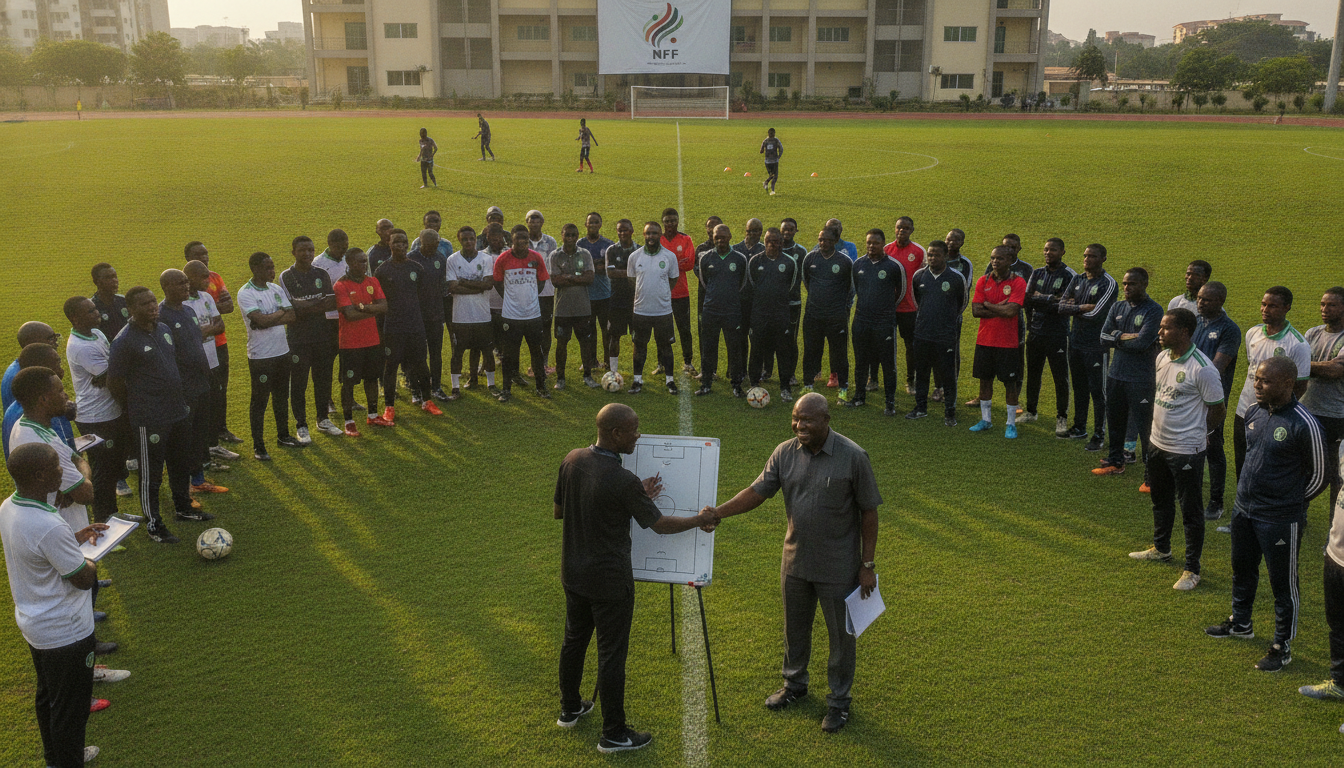
The Nigeria Football Federation has opened a six-day CAF B-License refresher course in Abuja to renew and upgrade coaching qualifications ahead of an August A-License intake. The CAF B-License refresher course, which begins on Sunday, June 21, 2026, is designed to bring licensed coaches up to date with CAF and FIFA requirements and identify those eligible to advance. The programme is being held at the NFF/FIFA Goal Project in Abuja and will run in two tightly managed batches to ensure effective delivery.
Course Schedule and Venue
The refresher runs across two overlapping batches over six days at the NFF/FIFA Goal Project in Abuja. The first group is scheduled for June 21 to June 23, while the second batch will meet from June 23 to June 25, allowing a compact delivery of content across the available dates. The NFF has positioned the Goal Project as the central venue for this and future coach education activities to streamline logistics and maintain consistent standards.
The federation’s technical leadership emphasized the need to complete the B-License renewals before progressing coaches to the A-License curriculum. NFF Technical Director Augustine Eguavoen framed the schedule as part of a broader effort to close existing gaps in licensing across the country. Officials say the timing also aligns with plans to stage the next A-License course in August 2026.
Two-Batch Format to Manage Participation
To keep class sizes conducive to hands-on learning, the federation will limit each cohort to 25 participants. The split into two batches responds to a high number of applicants and reflects a deliberate decision to balance volume with instructional quality. NFF officials stressed that a manageable group size is essential for practical coaching drills, feedback sessions and assessment.
Organizers explained that the overlapping dates allow for efficient use of facilities and educators while minimizing downtime between sessions. The arrangement also permits the federation to service more coaches within a constrained timeframe without compromising standards. After the refresher, assessments and administrative checks will determine which coaches are cleared to pursue the A-License.
Local Coach Educators to Lead Training
The NFF confirmed that the sessions will be delivered by its own cadre of FIFA and CAF-certified coach educators rather than bringing in external resource persons. Dr. Terry Eguaoje, Head of Coaching Education at the NFF, will lead the programme with support from certified colleagues. Coaches involved in the facilitation roster include Monday Odigie, Edema Fuludu and NFF General Secretary Dr. Mohammed Sanusi, all of whom hold recognized coach educator qualifications.
Officials highlighted the federation’s investment in internal capacity as a key advantage, noting that locally based educators are familiar with the domestic coaching context and constraints. The approach is intended to reinforce continuity between coach education, club practice and national team pathways. NFF sources said using in-house educators also provides cost efficiencies and faster scheduling.
Selection for August A-License Limited to 25
Completion of the CAF B-License refresher does not automatically guarantee a place on the forthcoming A-License course, which will be tightly capped. The NFF has indicated that the upcoming A-License intake, planned to commence in August 2026, will admit only 25 participants. That limitation means the refresher will serve both as a renewal exercise and a screening mechanism to identify the strongest candidates eligible for progression.
Eguavoen said that once the B-License renewals are completed, the federation will evaluate coaches’ readiness for the A-License based on performance, assessment outcomes and administrative compliance. The selection process is expected to prioritize coaches who demonstrate current technical understanding, practical competency and the ability to implement modern methodologies. The constrained slot allocation underscores the competitive nature of advancement to the A level.
Renewal, Upgrading and Coaching Standards
The NFF positioned the refresher as part of a stepwise approach to upgrading national coaching standards that began with C and D license cohorts. Technical leadership described the initiative as a continuation of efforts to professionalize coaching across all tiers of Nigerian football. Renewal of CAF B diplomas ensures that practitioners meet current benchmarks required by CAF and FIFA for certification and employment eligibility.
Officials also noted that the course content will emphasize contemporary coaching methodologies, tactical frameworks and player-development principles. Refreshers typically combine theory with practical on-field sessions, assessment drills and peer review to gauge coaches’ applied skills. By ensuring licenses are current, the federation aims to create a pipeline of coaches eligible for both club appointments and national age-grade and senior team roles.
Implications for Nigerian Coaching Pathway
The refresher course and the forthcoming A-License intake are likely to shape coaching opportunities at club and national levels through the next cycle of competitions. Renewed B licenses and a selective A-License cohort will influence staffing decisions at professional clubs, academies and the federation’s own technical structures. For coaches, securing updated accreditation may be a precondition for promotion to higher-responsibility roles or for meeting hiring criteria abroad.
Observers say the move could also strengthen the federation’s credibility with CAF and FIFA by demonstrating active enforcement of certification standards. A steady programme of education, renewal and progression helps align domestic coaching practices with continental expectations. The NFF has indicated plans to continue rolling out education programmes to address outstanding licensing backlogs and to widen access where feasible.
The Nigeria Football Federation has reaffirmed that the internal pool of certified educators is sufficient to deliver the refresher without external engagement. Officials emphasized that building local capacity for coach education is a strategic priority alongside transparent selection for elite courses. The federation also signaled that successful completion of the B refresher will be recorded formally, enabling coaches to apply for the A-License and other advanced programmes.
The CAF B-License refresher course in Abuja represents a focused push by the NFF to update coach qualifications, manage candidate volumes and prepare a shortlist for a limited August A-License intake. The exercise will be closely watched by clubs and coaches seeking advancement, and it marks a visible step in the federation’s broader effort to standardize coaching credentials across Nigeria.