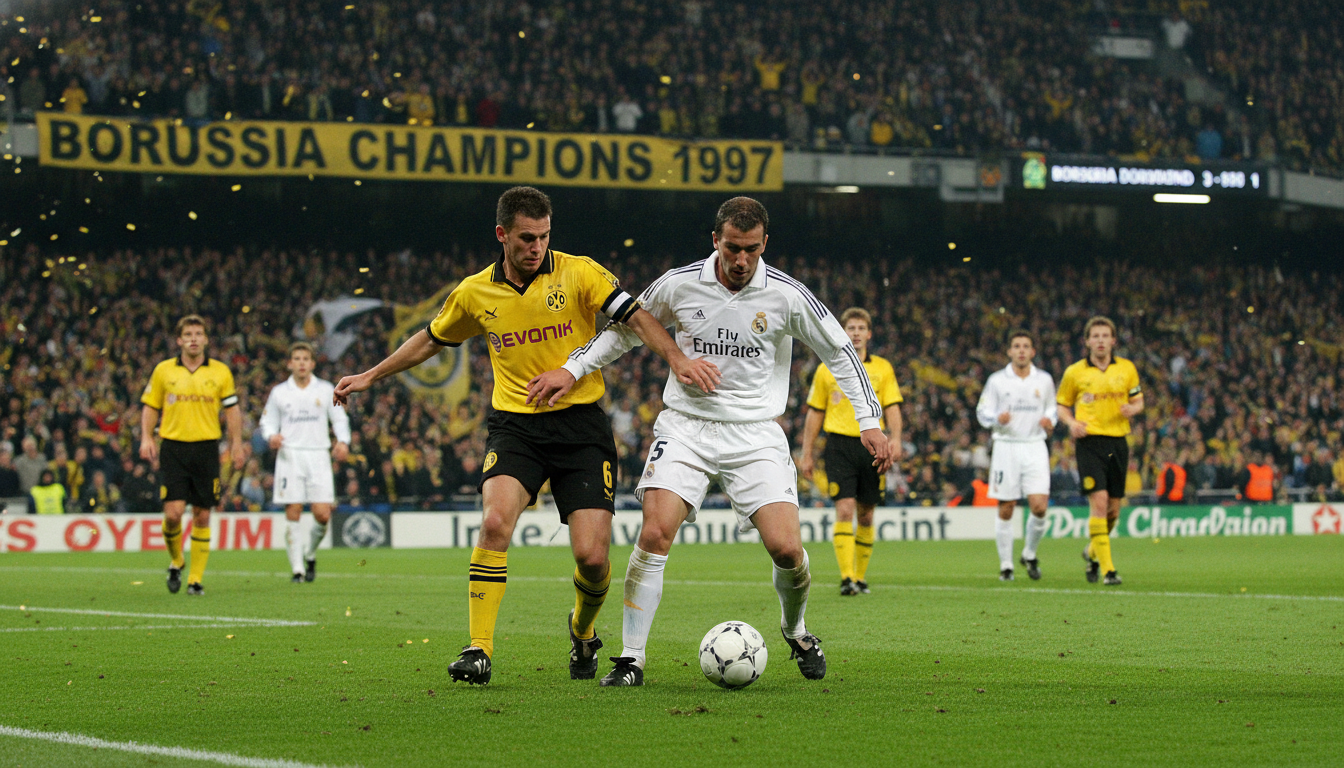
Paul Lambert’s masterclass marking Zinedine Zidane in Dortmund’s 1997 Champions League final
Paul Lambert was the unsung hero as Borussia Dortmund beat Juventus 3-1 in Munich, famously neutralising Zinedine Zidane in the 1997 Champions League final and etching his name into European football history.


Borussia Dortmund defeated Juventus 3-1 in the 1997 UEFA Champions League final, with Lambert’s disciplined midfield role widely credited as a decisive factor in the result. (uefa.com)
Lambert’s defining night in Munich
Paul Lambert arrived at Borussia Dortmund in the summer of 1996 and, within a year, played a pivotal role in the club’s first European Cup triumph. He was a low-profile signing who quickly became integral to a side that navigated a tough route to the final. (transfermarkt.com)
On May 28, 1997, Dortmund faced the reigning champions Juventus at the Olympiastadion in Munich, where Karl-Heinz Riedle struck twice and Lars Ricken added a late goal to seal a 3-1 victory. That scoreline underscored how Dortmund’s collective defensive effort, and Lambert’s personal assignment, frustrated a star-studded Juve attack. (uefa.com)
Lambert’s performance in that final has been repeatedly singled out by teammates, opponents and later commentators as a defining night in his career. The Scottish midfielder’s work ethic and tactical discipline provided Dortmund with the platform to control the midfield battle against elite opposition. (bbc.co.uk)
The tactical plan man-marking Zidane
Dortmund’s manager set out a clear plan for the final: disrupt Juventus’s rhythm by closing space around their playmakers, and never allow Zinedine Zidane time to turn and coil his passes. Lambert was given the uncomfortable but crucial task of tracking the Frenchman’s movement. (uefa.com)
Zidane’s game at the time thrived on subtle off-the-ball movement, drawing markers and opening corridors for others to exploit. Lambert accepted the challenge, combining physicality with positional intelligence to reduce Zidane’s influence without overcommitting. The result was tactical containment rather than theatrical heroics. (theguardian.com)
Years later, when Lambert and Zidane met again, Zidane reportedly reacted to the memory of that final with surprise and respect, a short tribute that underlined how seriously the world-class midfielder had taken Dortmund’s approach. (bbc.co.uk)
Match moments that mattered
Dortmund took control in the first half when Karl-Heinz Riedle converted two well-executed set-piece opportunities, giving the Germans a 2-0 lead before halftime. Those early goals changed the dynamic of the match, forcing Juventus to chase the game and leaving less room for Zidane to orchestrate. (uefa.com)
Alessandro Del Piero pulled a goal back for Juventus in the second half, briefly tilting momentum back toward the Italians, but Lars Ricken’s quick response re-established Dortmund’s cushion and closed the contest. Ricken’s goal arrived soon after he came on as a substitute, underscoring Dortmund’s depth and readiness to exploit openings. (uefa.com)
Throughout those decisive moments, Lambert’s consistency in midfield prevented Juventus from stringing together the sustained sequences of play that feed a player of Zidane’s quality. His presence constrained passing lanes and forced Juventus to attempt riskier plays. (uefa.com)
Aftermath and offers from Italy
The immediate fallout from the final included recognition from the Italian camp, who were reportedly impressed enough to make approaches for Lambert’s signature after the match. Offers from Serie A and positive private assessments illustrated how his display elevated his profile across Europe. (bbc.co.uk)
Antonio Conte, who watched the game from the stands due to injury, later told Lambert in person that he had been “unbelievable,” a compliment that captured the rare moment when a role player attracted admiration from elite contemporaries. Lambert ultimately decided not to move to Turin, opting instead to remain with Dortmund before returning to Scotland for family reasons. (bbc.co.uk)
That season’s Champions League success became a career highlight for Lambert and a selling point whenever clubs evaluated his contributions as a combative, intelligent midfielder. The interest he generated in the aftermath of the final demonstrated how a single high-profile match can recalibrate perceptions of a player’s calibre. (bbc.co.uk)
How Lambert’s role shaped Dortmund’s tactics
Dortmund’s plan in the final was not solely to muzzle Zidane but to apply a collective pressing structure that limited Juventus’s short passing options. Lambert occupied the space Zidane might exploit, but he did so within a system that encouraged immediate support from teammates. (uefa.com)
By denying Zidane comfortable receiving positions, Lambert forced Juventus to rely on longer, less-controlled passages of play. That strategic squeeze gave Dortmund more opportunities to recover possession and transition into attack, where they proved clinical with two early set-piece finishes. (uefa.com)
The match remains a case study in how disciplined individual marking, combined with team shape and situational awareness, can blunt the influence of even the most technically gifted players. Coaches and analysts point to that final as an example of pragmatic preparation trumping individual brilliance on the night. (theguardian.com)
Legacy at Dortmund and in Scottish football
For Dortmund, the 1997 victory delivered the club’s first European Cup and anchored a generation remembered for collective spirit and tactical smarts. Players such as Lambert moved from being respected professionals to continental champions, forever linked to that team’s achievement. (uefa.com)
For Scottish football, Lambert’s role provided a rare modern-era triumph on the biggest stage and a model for how players from smaller leagues can make an impact in Europe. His subsequent career back in Scotland and later work in coaching were informed by the confidence and experience gained during that season. (en.wikipedia.org)
The final also cast a long shadow over Juventus, who had been the holders and were denied a successive continental double. Dortmund’s disciplined approach, and Lambert’s personal responsibility within it, remain touchstones in recounting how underdogs can outmaneuver established powerhouses. (uefa.com)
The 1997 Champions League final is remembered as much for Dortmund’s cohesive game plan as for the stars who featured on both sides. Lambert’s name sits among those memories as the epitome of a player who fulfilled a precise tactical brief with minimal fanfare but maximum effect. (bbc.co.uk)
Paul Lambert’s performance in Munich endures as a lesson in the value of discipline, intelligence and positional awareness at the highest level of club football. The scene of a modest Scottish midfielder quietly stifling one of the world’s greatest playmakers remains one of European football’s most illustrative matchups.