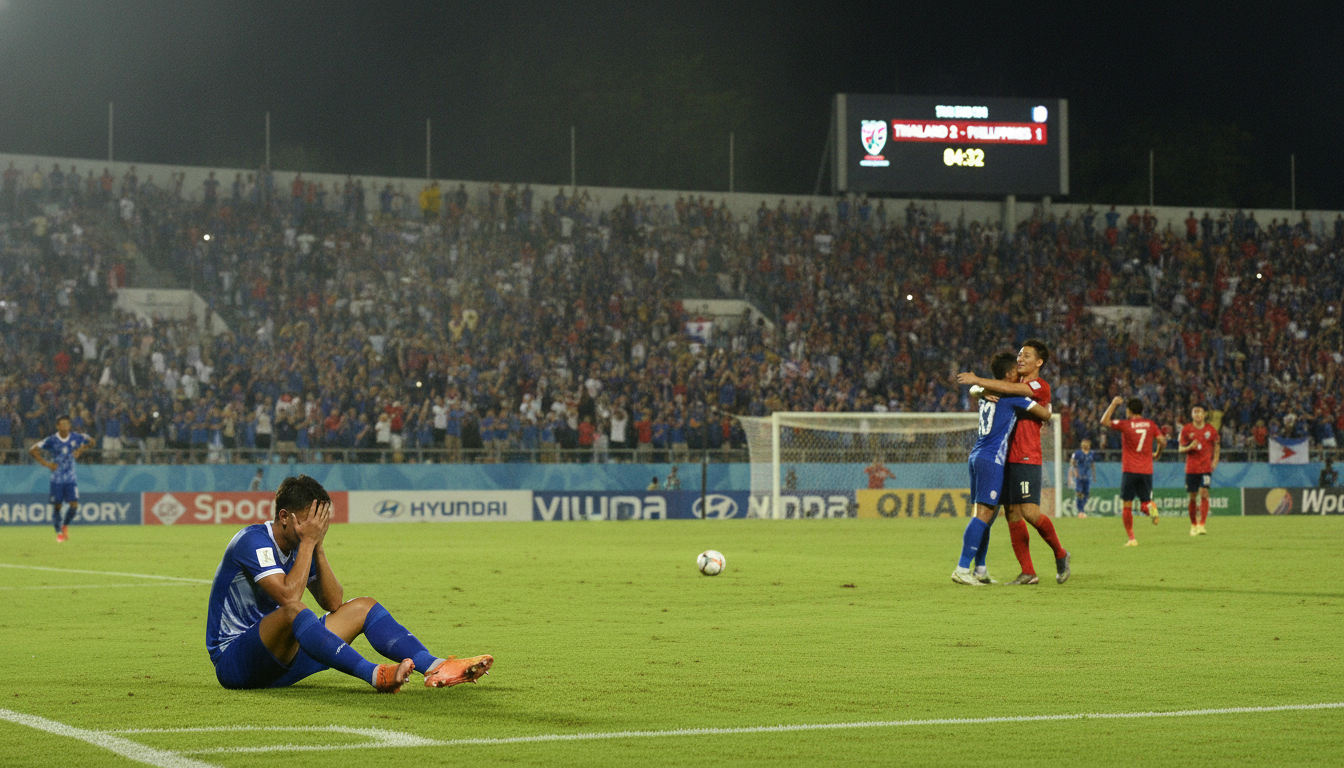
Philippines vs Thailand: Waris Choolthong’s 84th‑minute header sinks Philippines and leaves Hyundai Cup hopes precarious
Thailand beat the Philippines 1-0 after Waris Choolthong’s 84th-minute header, leaving the Filipinos needing a win in Malaysia plus favourable other results.


The Philippines suffered a late 1-0 defeat to Thailand in Tarlac on August 5, 2026, as Waris Choolthong’s header in the 84th minute decided a tight Group B contest. The result moved Thailand to nine points and put the Philippines on three points from three matches, a position that leaves their ASEAN Hyundai Cup progression dependent on other outcomes. Philippines coach Carles Cuadrat warned that even a win in Kuala Lumpur on Saturday may not be enough without goal-difference swings in their favour.
Late winner lifts Thailand to the top of Group B
Thailand’s victory was secured in the final quarter of the match when Waris Choolthong rose to meet a delivery and direct a header past the Philippine goalkeeper. The goal capped a patient and physical display from the seven-time regional champions who had reshuffled their lineup for this third fixture in 11 days. Thailand now sit on nine points and will carry momentum and an improved goal cushion into their remaining Group B game in Bangkok.
The match was far from free-flowing, with heavy rain softening the pitch and disrupting passing rhythms for both teams. Despite the adverse conditions, Thailand’s resilience and defensive organisation allowed them to maintain a clean sheet and grind out the crucial three points. Their approach under Anthony Hudson prioritized solidity and game management, a plan that paid off late.
Qualification permutations now rest beyond the Philippines’ control
The defeat leaves the Philippines needing a win against Malaysia and favourable results elsewhere to keep their semi-final hopes alive. With three points from three matches, Carles Cuadrat acknowledged that six points might not be sufficient this year because of goal-difference scenarios across Group B. Their qualification outlook now depends on multiple outcomes, including scorelines in the Malaysia and Myanmar fixtures.
Mathematical permutations mean the Philippines must not only secure three points in Kuala Lumpur but also overturn any negative goal-difference gaps against rivals. The narrow margins underline how competitive this edition of the ASEAN Hyundai Cup has become, and how a single late goal can dramatically alter the path to the knockout rounds. The team will travel knowing that victory alone does not guarantee progression.
Coaches’ assessments: Cuadrat’s caution and Hudson’s measured pride
Philippines coach Carles Cuadrat candidly described the result as a painful setback and conceded that the team’s margin for error is now minimal. He said the original objective had been to secure at least a draw that would leave qualification firmly in their own hands, and he urged his players to treat the remaining match as a high-stakes opportunity. Cuadrat emphasized the need to compete in a hostile atmosphere and promised his side would fight until the end.
Thailand coach Anthony Hudson highlighted squad rotation and physical management as key reasons for his satisfaction with the performance. Hudson praised his players for adapting to difficult conditions and for preserving a clean sheet despite making several changes to the lineup. He described pride in the team’s mentality, noting that the result was earned through discipline and determination rather than expansive attacking football.
Match conditions and tactical trends under heavy rain
A pre-match downpour left the Tarlac surface heavy and unpredictable, forcing both teams to shorten passing sequences and rely more on direct play and transitions. The Philippines attempted to control possession at times but found it difficult to fashion clear-cut chances in the final third. Thailand defended in numbers, absorbing pressure and looking to exploit set-piece and wide delivery situations, one of which produced the match-winning header.
The wet pitch also affected ball speed and footing, increasing the value of physical duels and second-ball recoveries. Both sides were cautious in possession to avoid turnovers near their defensive third, which contributed to a lower tempo and fewer sustained attacking spells. In those conditions, timing and concentration in the final minutes proved decisive.
Key players and moments that shaped the contest
Waris Choolthong’s aerial finish was the defining moment, but the match featured several noteworthy individual and collective efforts. Thailand’s defensive unit marshalled space effectively and limited the Philippines to sporadic shots and attempts from distance. On the other end, the Philippines created a handful of openings but lacked the decisive final touch to test the Thai keeper consistently.
Substitutions and squad rotation by both managers influenced the game’s rhythm, with freshness playing a part in the late stages when set pieces and counters became more prominent. The match underscored the importance of match fitness and bench depth during a condensed international schedule, factors both coaches referenced in their post-match comments.
What lies ahead: Malaysia away test for the Philippines, Myanmar next for Thailand
The Philippines now travel to Kuala Lumpur to face Malaysia on Saturday, a game that is effectively a must-win but may still leave their fate uncertain. Malaysia, playing at home under coach Tan Cheng Hoe, will present a different challenge in terms of atmosphere, tactical setup and crowd pressure. The Filipinos must contend with both the opponent’s quality and the knowledge that other Group B fixtures will influence their destiny.
Thailand return to Bangkok to play Myanmar in their final group match, a fixture that should allow Hudson to manage his squad while protecting their strong position. With nine points secured, Thailand can approach the last game with calculated rotation and strategic planning to preserve players for the knockout stages. Their focus will be on finishing the group phase in the best possible shape.
Implications for tournament narrative and regional balance
The late goal in Tarlac emphasized how closely matched teams in Southeast Asia remain and how tournament groups can swing on single incidents. Thailand’s victory reinforces their status among the favourites, blending experience with tactical pragmatism under pressure. For the Philippines, the setback is a reminder that previous successes and past progression do not guarantee a smooth path forward in a tournament defined by tight margins.
The outcome also raises the stakes for the remaining Group B fixtures and highlights the potential importance of goal difference as a tiebreaker. Teams that can combine defensive resilience with timely attacking efficiency are likely to advance, and the coming matchdays will test squad depth, travel management and match-day preparation across the region.
Philippines coach Carles Cuadrat has framed the visit to Malaysia as a must-win occasion and called on his players to embrace the challenge, while Thailand will aim to consolidate their advantage and enter the knockout rounds with momentum. The final round of group matches promises to be decisive for both sides and could produce dramatic twists as teams chase the semi-final berths.