Spain vs Portugal: World Cup Round of 16 Clash in Arlington Promises High Stakes and Star Matchups
Spain vs Portugal World Cup preview: a tactical and player-by-player look at the Round of 16 showdown in Arlington, Texas, featuring Cristiano Ronaldo and Lamine Yamal.


Spain and Portugal meet in the 2026 World Cup Round of 16 in Arlington, Texas, in what is widely regarded as the tournament’s most compelling knockout fixture. Spain vs Portugal is the headline matchup, pitting neighboring rivals with contrasting styles and a long recent history of dramatic encounters. Both teams have named strong starting lineups that include Cristiano Ronaldo and Lamine Yamal, setting the stage for a high-profile test of experience versus youthful dynamism.
Arlington setting and tournament context
Spain and Portugal will play their Round of 16 tie at AT&T Stadium in Arlington, a venue expected to draw a large, mixed crowd from across the continent. The match carries significant weight beyond progression: it is a cultural and sporting rivalry renewed on a global stage. The result will shape pathways to the quarterfinals and could redefine momentum for either side as the tournament reaches its decisive knockout phase.
Each nation arrives after a group stage that tested squad depth and tactical flexibility, with both managers making adjustments to cope with injuries and form. Spain’s possession-based structure has generated control but also exposed transitional vulnerabilities, while Portugal have leaned on counterattacking speed and the finishing instincts of veteran forwards. How each team adapts to the knockout format will be decisive over 90 minutes, and possibly beyond.
Fan interest and media attention have been intense in the days leading up to kickoff, with expectations that this fixture will produce tactical chess, individual moments of brilliance, and a defining result for either nation. The match is being framed as a generational juxtaposition, bringing together established superstars and emerging talents.
Tactical matchups that could decide the game
The midfield battle is likely to be a decisive zone, with Spain’s Rodri and Pedri expected to orchestrate possession and tempo from central areas. Spain’s midfield pairing aims to control passing lanes and recycle possession, forcing Portugal to defend deep or risk being exposed. Portugal’s midfield, built around Vitinha and Ruben Neves, offers a mix of ball progression and defensive discipline designed to disrupt Spain’s rhythm.
Wide areas could determine transitions and overloads, especially with Dani Olmo and Lamine Yamal on the flanks for Spain. Yamal’s direct running and ability to create instant forward momentum will test Portugal’s full-backs for pace and positioning. On the other side, João Félix and Bruno Fernandes provide Portugal with the creative variety to exploit pockets between Spain’s midfield and centre-backs.
Defensive structure and set-piece organization will also be critical. Spain’s backline under Luis de la Fuente has sought to maintain high positioning to compress space, which can invite counterattacks if possession is lost. Portugal’s centre-backs, including Rúben Dias, must balance aggression with caution to avoid leaving gaps for Spain’s incisive forwards. Set plays, both attacking and defensive, may tip the balance in a closely contested knockout match.
Key players — experience versus youth
Cristiano Ronaldo remains Portugal’s defining figure and will likely shape the narrative of the encounter whether he scores or not. His presence demands attention from defenders and can create openings for teammates. Beyond Ronaldo, Portugal rely on the combination of tactical discipline from veterans and the dynamism of players like Renato Veiga and João Cancelo on the flanks.
For Spain, Lamine Yamal represents a generational beacon with the capacity to change a game with speed and creativity. Paired with seasoned midfielders such as Rodri and Pedri, Spain possess a rare blend of youthful unpredictability and established control. Dani Olmo and Mikel Oyarzabal add finishing options and wide movement that can stretch Portugal’s defensive shape.
Goalkeeping and defensive leadership will be under scrutiny, as small margins often decide knockout games. Both teams have defenders experienced at club level in top European leagues, and their ability to coordinate under pressure will be a focal point. Individual battles — full-back duels, target forward contests, and midfield pressing matchups — could dictate the flow of the game.
Confirmed starting lineups and formations
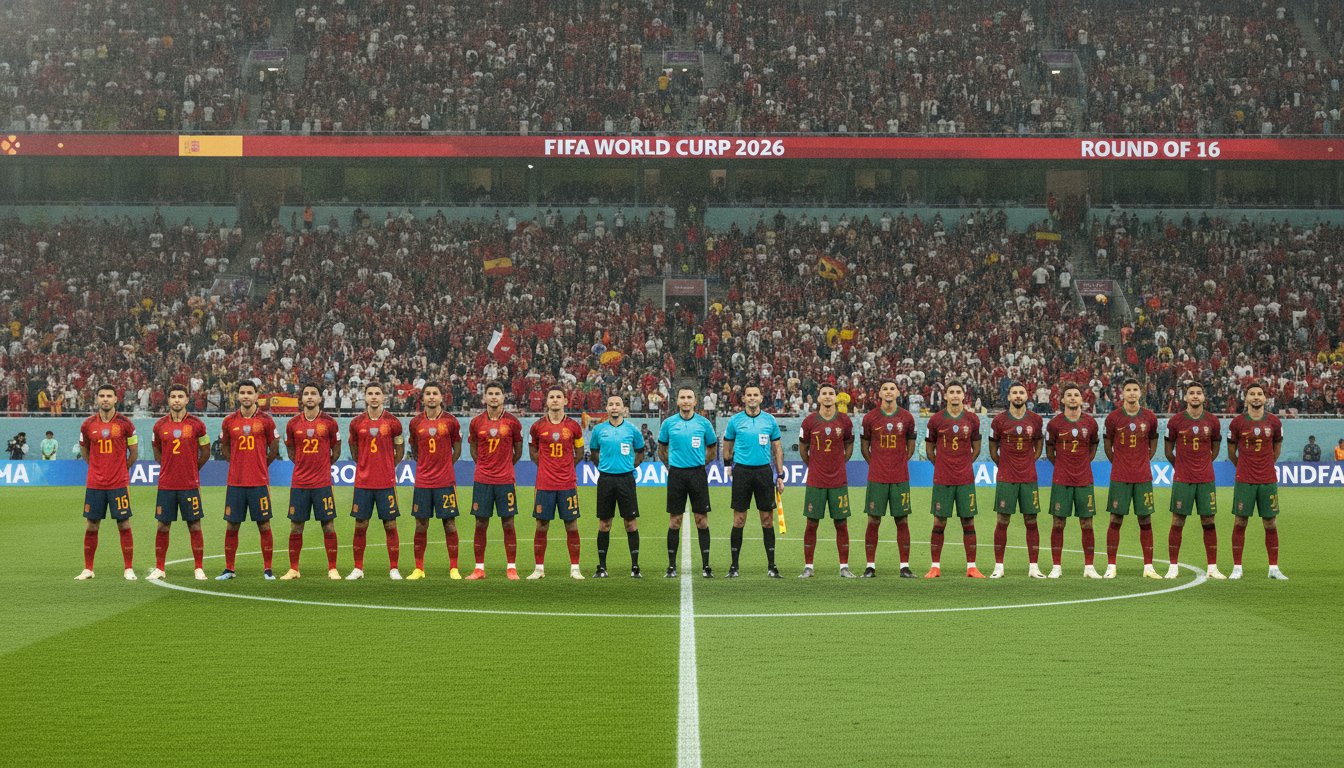
Spain (starting XI): Simon; Cucurella, Laporte, Cubarsi, Porro; Rodri (captain), Pedri; Baena, Dani Olmo, Lamine Yamal; Mikel Oyarzabal.
Portugal (starting XI): Diogo Costa; Diogo Mendes, Renato Veiga, Rúben Dias, João Cancelo; Vitinha, Ruben Neves; João Félix, Bruno Fernandes, Neto; Cristiano Ronaldo (captain).
Both coaches have opted for lineups that balance solidity with attacking intent, reflecting the importance of the fixture and the need to control key zones. Spain’s selection indicates a preference for possession-based control with quick wide outlets, while Portugal’s XI suggests a plan to remain compact and exploit moments of transition through the attacking experience of Ronaldo and Bruno Fernandes. Formation flexibility on either bench could be decisive as match situations evolve.
Managerial choices and match-day strategies
Luis de la Fuente’s selection for Spain signals confidence in his core midfield partnerships and an intent to sustain pressure through ball circulation. He appears to favour a controlled buildup and patient probing for openings, trusting his wingers and forwards to exploit spaces created by midfield dominance. Substitution policy is likely to target adding fresh legs to the wings or introducing a more direct striker if necessary.
Roberto Martínez has assembled a Portugal side that mixes physicality and creativity, with an eye on neutralising Spain’s midfield tempo. Martínez may look to compact central areas and hit Spain on the break, using full-backs to create width and Ronaldo as the focal point for finishing chances. Tactical shifts could include earlier attacking substitutions to chase a lead or defensive reinforcements to protect a narrow advantage.
Both managers will need to manage game-state risks carefully, as an early goal could force a rapid change in approach. Tactical discipline, timing of substitutions, and the ability to read the opponent’s adjustments will be defining elements that separate cautious planning from reactive problem-solving.
Historical context and recent encounters
The two nations share a recent record of high-profile matches that feed into the competitive narrative of this game. Their meeting at the 2018 World Cup remains a memorable six-goal encounter, highlighted by Cristiano Ronaldo’s hat-trick that evening. More recently, Portugal edged Spain in the UEFA Nations League final, a result that added a fresh competitive layer to the rivalry and that brought personal heroics into the spotlight.
These recent results contribute to the psychological texture of the fixture, influencing how teams approach duels and moments of pressure. Familiarity between players — many of whom face each other regularly in domestic leagues and European competition — reduces the unknown and raises the premium on small tactical innovations. The weight of past meetings will be present, but this World Cup knockout tie reshapes the stakes and opportunity for both teams to add a defining chapter.
What a win means for each side
For Spain, progression would affirm the tactical model that has relied on possession mastery and structural patience, and it would boost confidence around a young attacking core led by Yamal. Advancing would also validate selection choices and provide a clearer path toward deeper tournament ambitions. For Portugal, a victory would reinforce the resilience and attacking pragmatism that have kept Cristiano Ronaldo influential at the highest level, while also vindicating squad rotation and tactical adaptation under pressure.
A defeat would raise questions for the losing side about tactical approach, squad depth, and preparedness for tournament knockout intensity. Both teams are aware that World Cup knockout rounds amplify consequences, and that momentum gained or lost here often reverberates beyond a single match. The winner will gain not only a place in the quarterfinals but also a psychological advantage heading into the later rounds.
The final buildup and match expectations
Matchday atmospherics and early tactical cues should make the opening 15 minutes particularly revealing, as both sides test each other’s structure without overcommitting. Managers will weigh the risks of early pressing versus conserving energy for potential extra time. Crowd composition and climate will also play subtle roles in player performance and decision-making.
Expect the opening exchanges to be cautious but intense, with incremental probing and intermittent moments of high tempo. Key players on both teams can convert limited opportunities into decisive moments, and discipline in transition will be a premium. The match outcome is likely to hinge on a combination of individual brilliance, tactical poise, and effective in-game management.
Spain vs Portugal will be watched for its narrative threads as much as its tactical content: generational contrast, club-level familiarity, and the unmistakable aura of a storied rivalry on football’s biggest stage. The winner advances and inherits fresh belief; the loser walks away with lessons and, for many players, a career-defining afternoon of close margins.
Both teams are set and the world will be watching when the whistle blows in Arlington.