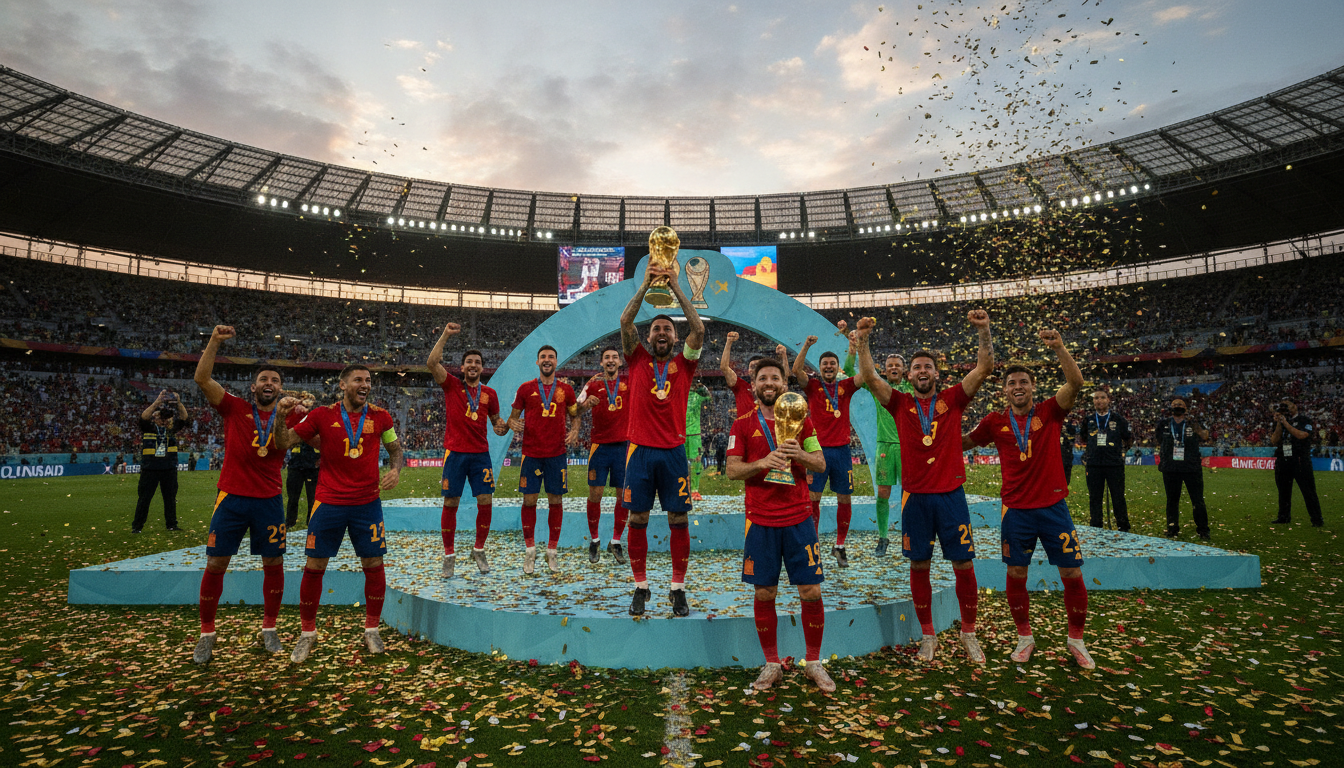
Spain World Cup triumph cements Spain’s era of global football dominance
Spain World Cup triumph: Spain defeated Argentina 1-0 in New Jersey on July 19, 2026, and returned to Madrid to a celebration that underlined a systemic dominance across men’s, women’s and youth football.


Spain’s victory over Argentina 1-0 in New Jersey on Sunday, July 19, 2026, delivered more than a single trophy — it completed a sweep of elite honours that has elevated Spanish football to an unprecedented level. The men’s team, after meeting the country’s royals and Prime Minister Pedro Sánchez, were greeted by an estimated crowd of almost two million people parading through Madrid on Monday. That outpouring followed a tournament win that now places Spain alongside the most sustained national programs in the modern game.
Spain completes a historic double
Spain’s win in New Jersey made the nation the first to hold both the men’s and women’s World Cup titles simultaneously.
The men’s 1-0 victory over Argentina added to a recent haul that already included European Championship and Olympic gold medals, alongside Nations League success. The women’s squad, separately, remain defending World Cup champions and have claimed the Women’s Nations League twice, solidifying a rare cross-gender supremacy.
Madrid celebration highlights national resonance
An estimated two million people turned out to welcome the squad through Madrid on Monday, transforming the capital into a citywide tribute to the team’s achievement.
Players and coaching staff met Spain’s monarchs and Prime Minister Pedro Sánchez as part of formal honours, reflecting the national significance attributed to this World Cup triumph. The scale of the reception signalled football’s deep cultural and political resonance in Spain, where sporting success often intersects with national identity.
A generation rebuilt after 2010’s golden era
The present Spanish squad represents the successful reconstruction of the national side following the decline of the 2010 golden generation featuring Andrés Iniesta, Xavi Hernández, Sergio Ramos and Gerard Piqué.
Rather than returning to that exact template, the federation and coaching staff have overseen a phased rebuild that merged fresh talent with an enduring tactical blueprint. The result is a team capable of winning across multiple formats and maintaining high performance under different managers and tournament conditions.
Systemic strength: youth development and talent pipeline
Spain’s recent run is underpinned by a robust youth pipeline that has produced winners at multiple age-group tournaments.
Investment in academy coaching, a clear curriculum across youth levels, and close ties between club development and national team approaches have yielded a steady flow of technically proficient, tactically adaptable players. The outcome is depth of talent that allows rotation and resilience across long tournaments.
Tactical identity and coaching cohesion
A defining feature of Spain’s success is the continuity of its tactical identity, emphasizing ball retention, positional structure and collective pressing.
Coaching staffs at national and club levels have largely adhered to a shared philosophy, which has allowed players to transition smoothly between domestic competition and international duty. That cohesion reduced tactical friction and enabled Spain to impose its style even in high-stakes matches, including the narrow, decisive win over Argentina.
Women’s program mirrors and reinforces men’s success
Spain’s women’s team has been central to the narrative of national dominance, providing both a model and momentum for the men’s program.
With back-to-back high-level performances — including being defending World Cup champions and two Women’s Nations League titles — the women’s successes have reinforced the value of consistent investment, professional structures and a unified playing philosophy across genders.
International context and historical significance
Spain is now the only country this century to claim two men’s World Cup titles and the first to hold both senior World Cups simultaneously.
These milestones place Spain among an elite group of nations whose footballing infrastructure delivers sustained excellence. The achievements invite comparison with previous dominant eras while also marking a distinct, modern paradigm rooted in collective development rather than reliance on a single generation of stars.
Implications for clubs and domestic competitions
The national teams’ success casts a spotlight on Spain’s domestic systems, where clubs’ academies and coaching pipelines have been crucial contributors to the national pool.
Domestic leagues and club academies can expect increased scrutiny and praise, along with potential boosts in investment, youth recruitment and coaching innovation as stakeholders seek to sustain the pipeline that produced this World Cup triumph.
Challenges and expectations ahead
Sustaining this level of dominance presents fresh challenges, including managing player fatigue, ensuring competition for places remains intense, and adapting tactical approaches as opposing nations evolve.
Success also raises expectations domestically and internationally, pressuring the federation and clubs to preserve the structures that have produced multiple trophies while remaining flexible to future tactical trends and player development needs.
Spain’s World Cup triumph in New Jersey is both a culmination and a signal of continuity: a moment when results matched long-term planning. The celebrations in Madrid and the formal recognition from national leaders reflected more than a single victory; they were an acknowledgement of a sustained program that has produced champions at senior and youth levels across men’s and women’s football. This era will be measured not just by trophies but by whether the institutions that delivered them can adapt, renew and inspire the next wave of players who will be tasked with defending an exceptional legacy.