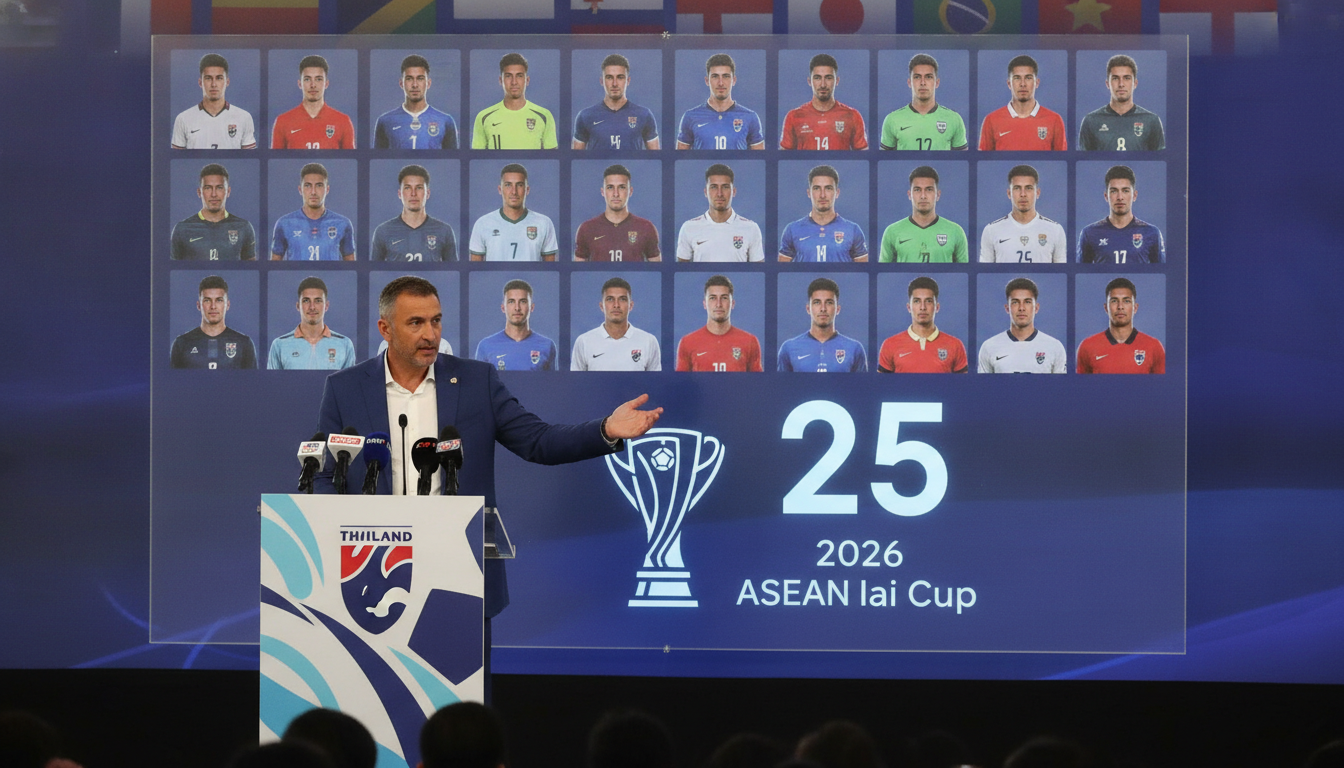
Thailand squad named: Hudson selects 25-man roster for ASEAN Hyundai Cup 2026
Anthony Hudson finalises a 25-man Thailand squad for the ASEAN Hyundai Cup 2026, mixing youth and experience as the team prepares for regional competition.

Thailand coach Anthony Hudson announced a 25-player roster in Bangkok on 9 July 2026 as the national team begins preparations for the ASEAN Hyundai Cup. The Thailand squad blends established internationals with emerging prospects, a mix the coach described as deliberate ahead of a competitive regional tournament. The Football Association of Thailand coordinated with domestic clubs to release players during a congested pre-season window, allowing the squad to assemble for training.
Hudson finalises 25-man Thailand squad
Anthony Hudson said he is “pleased with the squad” after a selection process that produced slight late changes to the roster. He emphasised the importance of giving younger players exposure while retaining a senior core to provide leadership on and off the pitch. Hudson thanked clubs for releasing players during pre-season, acknowledging the strain on teams preparing for domestic campaigns. The coach framed the ASEAN Hyundai Cup as a key opportunity for players to stake a claim for future selection.
Blend of emerging talent and senior leadership
The squad shows a clear attempt to combine long-term development with immediate competitiveness, with several younger faces included alongside veterans. Hudson’s approach preserves experience in defence and midfield while testing attacking and midfield depth through new call-ups. This strategy aims to maintain continuity from previous campaigns while identifying players who can contribute to Thailand’s medium-term plans. The selection suggests the coaching staff prioritise adaptability and versatility for tournament football.
Defensive depth and goalkeeper choices
Three goalkeepers were selected to cover the position with a mix of domestic league experience and prior national team exposure. Kamphol Pathomarkakul is included from Ratchaburi FC and offers shot-stopping and familiarity with Thai League opponents. Korakod Pipatnadda of Muangthong United and Chatchai Budprom of Buriram United provide additional options, with selection choices balancing form and international experience. Hudson appears to have favoured stability between the posts while keeping competition to push each keeper during camp.
Thailand’s defensive corps includes both long-standing internationals and reliable domestic performers, giving Hudson multiple configurations. Full-backs and central defenders such as Narubadin Weerawatnodom and Pansa Hemviboon from Buriram United bring high-level club pedigree. The inclusion of naturalised or foreign-born options is not present; the backline is composed of domestic league stalwarts from clubs like Port FC, BG Pathum United, and True Bangkok United. Versatility among defenders will be important if the team needs to adjust shape during the tournament.
Midfield composition and creative options
The midfield group reflects a balance between defensive reliability and creative playmaking, with players drawn from leading Thai clubs. Sarach Yooyen and Worachit Kanitsribampen offer ball control, tempo management, and set-piece acumen, traits Hudson will likely lean on in possession phases. Younger midfielders such as Kakhana Khamyo and Tossawat Limwanaset have been given roster spots to test their readiness for international competition. The staff will work on combinations in training to identify the most effective midfield partnerships against varied ASEAN opponents.
Hudson’s selection indicates an intent to rotate midfield personnel depending on match context, with several coaches’ options who can play multiple roles. Pokklao Anan and Picha Uthra can provide width and pressing ability from wide midfield positions. Chawalwit Saeleow and Seksan Ratree add depth with experience at domestic level and the potential to impact tempo late in games. This flexibility should help Thailand manage the physical toll of a tournament schedule.
Attacking options and scoring responsibilities
Striking options include proven domestic scorers and players who can operate as wide forwards or target players, giving Hudson tactical choices up front. Patrick Gustafsson and Teerasak Puephimai are expected to lead the line at different times, bringing contrasting qualities in hold-up play and pace. Yosakorn Burapha and Che Hanafi Mama provide additional attacking variety, while Patrick’s club form will be monitored closely in camp. The coach highlighted the tournament as an opportunity for forwards to show consistency in front of goal.
Support from attacking midfielders and wide players will be essential for goal production, and the squad includes players capable of supplying chances from wide areas. Creative transitions from midfield can pair with quick outlets up front, a formula the staff will practice in training. Hudson is likely to assess combinations that maximise each striker’s strengths, particularly when facing disciplined ASEAN defenses. Penalty and set-piece responsibilities will also be decided during the camp.
Full 25-man squad and club affiliations
The final roster lists three goalkeepers, a deep defensive group, a varied midfield contingent, and four forwards to cover attacking needs. Goalkeepers: Kamphol Pathomarkakul (Ratchaburi FC), Korakod Pipatnadda (Muangthong United), and Chatchai Budprom (Buriram United) were named. Defenders include Chaiyapol Adthana, Nattapong Sairiya, Narubadin Weerawatnodom, Pansa Hemviboon, Pichitchai Siankrathok, Manuel Tom Bihr, Waris Chuthong, Wanchai Jarunongkarn, Adisorn Promrak, and Usama Thiangkham.
Midfielders selected span several roles and clubs and are expected to compete for starting places in different formations. The midfield list features Kakhana Khamyo, Chawalwit Saeleow, Tossawat Limwanaset, Pokklao Anan, Picha Uthra, Worachit Kanitsribampen, Sarach Yooyen, and Seksan Ratree. Forwards named to the squad are Che Hanafi Mama, Teerasak Puephimai, Patrick Gustafsson, and Yosakorn Burapha. Coaches and federation officials will finalise numbers and roles during the training period leading into the tournament.
Preparation timeline and fitness considerations
Thailand’s preparation window comes at a challenging time for clubs finalising pre-season plans, but the federation secured player releases to maximise training days. Hudson acknowledged club cooperation and emphasised a targeted camp focused on fitness, tactical drills, and building team cohesion. Staff will monitor minutes and workload carefully to avoid injuries as domestic seasons approach. Friendly matches and intra-squad scrimmages are expected to be part of the schedule to sharpen combinations before the first competitive fixture.
The medical and conditioning team will play a pivotal role in ensuring recovery and readiness across a compact match schedule. Rotation is likely to be used to preserve player freshness and exploit tactical mismatches. Hudson’s staff will also assess set-piece routines and defensive organisation under pressure, two areas that often determine results in short-format tournaments. Clear metrics for performance and recovery will inform selection decisions as games approach.
Tournament context and Thailand’s prospects
The ASEAN Hyundai Cup presents both regional prestige and a platform to test squad depth ahead of future qualifying cycles. Thailand will face familiar opponents from Southeast Asia, each with distinct tactical approaches and growing competitive standards. Historical performance sets expectations high, yet the tournament’s condensed format makes consistency and match management critical. Hudson’s stated objective is to use the competition as a proving ground for talent while targeting positive results.
Opponents will present a mix of direct, counterattacking, and possession-based threats, and Thailand’s adaptability will be tested in group and knockout phases. The federation has not publicly outlined a guaranteed path but anticipates a challenging draw that requires early-season sharpness. Fans and stakeholders will watch squad rotation and in-game adjustments as indicators of readiness for higher-stakes fixtures later in the year. The tournament also offers players a chance to secure larger roles ahead of World Cup or continental qualification schedules.
The staff will also use performance data and match footage to evaluate individual contributions and tactical effectiveness. Emphasis on ball retention, defensive transitions, and clinical finishing will be central to the team’s tactical brief. Success in the ASEAN Hyundai Cup could reinforce coach Hudson’s selection philosophy and accelerate integration of younger players into the senior group. Conversely, underperformance would prompt reassessment of personnel and strategy before future international windows.
Thailand’s domestic clubs, which supplied the bulk of the roster, will monitor players’ minutes and post-tournament recovery closely. The balance between club and country remains sensitive during pre-season, and clear communication between federation and clubs is essential. Coaches at club level will likely adjust plans based on how players return from national duty, particularly regarding load management and injury prevention. The federation has indicated it will share medical updates with clubs to coordinate player care.
The selection also offers scouts and overseas clubs an opportunity to evaluate Thai talent in a concentrated international setting. Individual performances can lead to transfers or trials abroad, a pathway several players have pursued in recent years. Hudson and his staff will be aware that standout displays can influence player markets, which may affect future squad availability and development planning. The federation’s long-term talent strategy includes tracking players who earn competitive minutes during regional tournaments.
Thailand’s supporters will expect a competitive showing, and the squad’s mix of experience and youth is designed to meet those expectations while planning for the future. Ticketing, broadcast plans, and supporter engagement initiatives will likely be coordinated by the federation as the tournament approaches. Fan reaction to selections and early performances will shape public discourse around squad choices and tactical decisions throughout the competition. The team will need to deliver cohesion quickly to meet the high expectations of a passionate fan base.
Preparations will continue with a focus on sharpening tactical identity and forming reliable starting line-ups while keeping options open for rotation. Hudson’s comments suggest an openness to experimentation in the camp, balanced by the need to secure favourable early results. The coaching staff will evaluate training outcomes and adjust formations accordingly, potentially shifting between single and double pivot systems in midfield. Defensive shape and pressing triggers are expected to be refined during the opening days of the camp.
As the ASEAN Hyundai Cup opens, attention will turn to matchday selections, substitution patterns, and how effectively the squad translates training into results. Performance in the first two matches will be particularly instructive about the team’s readiness and the coach’s preferred combinations. The federation will release matchday squads ahead of fixtures, and observers will track changes from the initial 25-man list to see how rotation is employed. Competitive matches will reveal which players can handle the demands of tournament play.
The upcoming weeks will be decisive for players hoping to secure starting roles and for the coaching staff to demonstrate the effectiveness of their selection strategy. Hudson’s emphasis on opportunity for youth and newcomers frames the competition as a developmental milestone as much as a pursuit of silverware. The balance he has struck in the Thailand squad aims to deliver short-term competitiveness while building toward longer-term squad evolution. Observers will judge the success of that approach on the results and the performances produced on the pitch.
Thailand now moves into an intensive training phase with the squad, preparing tactics, set pieces, and team chemistry ahead of their opening match. The federation and coaching staff will monitor fitness, adapt game plans to opponents, and finalise roles in the days leading up to kick-off. Fans will be watching closely as the squad transitions from preparation to competition in pursuit of regional success and player development. The result of this tournament could shape selection and strategy decisions for months to come.