Timor-Leste squad for ASEAN Hyundai Cup 2026: Salazar names roster after Brunei win
Timor-Leste squad for ASEAN Hyundai Cup 2026 confirmed as coach Jose Pedro Alves Salazar named his roster on July 6, 2026, after a 6-1 aggregate qualifying victory over Brunei.


Timor-Leste confirm squad and coach’s intent
DILI, July 6, 2026 — Timor-Leste’s squad for the ASEAN Hyundai Cup 2026 was unveiled by head coach Jose Pedro Alves Salazar on Monday, following the nation’s decisive qualification series. The announcement caps a campaign that saw the Timorese overcome Brunei Darussalam 6-1 on aggregate in two-legged qualifiers to secure their place at the regional tournament later this month. The squad announcement signals Salazar’s selection priorities as the team prepares for Group A competition.
Salazar framed the selection around balance and experience, electing to mix domestic standouts with players who have shown form in regional club competition. The coach’s choices emphasize defensive solidity and a varied attacking bench designed to test more established Southeast Asian sides. Timor-Leste will aim to use cohesion and tactical discipline to offset the quality gaps they may face in the group stage.
Final roster breakdown
Salazar’s roster names three goalkeepers, seven defenders, five midfielders and eleven forwards, reflecting a forward-leaning squad structure. Goalkeeping options include Dylan Jose Niski, Alexandre Lima and Igidio Oliveira, each offering different profiles in shot-stopping and distribution. The defensive group lists Juvito Moniz, Jackson M. Pereira Fowler, Eric Tomas T. Silva, Joao Varudo, Ryan Harris Jom, Anizo Correia and Liam Fernando Farrugia.
The midfield contingent features Palomito Ribeiro, Natalino de Jesus, Claudio Osorio, Tristan Xavi Arrarte and Denilson Almeida, players expected to anchor transitions and support both phases. Salazar’s forward line is extensive, with Paulo Gusmão, Luis Figo, Joao Pedro, Olagar Xavier, Angenuku Viegas, Joao Rangel, Gustavo Mota, Oatnasio Guterres, Vabio Cannavaro, Zion Cruz and Alexandre Corsino all selected. The depth in attack gives the coach numerous tactical permutations for the tournament.
Qualification route and recent form
Timor-Leste’s route to the ASEAN Hyundai Cup 2026 was settled in a convincing two-legged tie against Brunei Darussalam. The combined 6-1 aggregate scoreline highlighted Timor-Leste’s improved attacking efficiency and a compact defending structure over both matches. That result provided both momentum and a confidence boost ahead of a challenging group stage assignment.
Across the qualifying matches, Timor-Leste displayed growing fluidity in their forward movements and sharper interplay through midfield corridors. Defensive performances were managed centrally, with full-backs contributing to ball progression while limiting Brunei’s counter opportunities. The qualification series also allowed Salazar to assess several fringe players under competitive conditions before finalizing his selections.
Group A draw and the challenge ahead
Timor-Leste have been placed in Group A alongside defending champions Vietnam, as well as Indonesia and Singapore. The draw places them in a demanding section that mixes teams with recent regional pedigree and deep squad resources. Vietnam, as the reigning champions, present a tactical and technical benchmark that will test Timor-Leste’s defensive organization.
Indonesia and Singapore offer contrasting challenges: Indonesia’s pace and attacking intensity will require disciplined defensive transitions, while Singapore’s compact structure and set-piece acumen will demand concentration. Fixture scheduling and travel logistics within the group will also factor into Timor-Leste’s preparation, particularly given the need to manage player fitness across multiple matches in quick succession.
Tactical outlook and selection rationale
Coach Salazar appears to favor a pragmatic approach that emphasizes shape and collective pressing over individualism. The inclusion of a larger forward pool suggests plans to rotate attacking personnel depending on opponent profiles and in-game circumstances. Midfield selections indicate a preference for players capable of two-way work, linking defense to attack while maintaining positional discipline.
Defensively, Salazar has kept faith with a mixture of natural center-backs and versatile full-backs to allow flexibility between a flat back four and a compact five when needed. The goalkeeper trio gives the staff options to pick a starter based on opponent tendencies and match conditions. Substitution patterns during the qualifiers signaled an inclination to introduce fresh legs late to change tempo and exploit tired defenses.
Player profiles to watch
Several names on the roster will attract attention for differing reasons: Dylan Jose Niski, as a primary goalkeeper option, will be pivotal in organizing the backline and initiating attacks from deep. In defense, Jackson M. Pereira Fowler and Eric Tomas T. Silva bring experience and physicality that the team will rely on against stronger opposition. Their ability to neutralize aerial and wide threats will be tested repeatedly in Group A.
In midfield, Palomito Ribeiro and Claudio Osorio are expected to manage possession and drive forward transitions, while Tristan Xavi Arrarte offers creative impulses that can unlock compact defenses. Up front, Luis Figo and Paulo Gusmão are among the forwards likely to see significant minutes given their finishing profiles and movement off the last defender. The coaching staff will monitor in-tournament form closely to determine the optimal attacking combinations.
Expectations, objectives and development focus
Timor-Leste enter the ASEAN Hyundai Cup 2026 as underdogs but with clear developmental objectives that go beyond immediate results. The federation’s focus includes exposing players to higher-level competition, building team cohesion and gathering tactical learnings against technically proficient opponents. Short-term goals will center on competitive performances and incremental improvements across each match.
Longer-term aims for the national program include establishing a sustainable player pipeline and using regional tournament experience to raise domestic coaching standards. The squad selection reflects a balance between achieving respectable tournament results and giving promising players exposure to pressure games. For many players on this roster, the Cup represents an important step in their international careers and an opportunity to attract interest from regional clubs.
Logistics, preparations and support staff
Ahead of the tournament, Timor-Leste’s technical staff have scheduled an intensive training block to finalize set-piece routines and defensive sequences. Match simulations and recovery protocols will be prioritized, given the condensed nature of the group schedule. Support staff have emphasized conditioning, nutrition and medical readiness as key components to withstand the tournament’s physical demands.
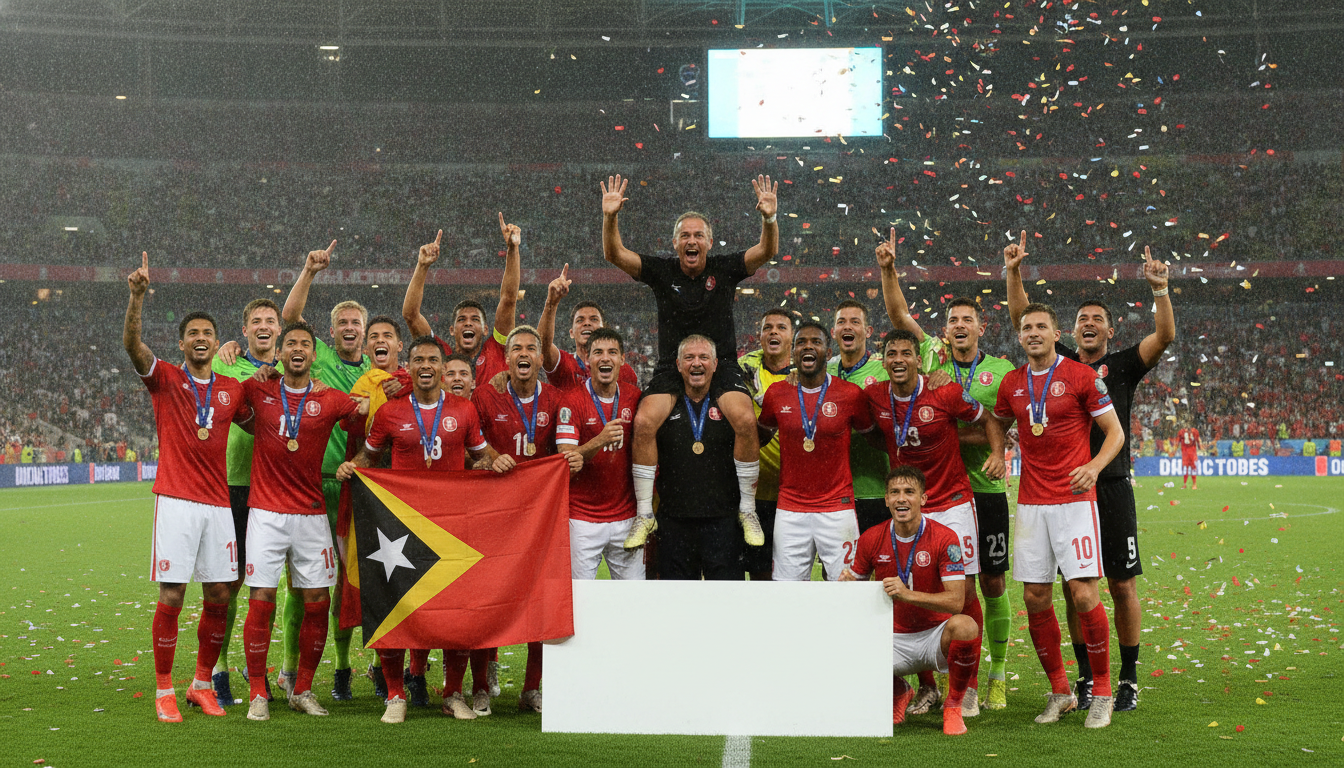
Federation officials have confirmed a small delegation will accompany the team to the competition hubs, including medical personnel and tactical analysts. Photo and media duties have been coordinated through the national federation, which provided official imagery for the squad announcement. The federation’s communications plan aims to keep supporters informed through regular updates as the campaign progresses.
Timor-Leste’s squad announcement comes at a pivotal moment for the team as it seeks to convert recent momentum into meaningful performances on the regional stage.
The squad list and coaching decisions reflect a pragmatic plan by Jose Pedro Alves Salazar to mix experience with attacking options, while the group draw sets up a stern test against Vietnam, Indonesia and Singapore. Fans and observers should expect a disciplined Timorese side focused on compact defending, quick transitions and measured attacking rotations during the ASEAN Hyundai Cup 2026.