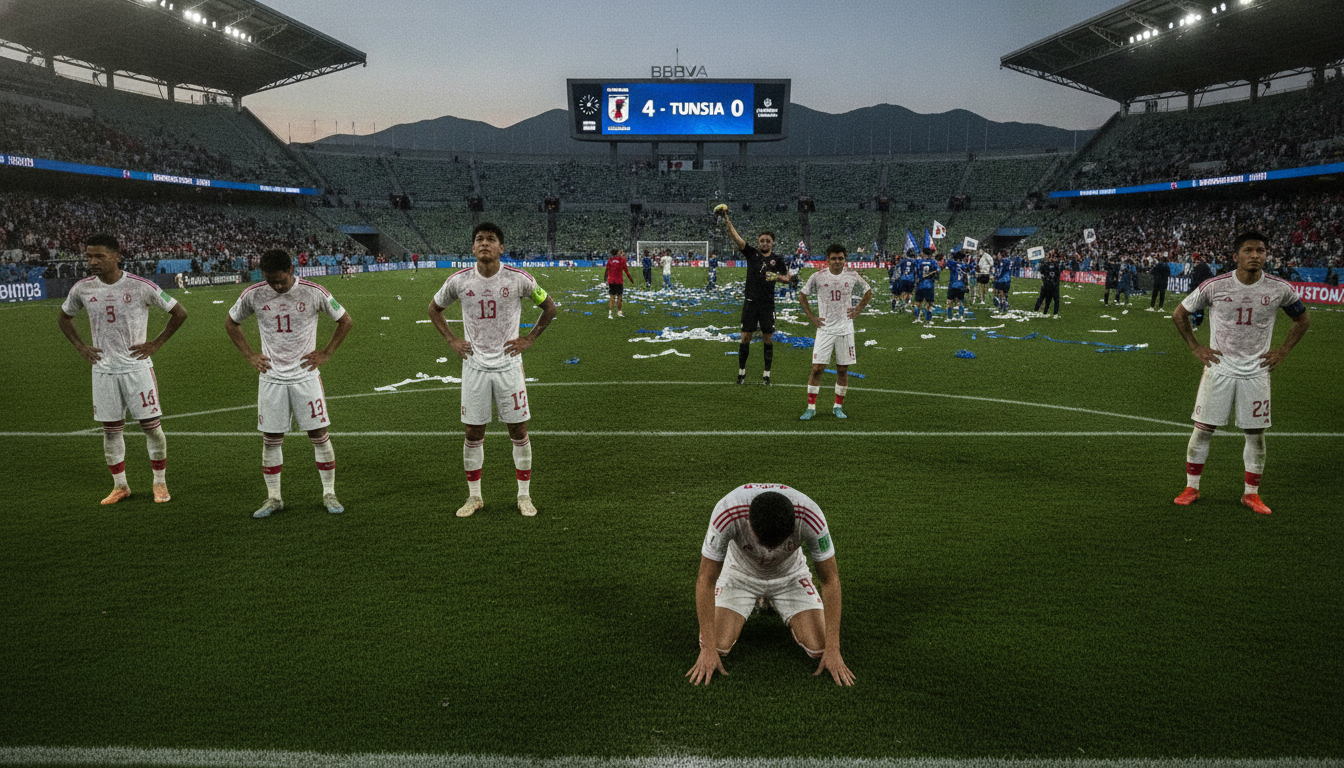
Tunisia eliminated from FIFA World Cup 2026 after Japan rout in Monterrey
Tunisia eliminated from FIFA World Cup 2026 after a 4-0 loss to Japan in Monterrey, with Daichi Kamada, Ayase Ueda and Junya Ito on the scoresheet in Group F.


Japan moved within touching distance of the last 32 as they hammered Tunisia 4-0 in Monterrey on June 21, a result that confirmed Tunisia’s exit from the 2026 FIFA World Cup. The win marked a decisive response from Japan after their opening draw and extinguished Tunisia’s hopes with one group game remaining. (tap.info.tn)
Match outcome and immediate consequence
Japan produced a comprehensive performance to secure a 4-0 victory that left Tunisia without a point after two group matches. The result mathematically eliminated Tunisia from progression in the expanded 48-team tournament and left their final fixture as a formality. (tap.info.tn)
The match in Monterrey also carried wider significance for Japan, who not only improved their position in Group F but did so in emphatic fashion. The clean sheet and four-goal margin underlined Japan’s attacking cohesion and defensive control on the night. (the-afc.com)
Goalscorers and decisive moments
Daichi Kamada opened the scoring inside the fourth minute with an early strike that set the tone for Japan’s dominance. Ayase Ueda added a second before half-time and capped the victory with a header late in the second half, while Junya Ito also found the net midway through the second period. (tap.info.tn)
The timing of the goals proved vital: an immediate early blow, a second before the break to take control, and further strikes after the interval to prevent any Tunisian recovery. Japan’s transitions and finishing were clinical, leaving Tunisia chasing a game they did not control. (sportsmole.co.uk)
Group F standings reshaped
The result reshuffled the Group F picture and tightened the race for the top two places. Japan’s victory moved them level on points with the Netherlands at the top of the group while Sweden remained in contention with three points from their opening win. Tunisia, by contrast, sit bottom of the group with zero points and an uphill task in their final match. (goalradar.org)
With two matchdays complete, goal difference and form have become central factors in what is shaping up to be a competitive final round. Both Japan and the Netherlands will enter the last round knowing results and margins could decide which side takes top spot in the section. (goalradar.org)
Tactical analysis: how Japan dominated
Japan’s victory was built on disciplined pressing and rapid forward movement that exploited Tunisia’s midfield gaps. The Samurai Blue turned turnovers into swift attacking phases, with wide movement and angled runs creating the spaces that led to their early and repeated strikes. (sportsmole.co.uk)
Tunisia struggled to regain control once Japan had established momentum, and individual errors compounded their difficulties. Japanese composure in possession and the ability to sustain attacking sequences left Tunisia vulnerable to both early counters and set-up plays, a pattern commentators highlighted in post-match analysis. (sportsmole.co.uk)
Significance beyond the result
The match in Monterrey also carried symbolic weight: it was reported as the 1,000th game in World Cup history, adding a historical footnote to Japan’s emphatic performance. That context amplified the significance of a four-goal win and provided a platform for Japan to assert continental pride on the global stage. (bdnews24.com)
For Tunisia, the defeat will prompt urgent reflection. The team arrived at the tournament with different expectations and leaves before the final matchday, raising questions about selection, tactics and preparations that the federation and coaching staff will need to address. (vavel.com)
What the final round holds for Group F
Attention now turns to the final round of group games, where each result will determine which two teams advance. Tunisia are scheduled to meet the Netherlands in their last Group F fixture on June 26, while Japan will face Sweden in the corresponding match, with qualification scenarios hinging on points, goal difference and head-to-head criteria. (101greatgoals.com)
That fixture list ensures an intense last matchday in Group F, with the Netherlands and Japan both in position to take control if they secure favorable results. For Sweden, their earlier win keeps them very much in the hunt and means all three chasing nations still have pathways to the knockout phase. (goalradar.org)
Reactions and immediate fallout
Responses from the Tunisian camp were muted and focused on explaining defensive lapses and missed opportunities rather than celebrating moments of individual quality. Media and analysts have pointed to a mixture of tactical errors and concentration lapses as key contributors to the heavy defeat. (sportsmole.co.uk)
Japan’s dressing room reaction was measured, with players and staff noting the importance of maintaining focus as the tournament progresses. The win bolstered Japan’s confidence and posture in the group, while also increasing pressure on their final opponents to respond. (the-afc.com)
Tunisia’s campaign ends with unanswered questions about squad balance, in-game management and the adjustments required if the nation hopes to return stronger to future tournaments.