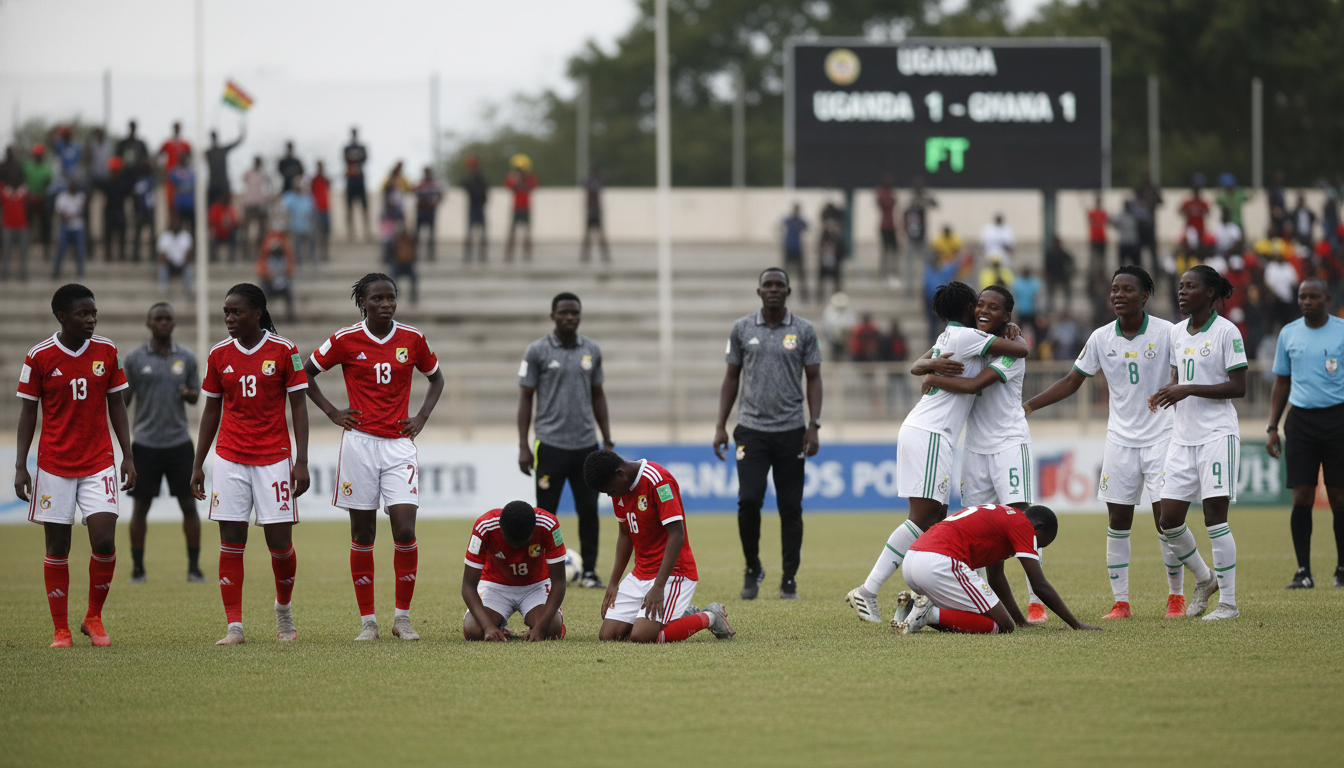
Uganda U-20 women eliminated as Ghana advance after 1-1 draw at FUFA Stadium Kadiba
Uganda U-20 women saw their FIFA U-20 Women’s World Cup hopes end after a 1-1 home draw with Ghana, losing the two-legged tie 3-2 on aggregate in a tense return leg at FUFA Stadium Kadiba.


The Uganda U-20 women began the return leg with urgency and secured an early breakthrough when Sylvia Kabene struck in the seventh minute, leveling the aggregate score and igniting the home crowd. That early goal briefly swung momentum in the Queen Cranes’ favour and set up an intense second half where both teams searched for the decisive margin. Ghana’s Black Princesses, however, held firm under pressure and responded late to regain the aggregate advantage and clinch qualification. The result ends Uganda’s campaign but leaves tangible positives to build on for the national youth programme.
Kabene’s early strike lifts home crowd
Sylvia Kabene stunned the visitors by finding the net inside the opening ten minutes, a strike that brought the aggregate level and sent the supporters into fevered appreciation. The early goal forced Ghana to readjust tactically and defend deeper as Uganda pressed in numbers to convert momentum into a match-winning lead. For long stretches after the opener the Queen Cranes sustained pressure with organized runs and quick transitions, probing Ghana’s backline and looking for gaps. The early breakthrough illustrated the attacking intent and ambition of the Uganda U-20 women, who began the game believing qualification was achievable.
The positive start reflected weeks of preparation and a willingness to take the game to a traditionally strong West African side. Uganda’s midfield rotation and forward movement tested Ghana’s discipline and required resilient defending to repel repeated incursions into penalty areas. Although the visitors did not concede again, the early phase showed Uganda’s capacity to create high-quality opportunities against elite youth opposition. That opening spell will be cited by coaches and analysts as proof the squad can compete under pressure when game plans are executed.
Red card shifts numerical balance but not the result
The contest took another dramatic turn in the 69th minute when Ghana’s Margaret Agyapong received a red card, reducing the visitors to ten players and handing Uganda a numerical edge. The dismissal arrived at a pivotal moment with the aggregate score still finely poised, and the Queen Cranes immediately sought to exploit the extra space. Uganda increased tempo, committed more players forward and launched a sequence of half-chances that tested Ghana’s increasingly compressed defence.
Despite the numerical advantage, Uganda struggled to fashion a clear, match-clinching opportunity inside the penalty area, often finding the final pass or touch missing in crowded spaces. Ghana, compact and disciplined, absorbed pressure and sought to hit on the counter when possible, showing tactical maturity beyond their reduced numbers. The red card created a pronounced tactical battle — Uganda’s urgency versus Ghana’s resilience — and ultimately set the stage for the decisive moments later in the half.
Owusu’s late goal restores Ghana’s advantage
In the 78th minute Linda Owusu produced the match’s pivotal moment, converting to restore Ghana’s aggregate lead and extinguish Uganda’s hopes of a late turnaround. Owusu’s strike arrived against the run of sustained Ugandan possession and demonstrated clinical opportunism from the visitors. The goal altered the tie’s complexion instantly, turning prolonged home pressure into a salvageable victory for Ghana and leaving Uganda with a narrow deficit to chase in the final minutes.
Following the equaliser, Ghana retreated into an organized defensive shape that limited clear-cut chances for the Queen Cranes in the closing stages. Uganda’s attempts to reassert control were met with staunch defending and smart game management by the Black Princesses, who prioritized protecting their aggregate advantage. The late goal underscored the fine margins that decide knockout ties and highlighted Ghana’s capacity to produce decisive actions at critical moments.
Aggregate picture and qualification consequences
The two-legged showdown finished 3-2 on aggregate in favour of Ghana, whose Black Princesses progress to the next stage and preserve their spot in the FIFA U-20 Women’s World Cup pathway. Across both fixtures the tie was tightly contested, with momentum swinging between the teams and only a single goal separating them on the balance sheet. For Uganda, the aggregate defeat ends a campaign defined by combative performances, tactical growth and individual moments of quality against strong opposition.
Ghana’s progression speaks to the depth and experience in their youth setup and their ability to manage knockout pressure, particularly away from home. The tie will be added to match portfolios used by both federations to assess player development, scout talent and measure the effectiveness of youth programmes. While advancement benefits Ghana’s immediate international schedule, Uganda’s narrow elimination will likely act as a catalyst for introspection and targeted adjustments in the months ahead.
Takeaways for the Uganda U-20 women programme
Although the Queen Cranes’ World Cup bid ended in heartbreak, there are clear takeaways that can inform future planning and player development across the youth pathway. The team demonstrated attacking intent and technical ability, highlighted by early moments of incisiveness and sustained periods of control. Tactical discipline and physical conditioning were evident, particularly in the way Uganda pressed and created overloads on the flanks during sustained spells.
Areas for improvement are equally clear: finishing under pressure, composure in congested final-third scenarios and converting numerical advantages into goals. Those marginal gains often determine outcomes at international youth level and should be a focus for coaching staff during the next training cycle. The match also revealed promising individual performers whose progression to higher age groups or the senior national team could be accelerated with competitive exposure and targeted mentorship.
Next steps for players, coaches and the federation
In the immediate aftermath the focus for players and technical staff will be recovery, review and a return to structured development work to convert lessons into results. Individual video analysis, increased set-piece work and situational drills designed to replicate late-game scenarios will be practical steps to address identified weaknesses. The federation’s role will be to ensure continuity through competitive fixtures, scouting opportunities and access to high-level training environments that can narrow the gap with established youth powers.
Longer term, investment in coaching education, talent identification across regions and stronger links between club and national setups will be essential to translate short-term promise into sustained international success. Exposure to regular international friendlies and tournaments will also build resilience and give players the repeated pressure situations they need to mature. For a generation motivated by near-miss experience, structured support and clear pathways can turn this campaign’s disappointment into a foundation for future triumphs.
Despite the sting of elimination, the performance at FUFA Stadium Kadiba contained evidence of progress that the Uganda Football Association can harness. The players showed competitive temperament and tactical awareness against a formidable opponent, suggesting several members of this U-20 cohort can become assets for the senior national team if nurtured correctly. Maintaining momentum, even in defeat, will be a test of institutional commitment and player determination in equal measure.
The Queen Cranes leave the qualifiers with their reputation enhanced by grit and competitiveness, and while the FIFA U-20 Women’s World Cup dream ends for now, the experience gained on the international stage offers a roadmap for growth. Continued focus on finishing, strategic squad-building and increased competitive opportunities will be critical as Uganda seeks to convert promising youth displays into sustained success. The journey continues for the players and coaches who will use this campaign as a learning milestone on the long road toward global tournaments.