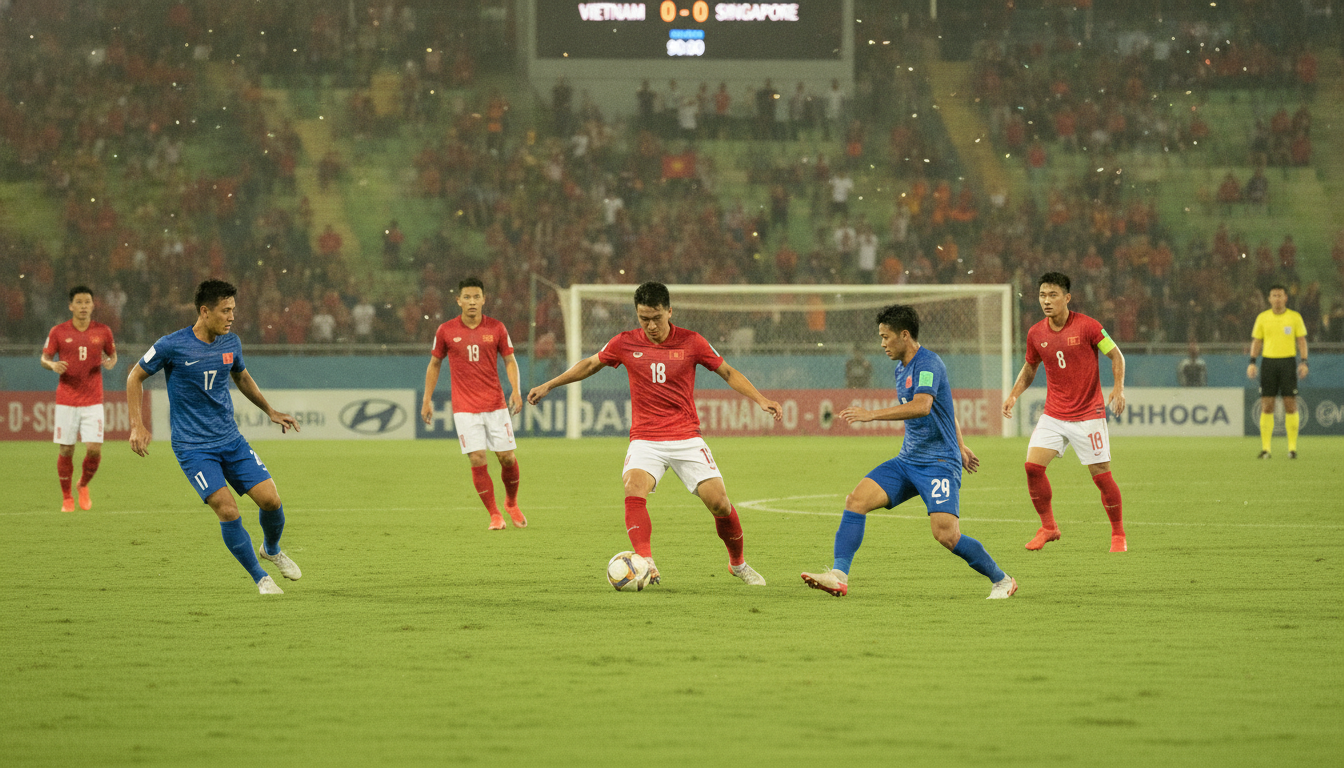
Vietnam vs Singapore 0-0: Hosts waste chances as Izwan Mahbud and Singapore defence secure stalemate in Hanoi
Vietnam vs Singapore ends 0-0 in Hanoi as hosts dominate but squander chances; Izwan Mahbud and resilient Singapore defense keep them top of Group A. So far


Vietnam vs Singapore finished 0-0 at Mỹ Đình National Stadium on July 31, 2026, after a match in which the hosts dominated possession but repeatedly failed to convert clear opportunities. The draw left Singapore top of Group A with seven points from three matches while Vietnam sit third on four points, and Indonesia remain a point behind Singapore. The match underscored Vietnam’s profligacy in front of goal and highlighted Singapore’s organised defensive structure and Izwan Mahbud’s key saves.
Hosts control early possession but fail to finish
Vietnam dictated the tempo for long spells, particularly across the opening 45 minutes, outpassing and pressing Singapore into a defensive posture. Nguyễn Đình Bắc, Trương Tiến Anh and Nguyễn Hoàng Đức combined frequently in advanced areas, creating multiple chances that failed to find the net. Several efforts were pushed wide or over the crossbar, with Vietnam striking both uprights at different moments in the match. Despite territorial dominance, the home side could not produce the clinical finishing required to break a disciplined Singapore backline.
Nguyễn Đình Bắc produced the first serious attempt, forcing the Singapore defence to scramble before his effort ran into the side-netting. Trương Tiến Anh threatened from distance when his 20-yard strike took a deflection and was palmed away by Izwan Mahbud, underlining Singapore’s reliance on their goalkeeper’s reactions. Nguyễn Hoàng Đức tested the woodwork with a long-range effort that cannoned off the bar and away from danger. Vietnam’s threat from crosses and late runs into the box repeatedly drew openings that simply went begging.
Singapore hold firm and threaten on counters
Gavin Lee’s Singapore set-up prioritised compactness and quick transition moments, allowing them to absorb pressure without surrendering structure. The visitors invited pressure in midfield but maintained two disciplined lines that made central penetration difficult for Vietnam. On rare breaks, Singapore advanced rapidly through Kyoga Nakamura and Song Ui-young, creating moments that forced Vietnam to stay vigilant even while controlling possession. That balance between containment and counter-attacking discipline proved decisive in keeping the score level.
The clearest opportunity for Singapore arrived late in the second half when Jacob Mahler’s shot was parried by Vietnam goalkeeper Patrik Lê Giang and the rebound fell into a dangerous area. Ilhan Fandi and Shawal Anuar were in the right positions to capitalise, but the subsequent header was directed over the bar, denying the visitors a potentially match-winning goal. Shawal later forced a reflex save from Lê Giang with a deflected attempt, reinforcing how Singapore could have left Hanoi with all three points. Instead, the combination of Vietnamese pressure and Singapore’s narrow escapes produced a stalemate.
Key moments and missed chances that decided the match
The match featured several pivotal moments that swung momentum yet never produced a game-changing finish for either side. Vietnam hit the woodwork twice — first through Hoàng Đức’s long-range strike and later when Nguyễn Tài Lộc’s 20-yard drive crashed back off the crossbar. Those small margins highlighted the difference between a win and a draw for the hosts. Singapore’s best sequence, the late parried shot and headed miss, was equally decisive in denying them the lead, with both teams ultimately punished for a lack of composure in the final third.
Other notable chances included Nguyễn Xuân Son’s driven effort across goal and Nguyễn Thành Chung’s aerial threat from set plays, which repeatedly tested Singapore’s ability to defend high balls into the box. Izwan Mahbud’s saves and the defensive clearances that followed were integrated responses rather than isolated interventions, speaking to the collective defensive discipline executed by Gavin Lee’s side. The accumulation of these key events produced a match where quality finishing, not tactical deficiency, was the primary determinant of the outcome.
Tactical takeaways: shape, pressing and transitions
Tactically, Vietnam’s approach saw them press higher and attempt to overload Singapore’s defensive third, emphasising wide entries and late runs from midfielders. Kim Sang-sik’s side sought to stretch the pitch and create crossing opportunities, while also testing Singapore from distance. Singapore’s response was to remain compact, protect central channels and force Vietnam to rely on low-probability wide deliveries rather than clear cut chances through the middle. That game plan limited high-quality opportunities even as Vietnam controlled the ball.
On transitions, Singapore displayed patience, choosing selective moments to counter rather than gamble for early breaks. Kyoga Nakamura’s set-piece deliveries and Jacob Mahler’s late runs demonstrated the visitors’ intention to convert defensive solidity into scoring threats. Vietnam’s pressing line sometimes left space behind, which Singapore nearly exploited late, but the hosts’ possession retention kept their opponents under sustained pressure for extended periods. Both managers thus left with tactical notes: Vietnam for finishing and creativity in the final third, and Singapore for maintaining defensive cohesion under prolonged pressure.
Individual performances and Hyundai Player of the Match
Singapore captain Haris Harun was named Hyundai Player of the Match for his pivotal role in midfield, providing stability, interceptions and leadership across 90 minutes. His positional discipline allowed Singapore to transition smoothly from defence to attack and limited the influence of Vietnam’s deeper midfielders. Izwan Mahbud’s shot-stopping and timing of interventions were equally crucial, as he negated several well-struck attempts and kept Singapore competitive on the road. Together, those performances formed the backbone of a visitor display that prioritised organisation and risk management.
Vietnamian attackers showed industry and fluency but lacked the cutting edge required in the final third to convert promising moves. Nguyễn Đình Bắc and Nguyễn Xuân Son both had moments of genuine danger, yet finishing and decision-making inside the box proved inconsistent. Defensively for Vietnam, Nguyễn Thành Chung led several aerial clearances and blocked efforts that would have allowed Singapore to exploit counter openings sooner. Patrik Lê Giang’s reflexes on the late Mahler shot also prevented a goal that could have swung the standings.
Standings impact and Group A implications
The goalless draw left Singapore with seven points from three matches, maintaining a slender lead at the top of Group A. Indonesia sit one point behind Singapore after their matches, while Vietnam remain third on four points with two matches played. Those standings create a compact group table where outcomes over the next rounds will be decisive for qualification prospects and group leadership. The parity in results also means goal difference and finishing quality will likely play a role as teams jostle for the top spots.
Vietnam and Indonesia face a direct confrontation on Monday, August 3, 2026, in Bogor, a match that could redefine Group A’s hierarchy and directly impact Vietnam’s path from third place. For Singapore, the focus shifts to maintaining defensive consistency while seeking points in their remaining fixtures to protect their narrow lead. Each team will review video evidence and match data to refine finishing in the final third and improve set-piece conversions, variables that could determine who advances as frontrunner from this tightly contested group.
Vietnam’s inability to score at home will be scrutinised by Kim Sang-sik and his coaching staff, who must find ways to turn possession dominance into tangible results. Meanwhile, Gavin Lee will take encouragement from his side’s defensive organisation but will likely demand greater clinical quality in attack before facing the next set of opponents. Both camps now face quick tactical and psychological preparation ahead of matches that could significantly shift Group A dynamics.
The stalemate at Mỹ Đình highlighted familiar tournament themes: pressure on favourites, the premium on defensive organisation, and how single moments can define qualification pathways. Vietnam’s home frustrations and Singapore’s disciplined resistance produced a match where the final table remains open and upcoming fixtures carry added significance.