2026 World Cup: Six European Sides Join Argentina and Morocco in Quarter-finals
2026 World Cup quarter-finals: six European teams, plus Argentina and Morocco, remain. Expansion added entries but champions come from Europe and South America.
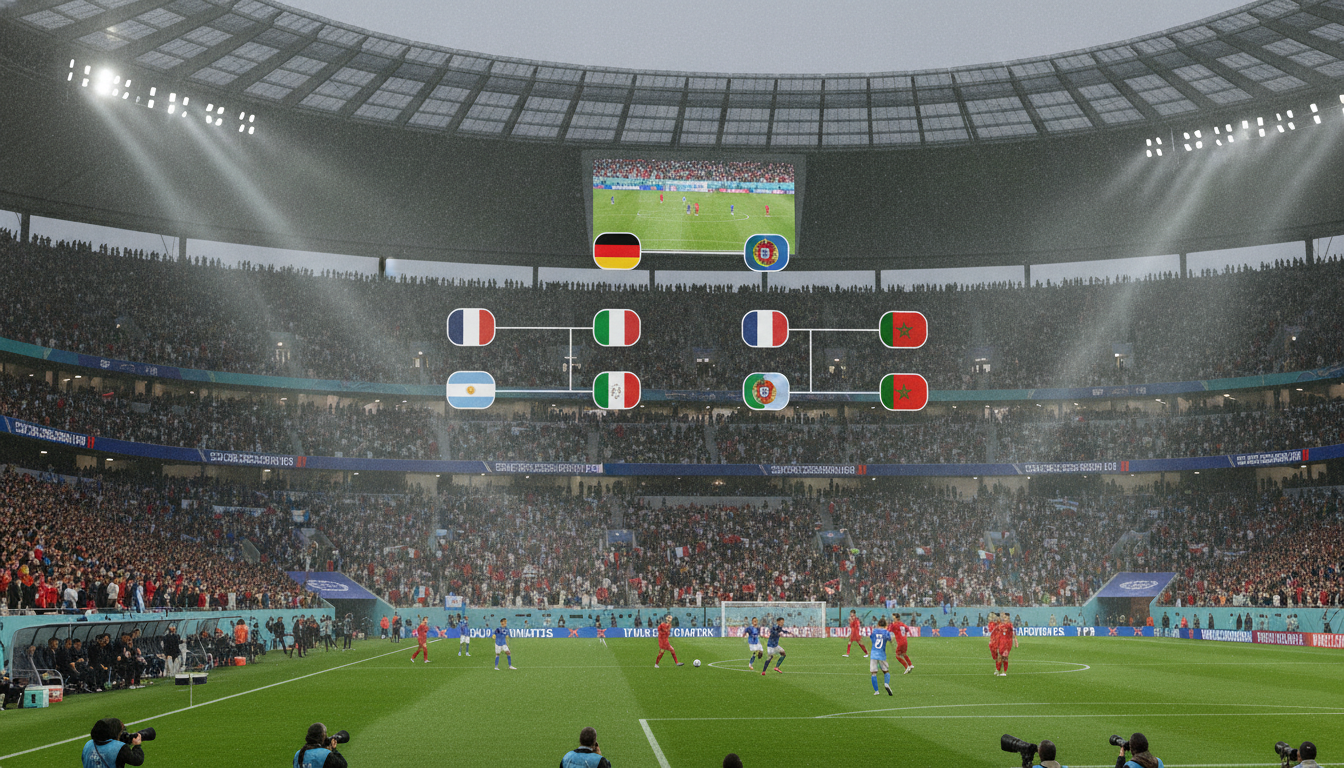
The 2026 World Cup has narrowed from an expanded field of 48 teams to an eight‑team quarter-final stage, with European sides occupying the majority of the remaining slots. Argentina, the defending champions led by Lionel Messi, and Morocco stand out as the only non-European representatives left in the competition. The composition of the last eight underlines a familiar competitive pattern even as the tournament’s footprint has grown.
Quarter-final makeup highlights European dominance
France, Spain, Belgium, England, Norway and Switzerland make up six of the eight quarter-finalists, underscoring the depth of European national teams at this World Cup. Those nations bring a mix of established powers and emerging contenders, reflecting both long-standing football infrastructures and recent tactical evolutions at club and national levels. The presence of these sides raises the prospect of an all‑European semi-final line-up, a scenario that has precedent in recent tournaments.
Argentina’s place in the last eight preserves South America’s stake in the title race, while Morocco carries the flag for Africa as the continent’s lone remaining team. The aggregate picture is stark: since the competition began in 1930, the world champions have come exclusively from Europe or South America. That historical trend continues to shape expectations in the knockout phase.
Expansion increased access but not the champion map
The 2026 tournament, featuring 48 teams for the first time, was billed as an opportunity to broaden global participation and give more countries experience on football’s biggest stage. Increased representation delivered a more varied group-stage tableau, with more nations afforded the chance to compete in a World Cup finals. Yet the knockout field shows that expansion has not immediately altered the geography of championship contenders.
Structural factors such as professional league quality, player development pipelines and resource allocation continue to favor nations in Europe and South America. While the larger format has allowed additional teams to showcase talent and upset expectations, the pathways to ultimate tournament victory still appear to run through established football powerhouses. The 2026 quarter-finals offer a reminder that access and elite competitiveness are distinct challenges.
Morocco remains Africa’s best chance to break the mould
Morocco’s run to the quarter-finals positions the North African side as the tournament’s leading representative of African football. The team’s progress has been built on defensive organization, disciplined structure and a capacity to produce decisive moments in tight matches. If Morocco can navigate the next rounds, it would extend a recent pattern of African nations reaching deeper stages, even if a title has yet to be secured by the continent.
The challenge ahead for Morocco is steep: knockout football at this stage often rewards tactical nuance and squad depth, areas where many European and South American teams still hold an advantage. Nevertheless, Morocco’s presence is significant for its potential to inspire other African federations and to demonstrate that progress on the international stage can be achieved without the scale of resources available to some rivals.
Argentina and Messi sustain South American pedigree
Argentina’s place among the final eight keeps South America firmly in the hunt for back‑to‑back titles. As defending champions, the Albiceleste arrive with experience of winning a recent global tournament and with players accustomed to high‑pressure knockout fixtures. Lionel Messi’s continued influence on and off the pitch provides a focal point for Argentina’s campaign, even as national team dynamics evolve around him.
South American football’s historical pedigree at the World Cup is evident in its balance of technical skill, competitive intensity and strong coaching traditions. Argentina’s survival to the quarter-finals preserves a continental pathway to the trophy, a route that has historically alternated with European dominance but remains central to the tournament narrative.
European depth driven by club systems and coaching ecosystems
The heavy European representation in the last eight reflects decades of investment in youth academies, advanced coaching education and competitive domestic leagues that feed national teams. Many European players benefit from year‑round exposure to top-level club competition, which can sharpen tactical awareness and match readiness for major tournaments. That structural advantage manifests in a larger pool of players capable of performing in knockout situations.
Tactical diversity among the European quarter-finalists is notable, with teams deploying varying formations and strategic approaches shaped by their domestic experiences. The cross‑pollination between club and international football in Europe creates a feedback loop that helps national coaches adapt quickly, a factor that can be decisive in tightly contested knockout fixtures. This ecosystemic strength helps explain why European sides frequently feature prominently in the latter stages.
Remaining weeks will likely reaffirm historical patterns
With only two rounds left to determine a champion, conventional wisdom points toward a winner from Europe or South America unless Morocco engineers a sequence of surprise outcomes. The World Cup’s century‑long record, in which all winners hail from those two continents, establishes a strong historical precedent that remains intact through this edition’s quarter-finals. The expanded field has diversified competition but not yet disrupted the continent-of-origin trend for champions.
How the tournament unfolds will depend on matchups, form, and tactical matchups over the final two weeks, as well as the physical and mental resilience of squads facing successive high‑intensity games. Injuries, suspensions and momentary lapses can still reshape expectations, and knockout football has produced its share of shocks. Yet the statistical and institutional advantages enjoyed by European and South American teams make them the likeliest candidates for the final.
The 2026 World Cup’s next phase will test whether the expanded format can produce an unexpected champion or whether history’s pattern will prove durable. The quarter-final lineup sets the stage for high-stakes matches that will determine whether the continent-centric dominance in world football is reaffirmed or tested by a breakthrough run from outside the traditional power blocs.