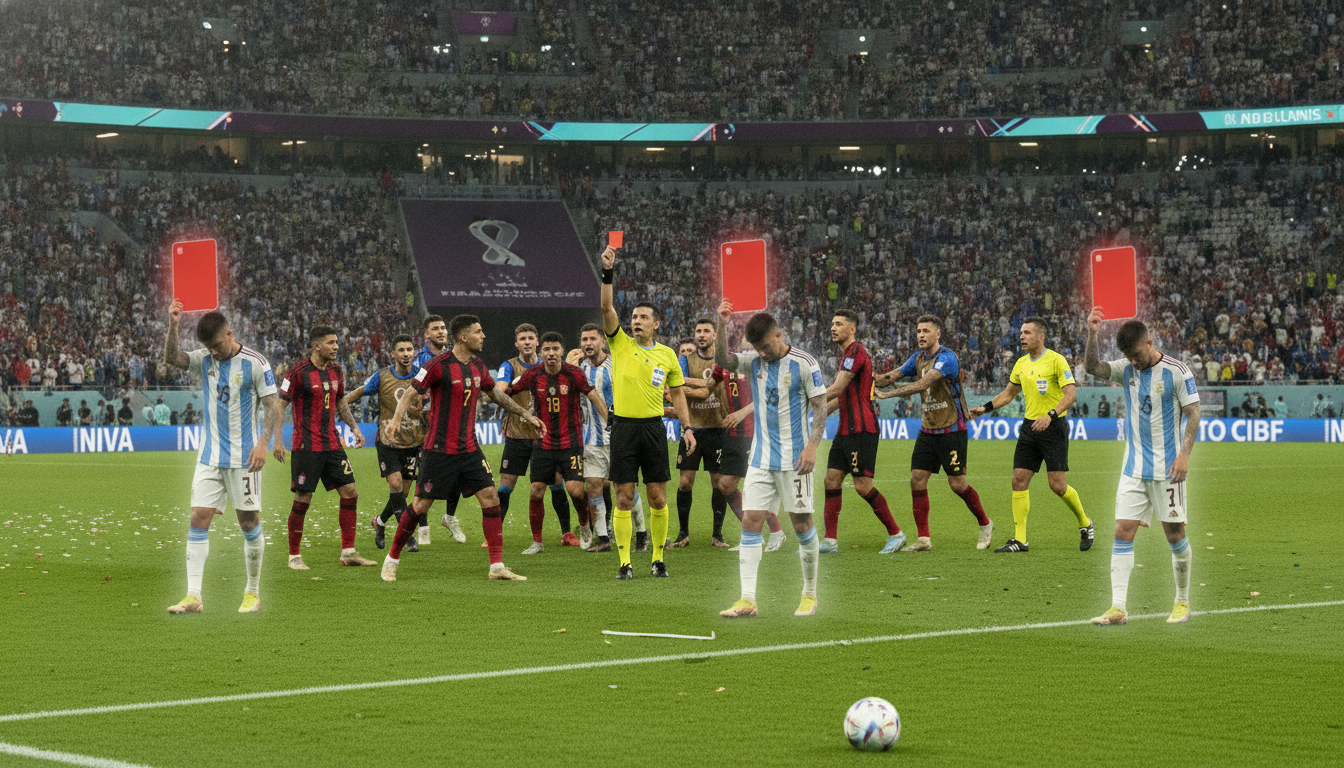
2026 World Cup opening day delivers drama as three red cards and Hwang In-beom stunner steal the show
Opening day of the 2026 World Cup produced three red cards in Mexico v South Africa, Hwang In-beom’s brilliant goal and refereeing controversy and debates.

The 2026 World Cup began with drama on and off the pitch as opening fixtures delivered a mix of spectacle and controversy. Mexico’s match with South Africa became the main talking point after referee Wilton Sampaio issued three red cards, while South Korea’s 2-1 win over the Czech Republic was highlighted by Hwang In-beom’s stunning finish. With 101 matches and 37 days remaining before the final in New Jersey, the tournament’s tone has been set early.
Red cards dominate opening fixture
The opening match between Mexico and South Africa was overshadowed by disciplinary action when referee Wilton Sampaio sent off three players. The speed and severity of the decisions sparked immediate debate among fans, pundits and former players about the enforcement of conduct at the tournament.
Such a flurry of dismissals on the opening day has raised questions about whether referees will adopt an uncompromising approach through the remaining fixtures. Tournament organizers and officiating bodies face early scrutiny to ensure consistency in applications of the rules.
Hwang In‑beom’s finish sets early benchmark
South Korea’s attack found a highlight reel moment when Hwang In-beom produced a sublime finish to help secure a 2-1 victory over the Czech Republic. The strike was widely hailed as a contender for goal of the tournament and offered an early reminder of the individual quality on show at this World Cup.
Hwang’s goal also delivered a morale boost for South Korea and provided the type of moment that can define group-stage momentum. Coaches and analysts will now study the build-up and technique that created such a decisive contribution.
Historical context fuels refereeing debate
The three red cards on matchday one revived comparisons to past tournaments, particularly the 2006 World Cup in Germany when a record 28 players were sent off across the competition. That tournament’s high tally was remembered for several volatile confrontations and heavy disciplinary measures.
By contrast, World Cups in 1950 and 1970 were notable for having no sendings-off at all, reflecting how the sport’s disciplinary standards and interpretations have evolved. Officials, teams and governing bodies are now navigating expectations shaped by decades of changing rules and technology.
Impact on Mexico and South Africa’s group prospects
Mexico and South Africa will have to assess the fallout from the opening match as they plan for the remainder of the group stage. Suspensions and altered team dynamics following red cards can shift immediate tactics and personnel choices for upcoming fixtures.
Coaching staffs are likely to emphasize discipline in training and adjust strategies to compensate for absent players. The early disciplinary issues underline how quickly group calculations can be affected by single-match events.
Off-field spectacle and the return of familiar faces
Beyond the on-pitch incidents, the tournament’s opening day offered off-field moments that captured global attention. The return of high-profile performers contributed to the spectacle surrounding the start of the 2026 World Cup and reinforced the competition’s role as a cultural as well as sporting event.
Such non-sporting elements amplify the tournament’s profile and influence public conversation, but they also sharpen focus on the matches themselves as attention fluctuates between entertainment and competition.
What referees, teams and fans should expect next
As the tournament progresses, referees will be under pressure to strike a balance between protecting players and allowing the game to flow. Teams that prioritize discipline and adaptability will be better placed to navigate suspensions and contentious decisions.
Fans can expect continued debate over officiating calls, especially given the global scrutiny that comes with every World Cup match. Governing bodies may feel compelled to issue clarifying guidance to referees to promote consistency.
The opening day of the 2026 World Cup combined high-quality football with contentious decisions that will ripple through the group stage. With 101 matches to come and the final scheduled in New Jersey, teams and officials will be working to manage the fine line between strict enforcement and preserving the spirit of the game as the tournament unfolds.