Black Queens fall 1-0 to Cameroon at 2026 CAF Women’s AFCON; must beat Mali to keep hopes alive
Black Queens lose 1-0 to Cameroon at the 2026 CAF Women’s AFCON after a first-half penalty; Ghana must beat Mali in final Group C match to stay alive.

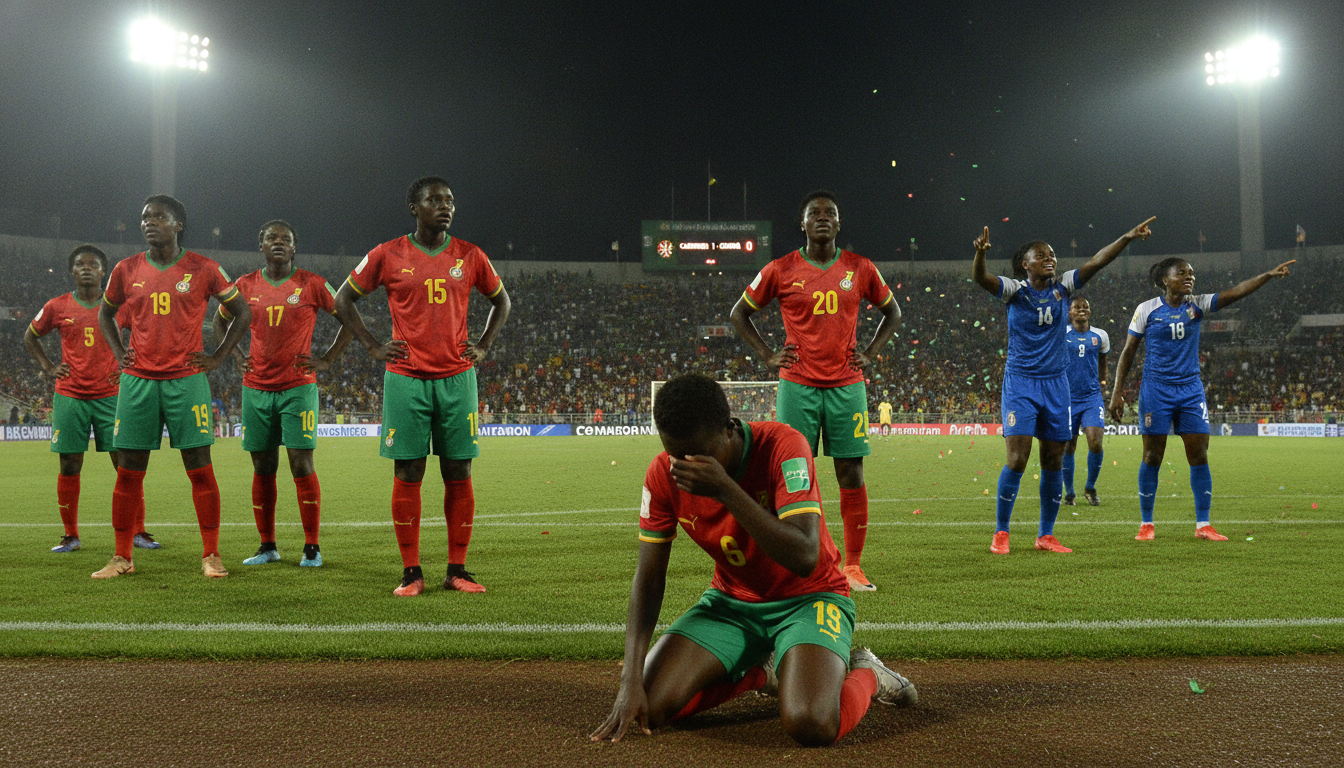
The Black Queens were defeated 1-0 by Cameroon in the second Group C match at the 2026 CAF Women’s Africa Cup of Nations on Sunday, with the only goal coming from a first-half penalty.
Ghana began the game with bright possession and several promising sequences, but the early set-back left the team chasing the match for the remainder of the 90 minutes.
Despite increased urgency after the break and a string of attacking phases, Coach Kim Lars Björkegren’s side could not find the equaliser and must now approach the final group fixture against Mali as a must-win.
Decisive Moment: Penalty Shapes the Match
The match’s turning point arrived in the first half when the referee awarded a penalty to Cameroon, a decision that produced the game’s only goal.
That moment altered the rhythm of the contest and forced Ghana to adjust its approach for the remaining minutes.
From that point on, Cameroon adopted a more conservative posture designed to protect their lead, while the Black Queens were left to probe for openings and create scoring opportunities.
First Half: Control Without a Cutting Edge
Ghana started strongly, controlling possession and moving the ball through midfield with purpose in search of early pressure.
The Black Queens managed several promising attacks but lacked the decisive final pass or shot to convert possession into a lead.
When the penalty was awarded against Ghana, the balance of the half shifted and Cameroon were able to play with the confidence that comes from being ahead.
Second Half: Positive Response but Missed Chances
After the interval, the Black Queens came out with renewed urgency and intent to restore parity on the scoreboard.
Ghana’s forwards and wide players combined to create several entries into the final third, producing shots and crosses that tested the Cameroonian defence.
Despite the encouraging attacking phases and a visible intensity from the substitutes, clear-cut chances were limited and the finishing touch was repeatedly absent.
Tactical Adjustments and Substitutions
Coach Kim Lars Björkegren made tactical changes intended to increase attacking momentum, introducing players who offered pace and directness in the final third.
Those adjustments briefly unsettled Cameroon and led to improved territorial control for Ghana, but the changes did not yield a goal.
The substitutions emphasized an intent to stretch the opposition and manufacture high-quality opportunities rather than rely solely on sustained possession.
Cameroon’s Defensive Discipline and Game Management
Cameroon defended with discipline and organization, often compacting space through the middle and forcing Ghana to work wide.
Their backline and midfield pairing showed effective communication, closing passing lanes and clearing danger when necessary.
Once in possession, Cameroon also demonstrated a pragmatic ability to retain the ball and run down time without compromising the defensive structure that protected their slender lead.
Set Pieces and the Search for a Way Through
Ghana’s set-piece deliveries and crosses into the box became focal points in the closing stages as the team searched for an equaliser.
While several service attempts troubled the Cameroonian defence, the final touches—headers or composed finishes—were either narrowly off target or cleared by defenders.
The failure to capitalise on dead-ball situations underlined one of the margins that separated the sides on the day.
Implications for Group C and Qualification Scenarios
The loss leaves the Black Queens in a precarious position within Group C and increases the pressure heading into their final match against Mali.
Mathematically, Ghana still retains an opportunity to progress, but the margin for error has narrowed and the team will likely require a positive result coupled with favorable outcomes elsewhere to advance.
The result also places greater importance on goal management and tactical clarity for the remainder of the group stage.
Mental and Physical Recovery Ahead of Mali
Recovering mentally from a narrow defeat will be as important as preparing tactically for the upcoming clash with Mali.
The players will need to refocus quickly, address finishing and decision-making in the final third, and maintain the defensive composure shown late in the game.
Ghana’s support staff and medical team will also play a role in ensuring fitness levels remain high for the decisive group fixture.
Coach Björkegren’s Challenge and Immediate Priorities
For Coach Björkegren, the immediate task is to reset the squad and identify small but impactful adjustments that can unlock a resolute defensive opponent.
The coach must balance urgency with discipline, encouraging a sharper attacking edge without exposing the team to counterattacks.
Tactical rehearsals will likely focus on set-piece routines, rapid transitions, and creating overloads in wide areas to force defensive reshuffling.
Fan Reaction and Broader Tournament Context
The performance showed encouraging elements—possession, phases of control and a determined second-half display—that supporters can build on.
However, in the high-stakes environment of a continental tournament, such positives must quickly translate into results or group-stage hopes can evaporate.
Across the wider competition, small margins have separated teams, and Ghana must convert lessons from this match into points.
Preparation Window and Scouting Mali
With limited recovery time before facing Mali, match preparation will hinge on video analysis, targeted training, and managing player workloads.
Scouting reports will shape a game plan that seeks to exploit identified weaknesses while neutralising Mali’s strengths.
Execution of set plays and sharper decision-making in the final third will be essential elements in any plan to secure the necessary result.
The Black Queens showed resilience and a clear attacking intent after conceding, but a single penalty proved decisive in a tightly contested Group C encounter that now sets up a consequential showdown with Mali.
Ghana must convert urgency into clinical execution if the team is to extend its stay in the 2026 CAF Women’s Africa Cup of Nations.