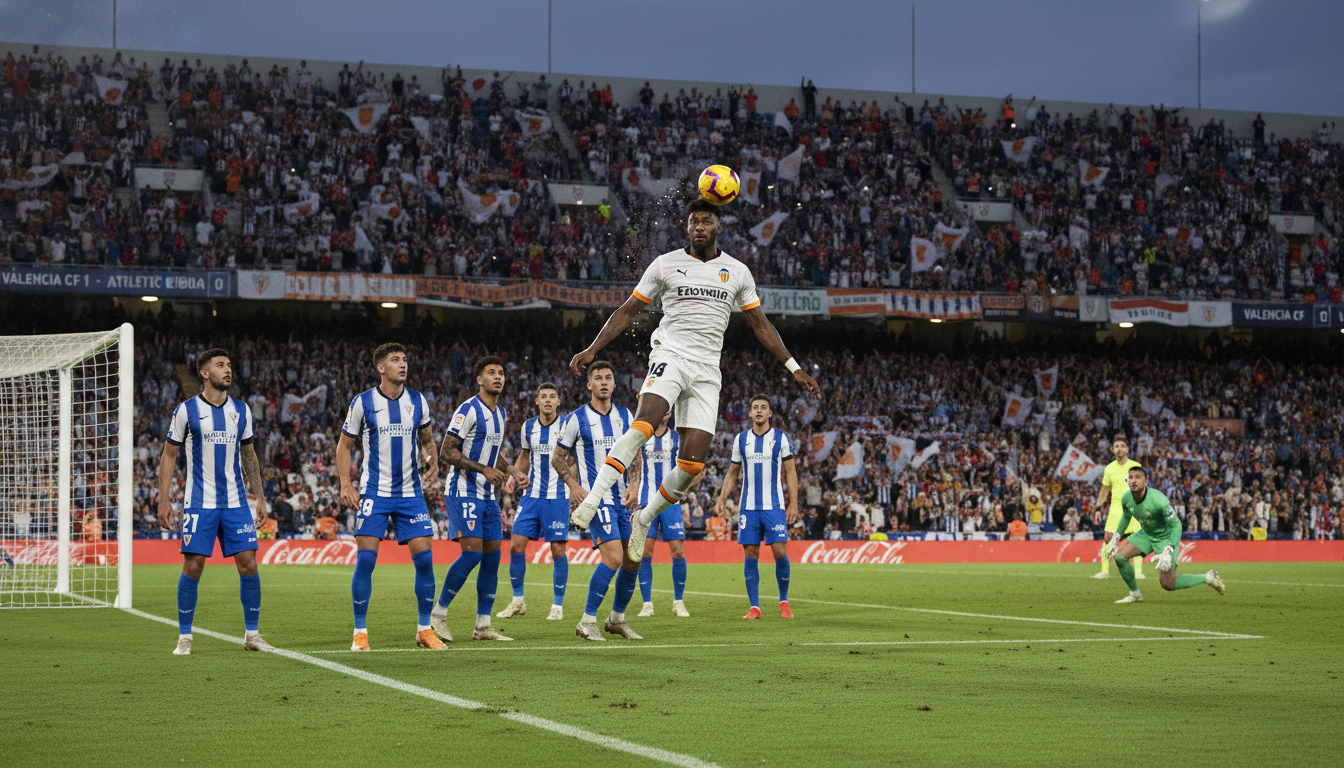
Umar Sadiq Rediscovers Scoring Touch with Two Headed Goals for Valencia
Umar Sadiq ends a 60-day scoring drought with headed goals for Valencia, rediscovering aerial form and adding a new dimension to the team’s attacking options.


Umar Sadiq snapped a 60-day goal drought with a headed equaliser in Palma before following it up with another header at Mestalla, a return to form that has reignited Valencia’s attacking conversation. The Nigerian striker’s recent headed finishes, rare across his career, came in consecutive fixtures and provided vital contributions as the club seeks momentum in the league. Sadiq’s resurgence has been notable not just for the goals themselves but for the method of delivery — two headers that highlighted timing, positioning and an emerging aerial reliability.
Sadiq ends 60-day drought with headed equaliser at Mallorca
The forward had not found the net since the February 15 derby with Levante, a span of roughly two months that had raised questions about his consistency in front of goal. He broke that run with a headed leveller at Son Moix, converting an unusual headed assist into a finish that changed the course of the match. That goal delivered immediate psychological lift, both for Sadiq individually and for a Valencia side that has been searching for attacking stability.
Sadiq’s equaliser in Mallorca arrived from a chaotic delivery that required concentration and decisive movement inside the box. The finish underlined his ability to make the right runs even when the ball takes unexpected trajectories. For a player whose career has often been defined by moments of brilliance and spells of quiet, the timing of this goal was important for restoring belief.
Second headed goal at Mestalla underlines aerial impact
In the next league outing at Mestalla, Sadiq doubled his tally of headed finishes when he rose to meet a quality cross from José Gayà and directed the ball home to make it 2-0. The sequence combined an accurate wide delivery with Sadiq’s quick reaction and head placement, producing a classic center-forward header. That strike reinforced the idea that his header against Mallorca was not a one-off lucky strike but the start of a pattern in the recent matches.
The Mestalla finish also demonstrated improved synchrony between the full-back supply and the striker’s movement, suggesting Valencia’s attacking patterns may be shifting to exploit aerial opportunities more frequently. For coaching staff and analysts, the two headers in close succession offer tangible evidence that Sadiq can be a focal point for crosses when the team commits to that approach.
Career profile shows headers are a minority of his goals
Across his senior career and including goals scored during late youth and development stages, Sadiq has amassed 141 goals from 2015 to the present, with only 19 of those coming via his head. That figure represents roughly 13.5% of his total goals, indicating that headed finishes have not historically been a dominant feature of his scoring repertoire. The recent spike in aerial goals is therefore noteworthy against a backdrop where most of his strikes have been composed with feet or from close-range poaching.
This statistical context does not diminish the value of headers when they arrive, but it does highlight how unusual this phase is for Sadiq. He has shown adaptability and an ability to find solutions in the penalty area, and the new-found efficiency with his head could expand his profile from a primarily ground-based threat to a more multi-dimensional forward.
How Valencia’s wide play has created headed chances
Valencia’s recent attacking sequences have placed more emphasis on wide overloads and early crossings, which naturally increase opportunities for aerial duels in the box. Gayà’s delivery at Mestalla and a nod-assisted sequence involving Javi Guerra in Palma underlined the importance of coordinated wing play and set-piece routine. Those patterns have allowed Sadiq to occupy high-value positions inside the six-yard area and attack the ball with relative freedom.
The coaching staff appear to be calibrating crossing frequency and precision to suit Sadiq’s strengths in body positioning and reach. When full-backs and wingers commit to high, driven or floated crosses with clear targets, a striker who times runs accurately can convert at higher rates. The two recent headers suggest Valencia are increasingly willing to use Sadiq as a predictable aerial outlet in the box, particularly against teams that concede space on the flanks.
Technical elements behind Sadiq’s recent headed finishes
Both headed goals shared common technical traits: early identification of space, a short first touch to adjust body shape, and decisive contact with the crown of the head to direct the ball low and on target. These fundamentals — timing, positioning and head placement — are standard for effective aerial finishing but are not always associated with Sadiq’s historical scoring style. The success of these elements in consecutive matches suggests deliberate work on those mechanics during training sessions.
In addition to technique, anticipation and reading of the flight of the ball were crucial. Sadiq’s ability to lose markers at the last moment and to attack the ball at its peak allowed him to convert crosses that might otherwise be contested or cleared. That blend of physical presence and timing can be especially productive when coupled with consistent high-quality deliveries from the wide players.
Tactical implications for Valencia’s remaining fixtures
Sadiq’s renewed aerial threat gives Valencia a broader set of tactical options in the run-in, especially in matches where breaking down compact defences on the ground has been difficult. Coaches can now mix approaches — alternating between low-driven combinations through midfield and targeted crosses to the striker — to keep opponents uncertain. This variety can also free up space for inside forwards and late-arriving midfielders as defenders are forced to respect Sadiq in the air.
Moreover, set pieces take on added importance. If Sadiq continues to win and convert aerial duels, corners and free-kick routines become higher-probability scoring situations. That potential uptick in set-piece efficiency could be decisive in tight matches where open-play opportunities are scarce. For Valencia, leveraging those moments effectively could influence league positioning and short-term morale.
Sadiq’s recent form also has selection implications. A striker who can score with his head allows the manager to consider specific formations or personnel pairings that enhance crossing lanes. That may bring increased minutes for overlapping full-backs or for wingers who are adept at whipping early crosses into the box. Tactical flexibility at this stage of the season can be a marginal but meaningful advantage.
What the streak means for Sadiq’s confidence and market profile
Scoring is as much psychological as technical, and the end of a prolonged shutout has an obvious confidence benefit. For a forward like Sadiq, who has oscillated between prolific runs and barren spells, breaking a drought with two headed strikes can ease mounting pressure and restore composure in tight penalty-area situations. Confidence can cascade into smarter movement, quicker decision-making and a better sense for when to influence play versus when to conserve position.
From a market and scouting perspective, a sudden uptick in aerial productivity may attract attention from clubs that value a target man or hybrid striker who combines pace with height. While single-game form is not conclusive, demonstrating the capacity to score in multiple ways enhances a player’s perceived versatility. For Valencia, retaining a rejuvenated Sadiq or highlighting his adaptability could become a talking point in contract and transfer discussions.
Umar Sadiq’s recent headed goals are a timely reminder that forwards can reinvent elements of their game through focused work and tactical adjustments. The two finishes, one earned in Palma and another at Mestalla, have given Valencia immediate returns and created questions about how the team will exploit this avenue further. If Sadiq sustains this form, his role as a primary attacking outlet will become harder for opponents to ignore.