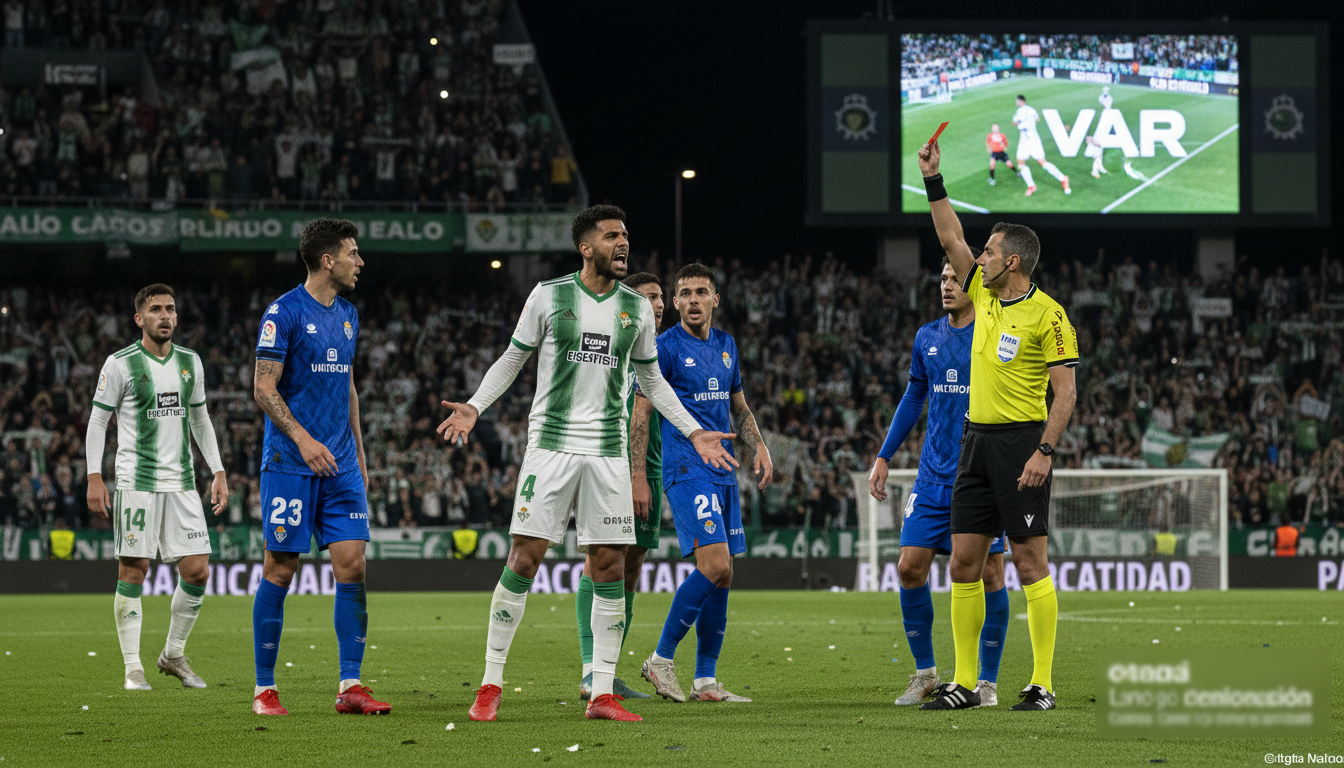
Amrabat red card ruling upheld by CTA after studs challenge in Betis v Oviedo
CTA officially says Sofyan Amrabat should have been sent off after a studs-on challenge on Thiago in Betis v Oviedo at La Cartuja; VAR did not recommend review.


The Technical Committee of Referees has concluded that Sofyan Amrabat should have received a straight red card for a studs-on challenge on Thiago during Betis v Oviedo at La Cartuja, a decision that spotlights VAR protocol and on-field discipline. The committee confirmed the match referee and the video assistant referee did not apply the appropriate disciplinary sanction despite the high intensity of the contact. This finding could prompt a disciplinary review and renewed scrutiny of how VAR teams handle incidents that occur as the ball leaves play.
CTA Determination and Key Findings
The CTA stated that the match referee and the VAR team reached an incorrect disciplinary outcome for the Amrabat incident, while agreeing with the technical call regarding a corner. The committee emphasized that the ball was beyond the line when contact occurred, which removed the option of awarding a penalty. However the CTA underlined that the position of the ball does not absolve a player of disciplinary responsibility. The panel concluded the studs-on contact endangered Thiago and met the threshold for violent conduct requiring a red card.
Description of the La Cartuja Incident
The incident took place in the 38th minute with Betis leading 1-0, when the midfielder launched into a challenge as Thiago contested possession near the byline. Match footage shows Amrabat’s studs striking Thiago’s ankle with significant force, producing a twisting motion that the committee described as endangering the opponent’s physical integrity. While broadcast angles left some ambiguity about the precise moment the studs made contact relative to the ball, the CTA judged the force and intent sufficient to merit an immediate sending off.
Referee and VAR Decisions on the Day
Referee Cordero Vega did not award a foul or show a card during the match, and after consulting with VAR assistant González Francés the on-field decision stood as a corner for Betis. The referee communicated to players that a penalty could not be awarded because the ball had already crossed the goal line, rendering it out of play. The committee accepted that the technical decision to indicate a corner was correct but found fault with the lack of a disciplinary review that would have addressed potential violent conduct by Amrabat.
Regulatory Framework and Disciplinary Responsibility
The CTA reiterated that Laws of the Game require match officials to sanction violent conduct regardless of whether the ball is in play, so long as the incident results from play or its aftermath. The committee explained that the technical assessment and the disciplinary assessment are separate and must be handled independently by officiating teams. This separation means a correct call on whether the ball left the field does not negate the need to evaluate the severity of contact and to apply appropriate sanctions for endangering actions.
VAR Protocol and Where It Fell Short
According to the committee, VAR should have intervened to prompt an on-pitch review for possible violent conduct, as the images suggested studs-on force and a high risk of injury. The CTA maintained that the VAR team did not recommend a review that could have led the referee to issue a red card. That omission has raised questions about the criteria used by VAR officials when deciding whether to escalate incidents that occur at the edge of play. The committee called for clearer application of protocols when the sole issue concerns disciplinary action rather than a technical decision.
Potential Consequences for Amrabat and Betis
A direct red card would have carried an automatic suspension and potentially further disciplinary measures depending on the competition regulator’s assessment. The CTA ruling may prompt the competition’s disciplinary committee to examine the incident independently, as the committee’s remit allows it to refer matters for additional sanctioning. Betis could face the indirect competitive consequences of a suspension if a post match charge is brought, although any formal punishment would rest with the league or the competition organizer rather than with the CTA itself.
Impact on Future Matches and VAR Reviews
This ruling is likely to be cited in future VAR and refereeing training as an example of the need to separate technical and disciplinary evaluations. Referees and VAR operators will be reminded to consider endangering conduct even when the ball has left play, and to recommend on field reviews for incidents that risk player safety. The CTA’s public explanation may also influence how quickly VAR teams escalate borderline episodes to the pitch monitor, particularly when video angles create uncertainty about the exact sequence of contact.
The match between Betis and Oviedo will be remembered for its sporting action and now for the controversy over a single decisive challenge that the CTA says should have led to a sending off. The committee’s explanation clarifies the reasoning behind its view and aims to reinforce the principle that protecting player safety remains paramount. The unfolding disciplinary process and any reaction from the clubs will be watched closely for how refereeing standards and VAR procedures evolve in response to this ruling.