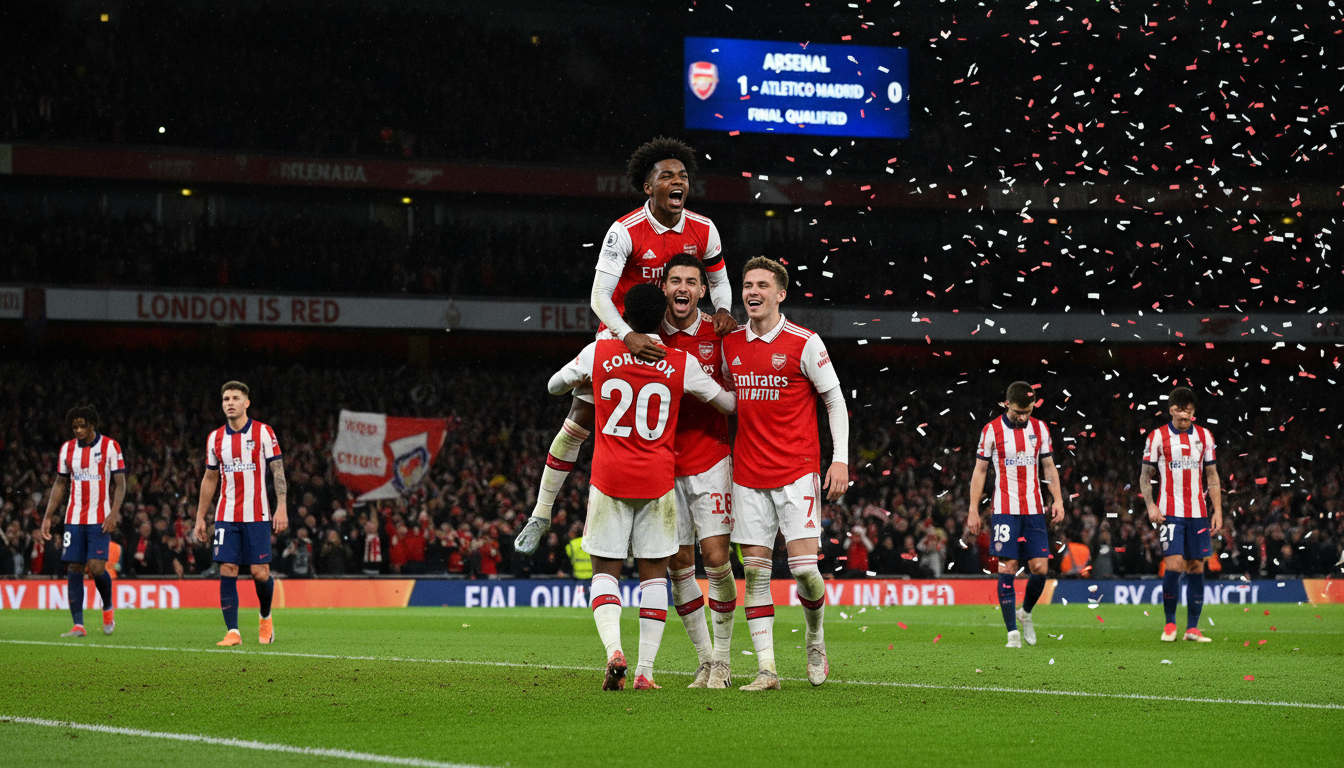
Arsenal beat Atletico Madrid 1-0 to reach Champions League final
Arsenal beat Atletico Madrid 1-0 on May 5, 2026, to advance to the Champions League final in Budapest on May 30, with Bukayo Saka’s late first-half finish the difference for Mikel Arteta’s side.

Arsenal vs Atletico Madrid decided by single Saka touch
Arsenal vs Atletico Madrid was settled by a narrow 1-0 victory for Arsenal in the second leg of the semi-final on May 5, 2026, sealing a 2-1 aggregate win. Bukayo Saka’s composed finish at the end of the first half proved decisive after a break that exposed Atletico’s backline. The result sends Arsenal to the Champions League final in Budapest on May 30, where they await either Bayern Munich or Paris Saint-Germain. Arteta’s team combined defensive discipline with measured counter-attacks to protect their aggregate advantage.
Atletico’s early intensity failed to yield a goal
Diego Simeone’s side began with the aggression and pressing that have underpinned their season, causing Arsenal early problems in possession. Antoine Griezmann and Julian Alvarez linked well to create openings, and Atletico’s high tempo forced Arsenal into several important interventions. Despite commanding the early phases, Los Rojiblancos were unable to find the clinical finish required to overturn the deficit. Their promising positions frequently ended in blocked shots or last-ditch defending rather than clear-cut opportunities.
The breakthrough came from a swift counter
In the closing moments of the first half a rare Arsenal counter produced the decisive play, with Viktor Gyokeres forcing Atletico to retreat before delivering a dangerous cross from the right. Leandro Trossard’s initial attempt was smothered by Jan Oblak, but Saka reacted quickest at the far post to steer the rebound into the net. The goal came at a pivotal moment, immediately before the interval, and shifted momentum back to Arsenal as the teams headed into the break. That moment underscored Arsenal’s threat on the break and their ability to punish small defensive lapses.
Key defensive work kept Atletico at bay
Across both halves Arsenal relied on strong individual and collective defending to protect their slim lead, with Gabriel Magalhaes particularly prominent in aerial duels and crucial blocks. Declan Rice’s disciplined midfield cover prevented several Atletico transitions from becoming genuine goalscoring chances. Jan Oblak was only called into meaningful action once, as most dangerous deliveries were intercepted or scrambled away before testing the goalkeeper. Arsenal’s backline and midfield balance frustrated Atletico’s attempts to build sustained pressure in the second half.
Substitutions and tactical tweaks failed to unlock Simeone’s plan
Both managers made a flurry of changes after the interval, but the alterations did not produce the attacking overhaul Atletico needed. Simeone introduced fresh attacking options as Atletico pushed for an equaliser, yet the visitors increasingly found themselves stretched and vulnerable to Arsenal counters. Arsenal’s own substitutions were aimed at shoring up the middle and maintaining control of the tempo rather than extending their lead. As the game progressed, Atletico’s urgency turned into haste, and clear openings became scarcer.
Missed chances and late drama that never arrived
Atletico’s best opportunities in the second half included a presentable chance for Giuliano Simeone, who rounded David Raya but could not direct his finish under pressure, and a late moment for Alexander Sorloth that came to fruition only as a scuffed effort. Piero Hincapié and other Arsenal outlets threatened on the transition and tested Atletico’s defenders in the closing stages. A penalty appeal for Atletico was dismissed after officials deemed the contact insufficient, leaving Simeone’s side with limited avenues to force extra time. In the final minutes Arsenal managed the clock and space effectively to preserve their aggregate advantage.
What the win means for Arsenal’s season and Arteta’s legacy
Advancing to the Champions League final places Arsenal in position to compete for European silverware at a high point in Mikel Arteta’s tenure, reinforcing progress made domestically and in continental competition. The result offers a validation of Arteta’s tactical approach, which combined solid defensive organization with selective attacking intent. For a squad still blending youth and experience, the run to Budapest will be a major milestone and a platform for further growth. The achievement will also intensify expectation around the club as it prepares for the season’s final fixture on May 30.
Mikel Arteta and his coaching staff will now switch focus to recovery and preparation ahead of the final, plotting how best to set up against either Bayern Munich or Paris Saint-Germain. Atletico Madrid, meanwhile, leave the competition having reinforced their identity and resilience over a campaign that featured notable European nights. Diego Simeone’s team can reflect on a run that reignited belief among their supporters, even as they rue the narrow margins that ended their bid for the trophy.
Arsenal’s supporters celebrated a hard-fought victory that combined timely finishing with defensive composure, while Atletico’s players trudged off knowing they had left several opportunities unexploited. The win elevates Arsenal back into the European spotlight and sets a high-stakes finale in Budapest at the end of May.