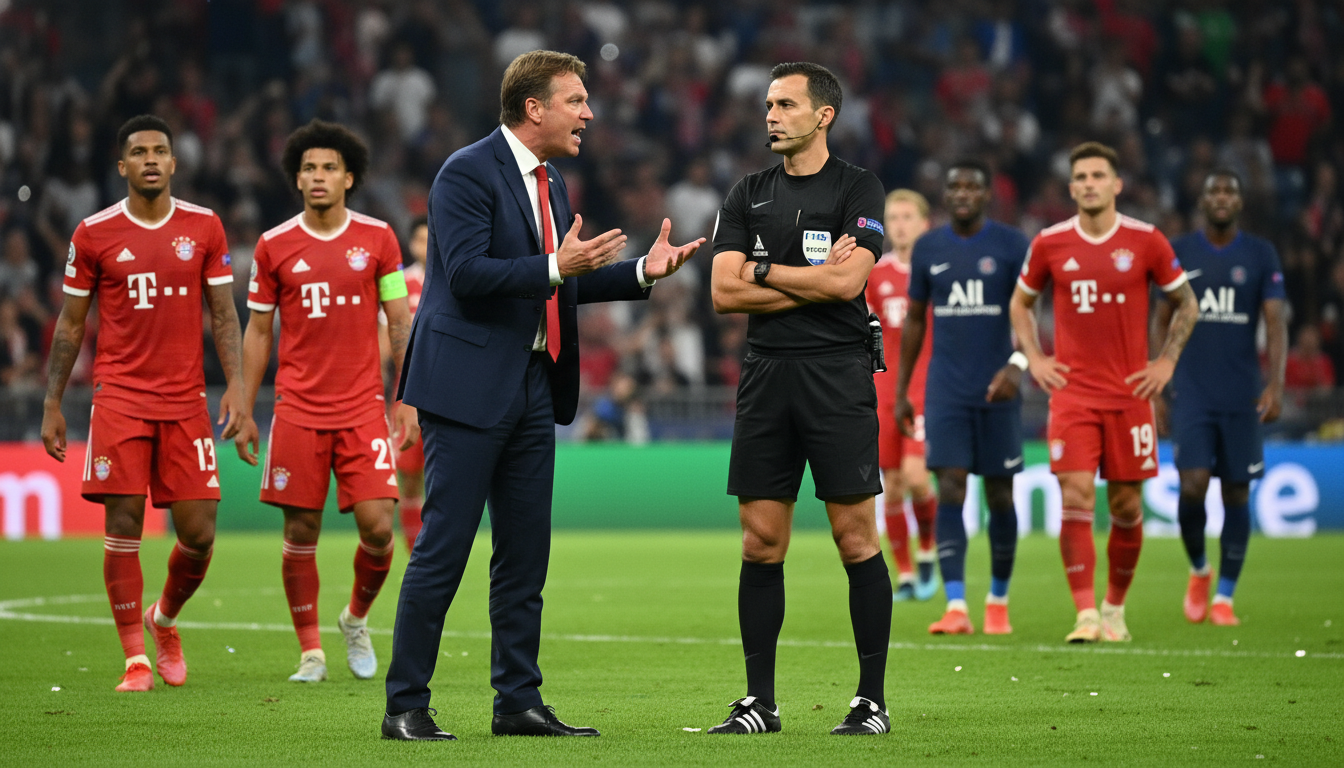
Bayern vs PSG refereeing controversy overshadows Champions League semi-final defeat
Bayern Munich say referee decisions cost them in the Champions League semi-final as disputed handball and booking calls in the second leg against Paris Saint-Germain sparked a high-profile refereeing controversy.


Bayern Munich emerged from their Champions League semi-final second leg loss to Paris Saint-Germain frustrated and vocal after a series of contentious refereeing decisions that they say altered the course of the tie. The club highlighted two pivotal incidents — a handball by PSG midfielder João Neves in his own area and an earlier sequence involving Konrad Laimer and Nuno Mendes — that went against the German champions. Bayern’s chief executive publicly questioned the choice of match official and suggested the appointment may have influenced the outcome.
Critical decision: João Neves handball
A major flashpoint in the second leg was a handball claimed by Bayern inside the PSG penalty area involving midfielder João Neves.
Bayern players and staff insisted the ball struck Neves’ arm in a position they believed warranted a penalty, while the referee allowed play to continue. The non-call left Bayern visibly aggrieved on the touchline and contributed to an increasingly tense atmosphere between the teams and match officials.
Referee João Pinheiro did not award a spot-kick, and there was no immediate VAR overturn. The incident became central to post-match criticism because of its timing and potential to change momentum in a knockout fixture where margins are minimal.
The Laimer–Mendes sequence and booking controversy
An earlier episode involving Konrad Laimer and Nuno Mendes also drew scrutiny and added to Bayern’s sense of injustice.
Officials determined that Laimer handled the ball moments before an incident involving Mendes, a decision that effectively prevented a second yellow card for the PSG left-back. Had Mendes received that second caution, he would have been sent off and Bayern would have played with a numerical advantage for the remainder of the match.
Bayern questioned both the interpretation of the contact and the consistency of the officiating, arguing that similar contacts in other matches have produced different outcomes. The two incidents, taken together, formed the basis for the club’s public challenge to the referee’s performance.
Bayern CEO’s public criticism of referee selection
Club leadership did not contain its reaction after the match, with Bayern Munich’s CEO expressing sharp reservations about the referee assignment.
Jan-Christian Dreesen described the match official’s appointment as striking given his limited Champions League record and linked that limited experience to the controversial calls made on the night. The CEO’s comments emphasized concern about UEFA’s referee selection for fixtures of this significance.
The critique from Bayern’s board adds pressure on governing bodies to explain appointment protocols and to consider whether referee experience is adequately weighed for high-stakes knockout matches.
João Pinheiro’s Champions League experience examined
João Pinheiro, the Portuguese official at the center of the controversy, has a record that Bayern officials noted during their post-match remarks.
The degree to which an official’s number of prior Champions League appointments should influence selection has become part of the public debate, with Bayern arguing that more experienced referees are preferable for major knockout ties. Observers pointed to the intensity and scrutiny that come with semi-final duties as a factor in the discussion.
UEFA’s internal selection criteria and monitoring processes for referees are likely to come under closer inspection if clubs continue to voice concerns publicly. Transparency about appointment decisions and the metrics used to assess referees could be called for by stakeholders across European football.
Potential UEFA review and disciplinary avenues
Following high-profile refereeing disputes, UEFA typically has mechanisms to review decisions and to assess referee performance after matches.
Bayern’s public statements increase the likelihood that the governing body will issue a formal assessment of the officiating, even if such reviews rarely lead to retrospective changes to match results. The immediate priorities for officials will be to determine whether procedural errors occurred and whether any disciplinary steps are necessary regarding conduct or decision-making.
Clubs can also lodge official protests or appeals under UEFA’s regulations, though such processes are narrowly defined and rarely result in altered outcomes. Regardless, the scrutiny that follows significant controversies may influence future referee appointments and the application of VAR protocols.
Match implications and tactical consequences
Beyond the referee controversy, the officiating decisions had clear tactical and psychological ramifications during the match.
Bayern’s inability to secure a penalty at a crucial juncture and the preservation of a full PSG back line following the non-dismissal of Mendes altered how both teams approached the remainder of the contest. Tactical adjustments from each coach reflected the changing risk calculus created by those decisions.
Matches at this level often hinge on small margins, and when contentious calls occur, they not only affect immediate scoring opportunities but also shape substitutions, player discipline, and the deployment of pressing or protective strategies as teams chase or defend results.
Reactions from players, staff and wider football community
Responses to the match spilled beyond Bayern’s executive ranks, producing commentary from former players, pundits and fans who debated the incidents across media channels.
While Bayern framed the decisions as decisive moments, others urged restraint, noting the complexity of split-second judgments and VAR’s role in correcting clear and obvious errors. The broader football community used the episode to renew discussion about refereeing standards, the limits of VAR intervention and consistency in match officiating.
The debate highlighted a recurring tension in modern football: the balance between human discretion and technological review, and the challenge of achieving consistent outcomes across different competitions and jurisdictions.
Bayern faced frustration in their Champions League semi-final second leg against Paris Saint-Germain, and the club’s articulation of grievances has focused attention on key refereeing calls that influenced the match. The incidents involving João Neves and the Laimer–Mendes sequence have become the focal points for questions about referee appointments and VAR use in high-stakes fixtures.
The controversy around João Pinheiro’s performance is unlikely to fade quickly, and it underscores broader concerns across European football about transparency, consistency and the systems used to support match officials. As UEFA considers its response and as clubs weigh their options, the debate will persist about how best to protect the integrity of marquee fixtures while ensuring fair and uniform application of the rules.
Ultimately, the sporting outcome stands: Bayern Munich were eliminated after their semi-final second leg defeat to Paris Saint-Germain. The referee decisions will now be examined in reports and by stakeholders, and their legacy may influence referee selection, VAR protocols, and how clubs engage with governing bodies in future knockout contests.