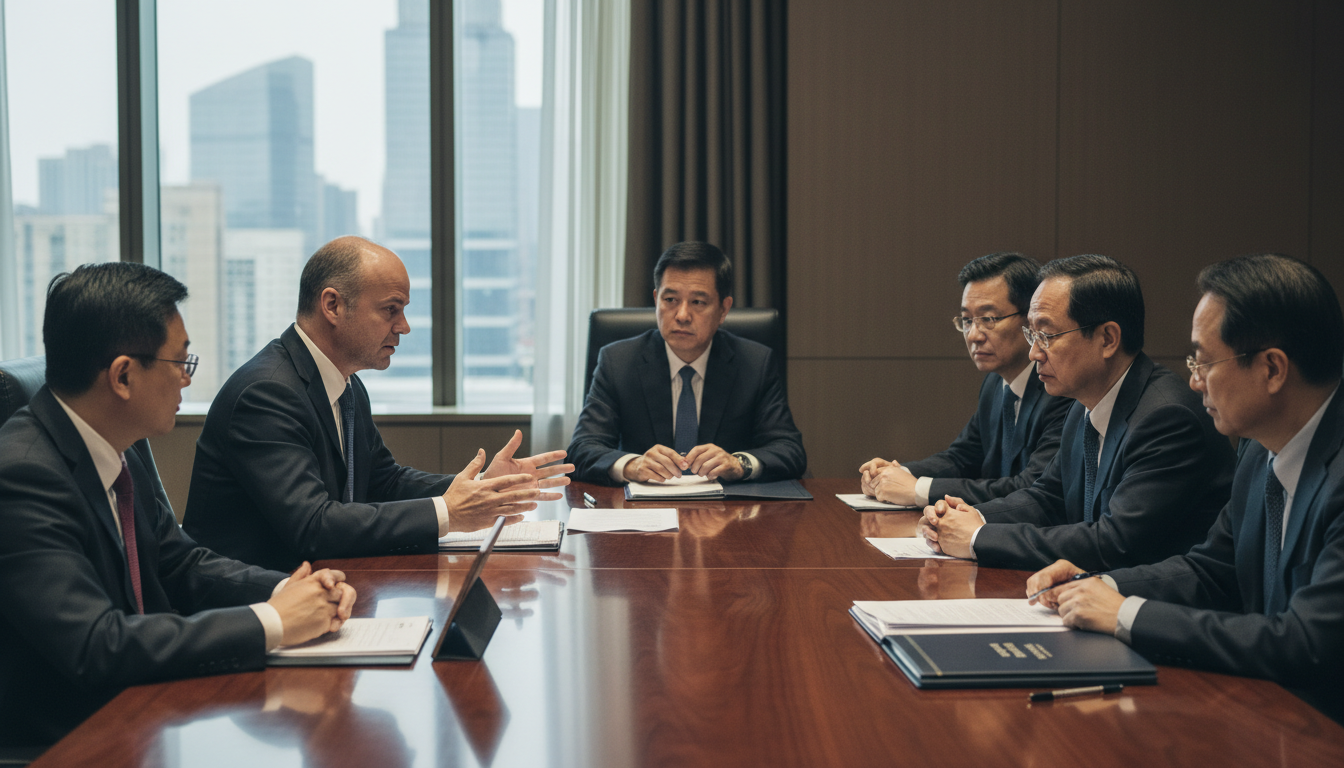
FIFA Offers Deep Discount on China World Cup TV Rights in Last-Minute Bid
FIFA delegation travels to Beijing to renegotiate China World Cup TV rights, proposing a cut to $120–$150M in hopes of closing a deal ahead of the June 2026 tournament.


FIFA has dispatched senior media executives to Beijing this week to press China’s state broadcaster on securing television rights for the 2026 World Cup.
The move represents a dramatic reduction from the body’s initial asking price and signals an urgent push to lock in coverage for Chinese audiences ahead of the tournament.
China World Cup TV rights are at the center of the talks, with FIFA proposing a package price aimed at bridging a sizeable gap with the broadcaster’s earlier offer.
Delegation and senior figures leading negotiations
A delegation led by FIFA’s senior media officials is in Beijing to meet executives at the national broadcaster and government-linked outlets.
The team reportedly includes the world governing body’s secretary general and its director of media rights, underscoring the priority FIFA places on resolving the matter quickly.
Their presence in the Chinese capital reflects direct engagement at the highest level as FIFA seeks to finalize terms before the tournament begins in June 2026.
Price cut, outstanding gap and the offer on the table
FIFA has reportedly moved from an initial asking figure of about $300 million down to a proposed range of $120 million to $150 million.
That revised demand still remains above the roughly $80 million figure that the state broadcaster had publicly indicated it would pay, leaving a persistent but narrower gap.
Sources describe these concessions as “significant,” aimed at overcoming commercial and political sensitivities while preserving the overall value of global broadcast rights.
Packaging 2026 and 2030 rights as a negotiation strategy
Negotiators are said to be discussing bundled packages that would couple the 2026 rights with the 2030 tournament rights in China.
The 2030 World Cup, planned across six countries, offers an opportunity to build a longer-term relationship and smooth out per-tournament pricing volatility.
FIFA’s willingness to combine cycles reflects a strategic effort to attract a higher total commitment and to provide the broadcaster with a predictable multiyear schedule.
Market context: how China’s offer compares internationally
A document circulating on social channels listed reported fees being paid by other territories, revealing a wide variation in market valuations.
Revenues reportedly range from relatively modest sums for smaller markets to hundreds of millions in major Asian territories, highlighting the premium assigned to high-demand broadcast rights.
For FIFA, China represents one of the largest and most commercially significant markets where securing a domestic free-to-air partner is both financially and reputationally important.
Commercial and political stakes for CCTV and Chinese broadcasters
For China’s state broadcaster, carrying the World Cup carries strategic resonance beyond pure commercial return, tying into cultural diplomacy and domestic sporting agendas.
A lower per-tournament fee, or a bundled deal, could still be acceptable if it guarantees live coverage, highlights packages and ancillary content across multiple platforms.
Chinese authorities and broadcasters will weigh audience reach, advertising potential and the domestic policy environment in deciding whether to accept a higher offer.
Timeline, expectations and potential announcement window
Both sides reportedly expect a deal could be announced in the latter half of May, a narrow window given the tournament opens in June 2026.
FIFA’s timetable appears compressed, reflecting the need to finalize distribution plans, technical arrangements and local promotion ahead of the start of play.
Any delay beyond the stated timeline would force contingency measures including sublicensing or limited coverage arrangements for viewers in China.
Implications for global rights and future bargaining positions
A discounted sale to China would reshape the arithmetic of FIFA’s global rights portfolio and could set a precedent for other markets seeking reduced fees.
Broadcast partners and rights buyers worldwide will watch closely to gauge FIFA’s flexibility on price and packaging as negotiations progress for other territories.
Stakeholders say this outcome could influence future cycles and how FIFA balances immediate revenue with broad global reach.
Distribution logistics and viewer access considerations
Beyond headline figures, the deal must resolve technical distribution, platform exclusivity and the extent of free-to-air versus pay-TV exposure.
Chinese viewers anticipate live matches, highlights and editorial content across linear channels and digital platforms, which will determine advertising and sponsorship yields.
FIFA and broadcasters will also need to agree on language feeds, on-screen graphics and rights for ancillary content such as behind-the-scenes material and documentaries.
Commercial partners and sponsor visibility in the China market
Sponsors tied to the World Cup have material interests in the Chinese broadcast arrangement, since market exposure translates into commercial return.
A wider domestic reach through a major state broadcaster would be attractive to global sponsors seeking visibility in China’s vast audience pool.
Conversely, a restricted or paywall-limited arrangement would reduce the immediacy of sponsor impact and could affect global activation plans.
Potential outcomes and next steps to watch
Observers expect one of three likely outcomes: a bundled multi-tournament deal, a single-cycle agreement at the mid-range price, or an ongoing impasse requiring sublicensing.
Each path carries different commercial consequences for FIFA, the broadcaster and advertisers, and would shape viewer access in China.
Industry participants say an official announcement in late May would resolve uncertainty and allow marketing and technical teams to finalize preparations.
FIFA’s decision to travel to Beijing marks a last-minute intensification of efforts to secure China World Cup TV rights, with both sides portrayed as realistic about the need for compromise.
How the negotiations conclude will affect millions of viewers, commercial partners and the wider market for major sports rights as the global soccer calendar moves into one of its biggest events.