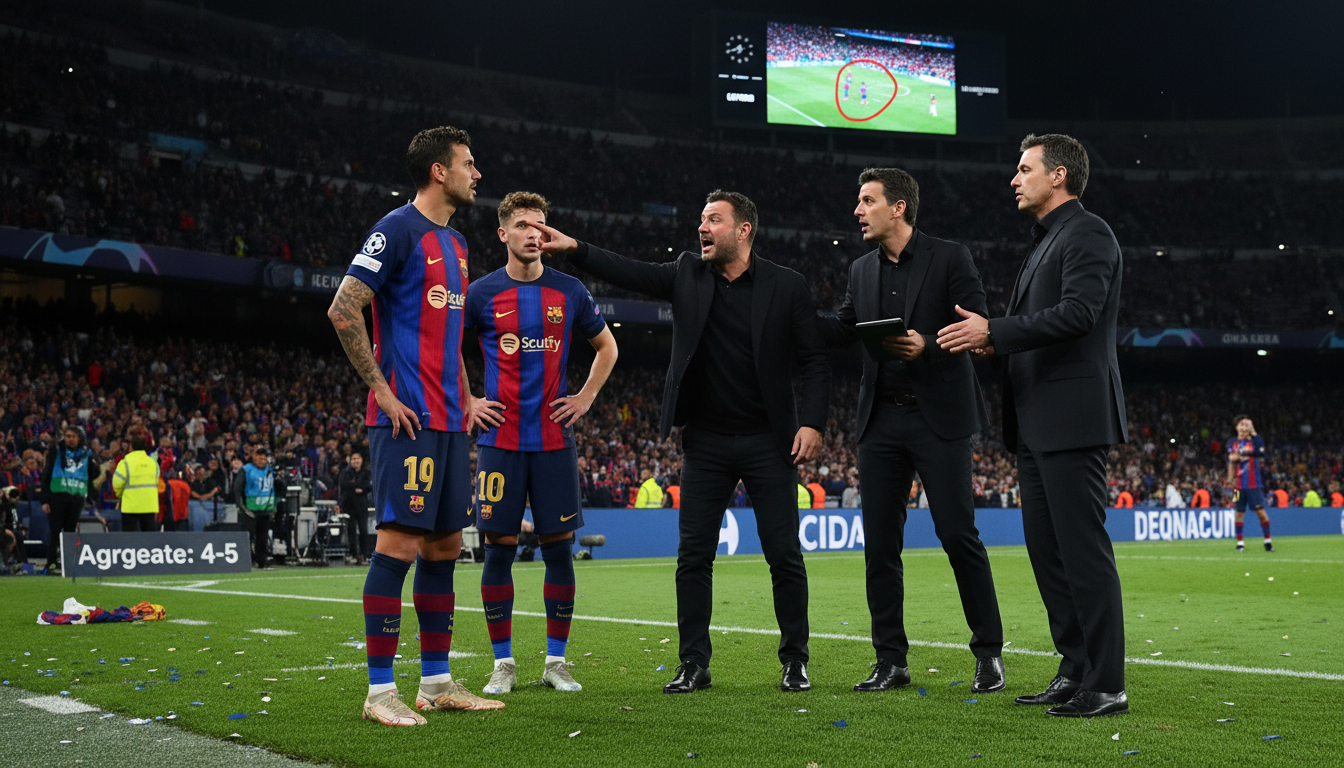
Barcelona refereeing errors: Barça lodge second formal complaint to UEFA after Champions League exit
Barcelona say refereeing errors cost them a Champions League semi-final place, file a second complaint to UEFA and demand clearer VAR and officiating standards.


Barcelona have lodged a second formal complaint with UEFA, asserting that refereeing and VAR decisions across both legs of their tie with Atlético Madrid materially affected the outcome and deprived the club of a place in the Champions League semi-finals. The club’s submission alleges a pattern of incorrect applications of the laws of the game, citing two red cards that were upgraded after pitchside reviews and at least one incident in which an apparent handball in Atlético’s penalty area was not punished. Barcelona say refereeing errors cost them a semi-final spot and have asked UEFA both to investigate the incidents and to work with the club on measures to improve transparency and consistency in officiating.
The complaint follows Barcelona’s 3-2 aggregate defeat to Spanish rivals Atlético Madrid, a tie in which the Catalan side won the second leg but were unable to overturn a two-goal deficit from the first match. Barcelona argue the accumulation of controversial calls—rather than any single event—changed the competitive balance of the tie and created significant sporting and financial damage to the club. UEFA has already dismissed a first protest as inadmissible, but the club has returned with a more detailed challenge and an offer to collaborate on refereeing reforms.
Details of the second complaint submitted to UEFA
Barça’s latest filing reiterates points raised after the first leg and expands on additional incidents from the return match.
In its statement the club alleges “several refereeing decisions” were inconsistent with the laws of the game and criticises both the way regulations were applied on the field and the lack of VAR intervention in critical moments. The document also asks UEFA to consider the cumulative effect of these rulings on the progression of the tie and the club’s financial position tied to Champions League advancement.
The club has framed the complaint not solely as an appeal but as a request for UEFA to engage in a review of current officiating procedures. Barcelona say they want a more rigorous and transparent application of technology and rules, and they have positioned the submission as an opportunity to help shape future improvements rather than a purely punitive action.
Red cards after pitchside reviews decided key moments
Both legs featured a dismissal that was initially shown as a yellow card and later upgraded to a red following a review at the pitchside monitor, a procedure now common under VAR protocols.
In the first leg Pau Cubarsí was sent off after referee István Kovács and the video match officials judged the challenge to have denied an obvious goalscoring opportunity following a monitor check. In the second leg Eric García received the same treatment when referee Clément Turpin upgraded a yellow to a red after consulting the pitchside screen. Barcelona contend that those decisions were inconsistent with precedent and context and that they altered the dynamic of both matches.
The timing and nature of red cards in two-legged ties can have an outsized influence on results, and Barcelona emphasise that losing a player in each match forced tactical adjustments that impacted their ability to overturn the aggregate deficit. The club’s complaint argues that errors in interpreting the relevant laws when applying the upgrade mechanism contributed directly to their elimination.
Contested handball incident left unpunished in first leg
A further point of contention in Barcelona’s submission concerns an incident in which Atlético defender Marc Pubill handled the ball inside his own penalty area during the first match, according to the club’s account.
Barcelona say play was allowed to continue after the on-field officials and the VAR team, led by Christian Dingert, did not intervene to award a penalty. The club maintains that the decision not to review or overturn that play represented a “grave lack of VAR intervention,” a phrase it used in its earlier protest, and claims the missed call should have been decisive in restoring parity to the tie.
UEFA’s initial response declared the first complaint inadmissible, a move that left Barcelona frustrated and prompted the club to gather further detail and formalise a second submission. In that filing, Barcelona reiterates the handball episode as a clear case where VAR should have triggered corrective action.
Club argues sporting and financial harm resulted from officiating
Barcelona’s statement goes beyond match control issues and frames the refereeing controversy in economic terms, arguing that being eliminated from the Champions League at this stage carries immediate financial consequences.
Advancement brings increased prize money, ticket revenue, and commercial exposure, and the club says those outcomes were jeopardised by decisions it regards as avoidable officiating mistakes. The complaint describes the combined refereeing outcomes as producing “significant sporting and financial harm” and asks UEFA to assess remedies and mechanisms to prevent similar situations.
The club also points to reputational considerations, arguing that inconsistent decision-making undermines fan confidence and the perceived fairness of UEFA competitions. By seeking procedural changes, Barcelona aim to address both competitive integrity and the commercial stakes associated with elite European fixtures.
Player reaction and the club’s public messaging
Several Barcelona figures expressed frustration publicly after the second leg, with forward Raphinha describing the pair of matches in stark terms. He told reporters that he felt the team had been robbed, a sentiment that captured the mood within the squad after elimination.
Beyond player comments, Barcelona’s official communications stressed a willingness to cooperate with UEFA to improve officiating, rather than simply to lodge grievances. The club has framed its approach as constructive, proposing collaboration that could include clearer protocols for VAR use, enhanced training for match officials, and greater transparency around decision-making.
Barcelona’s messaging is designed to underscore both the immediate grievance over the tie and a longer-term objective of systemic reform, positioning the club as seeking solutions that could benefit the wider game.
Possible UEFA responses and next steps
UEFA’s procedural options in response to a formal complaint range from administrative review to instructing internal refereeing bodies to reassess individual performances and systemic protocol. Barcelona’s complaint will now sit within UEFA’s officiating and disciplinary framework, which is responsible for evaluating whether rules were misapplied or if VAR procedures were improperly followed.
Given UEFA’s earlier ruling of inadmissibility on the first protest, the governing body will need to explain whether the new material in Barcelona’s second submission changes its assessment. Outcomes could include a public clarification of decisions, internal guidance for match officials, or targeted training, though overturning match results is extremely rare and typically requires clear evidence of procedural breach affecting competition integrity.
The timeline for any UEFA response is unclear, and the club’s request to collaborate could shape the tenor of follow-up actions. Whatever the next steps, the dispute is likely to prompt renewed debate about how VAR is deployed in high-stakes fixtures and whether existing safeguards are sufficient to ensure consistent enforcement.
Final paragraph summarising what to watch next
Barcelona’s escalation of the issue to UEFA keeps pressure on European football’s governing body to address concerns about VAR and match officiating, and the outcome of this complaint will be closely watched by clubs, referees and supporters as a potential indicator of how technology and rules will be managed in future Champions League ties.