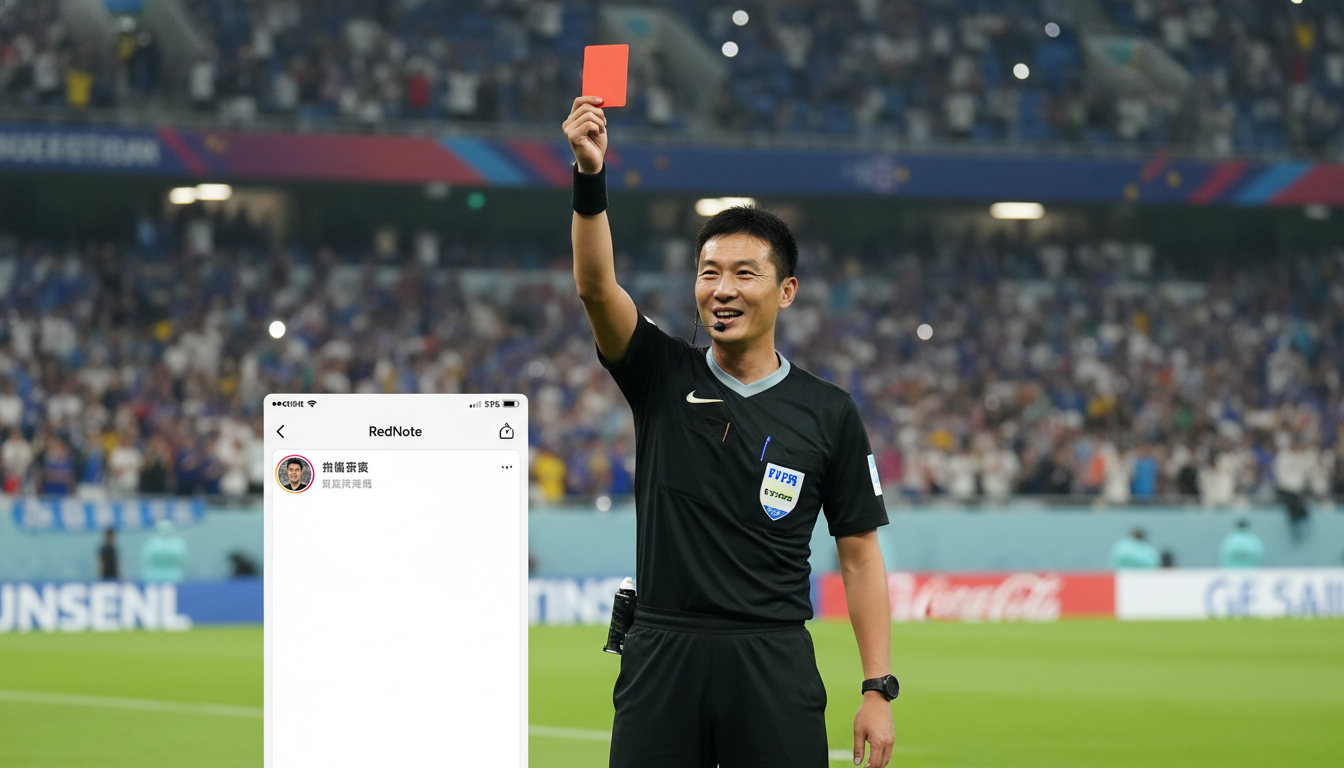
Chinese referee Ma Ning launches RedNote account ahead of World Cup
Ma Ning’s unexpected RedNote debut — including a playful profile shot — drew millions of views within hours as the referee prepares to oversee matches at the upcoming FIFA World Cup.


Ma Ning, one of China’s most prominent and polarizing referees, opened an account on RedNote this week just days before he is due to officiate at the FIFA World Cup.
The 46-year-old official posted a profile photo that sharply contrasted with his on-field reputation, prompting widespread reaction across the platform.
Within hours his initial activity generated thousands of followers and millions of views, underscoring intense public interest in his move online.
Ma Ning launches RedNote account ahead of World Cup
Ma Ning’s decision to join RedNote came at a highly visible moment in the international soccer calendar, with the referee scheduled to take charge of matches at the FIFA World Cup.
The account activation and first post arrived days before his travel to the tournament, a timing that quickly drew attention from fans and media alike.
By presenting himself on a major social platform, Ma has entered a new public arena that places his image and remarks under closer scrutiny than ever.
The account’s creation signals a deliberate effort to shape public perception in the run-up to one of football’s biggest events.
Officials often avoid high-profile public exposure ahead of major tournaments, but Ma’s move suggests a different approach to engagement with supporters and critics.
The RedNote profile immediately became a focal point for scrutiny about how referees interact with fans in the digital age.
Playful profile picture contrasts stern on-field reputation
In his first visible post, Ma held up a red card and looked directly into the camera in a fisheye, high-angle photograph that many users described as playful.
The image departs from the austere, authoritative persona most associated with referees and particularly with Ma, who has a record of strict enforcement on the field.
The visual choice prompted lighthearted responses from users who found the shot unexpectedly charming rather than intimidating.
Comments ranged from amused to astonished, with some followers joking about receiving a red card simply for opening the app.
That tone contrasted sharply with memories of contentious on-field decisions that have at times drawn criticism from players, coaches and supporters.
For Ma, the photo offered a different narrative: a brief, controlled glimpse into a more personable public image.
Rapid follower growth and platform engagement
Ma Ning’s RedNote account attracted more than 25,000 followers and amassed over 6.7 million views on related posts within three hours of his first upload.
Such immediate traction is notable for a referee, a role that rarely commands the same online followings as players or managers.
The spike in engagement demonstrates the public’s appetite for content tied to high-profile match officials and the curiosity that surrounds personalities heading to the World Cup.
High view counts in a short window indicate that Ma’s presence resonated beyond his existing domestic audience.
Activity metrics like rapid follower acquisition and viral view numbers also highlight how social platforms can amplify interest in sporting figures outside the traditional athlete cohort.
For tournament organizers and football federations, increased visibility of officials raises fresh questions about conduct, communications policies, and the lines between personal and professional representation.
Timing and implications for World Cup preparations
The timing of Ma’s social-media debut, mere days before his departure to the World Cup, raised immediate questions about whether the move was coordinated with his professional obligations.
Referees are subject to tight schedules, briefings, and media protocols ahead of major tournaments, and public platforms can complicate those obligations if content becomes a distraction.
Tournament administrators typically emphasize neutrality and discretion for match officials, seeking to limit external pressures that could affect on-field decision-making.
While there is no indication that Ma’s account will interfere with his duties, his public image is now more exposed to real-time commentary during a period when every decision will be magnified.
Any posts, images or interactions could be parsed by audiences and pundits in the context of his upcoming appointments, increasing the stakes of seemingly minor online activity.
Officials and federations may monitor such visibility closely to ensure that it aligns with codes of conduct and tournament guidelines.
Public and professional reaction to Ma Ning’s move
Responses to Ma’s RedNote entrance were mixed: some users reacted with amusement and curiosity, while others recalled past controversies tied to his refereeing.
Supporters pointed to the humanizing aspect of the profile photo, noting how a lighter image can offer balance to the pressure-filled role of a World Cup official.
Critics used the moment to revisit disputed calls and high-profile matches in which Ma’s decisions were contested.
Media commentators emphasized the broader conversation about referees in the era of social media, where personal branding collides with expectations of impartiality.
Colleagues within refereeing circles often counsel restraint, arguing that match officials should avoid actions that might be misread or politicized.
At the same time, the ability to control one’s public narrative is increasingly seen as valuable for officials who operate in a highly visible, intensely scrutinized environment.
Ma Ning’s refereeing record and history of contentious decisions
Ma Ning has built a reputation for strict enforcement and a willingness to intervene decisively during matches, attributes that have produced both praise and criticism over the years.
His on-field style has been the subject of heated debate in domestic leagues and regional tournaments, with some stakeholders commending his consistency and others disputing specific rulings.
That mixed legacy helps explain why his social-media debut generated such a sharp reaction from fans and commentators.
Referees whose decisions frequently affect outcomes tend to attract sustained public attention, especially in nations where football is followed passionately.
Ma’s history of contentious moments provides context for why a seemingly light-hearted profile picture could draw a flurry of commentary and retrospective criticism.
For referees preparing for global tournaments, past decisions remain part of their public record and continue to shape perceptions regardless of new outreach efforts.
Final paragraph
As Ma Ning heads to the FIFA World Cup, his RedNote account adds a new dimension to public conversations about officiating and image management in modern football, and officials, fans and governing bodies will be watching closely to see how this experiment in openness plays out on and off the pitch.