

Budapest fan brawl ahead of Champions League final as police analyse CCTV and make arrests
Budapest police are analysing camera footage after a May 30, 2026 early‑morning clash between Arsenal and Paris St‑Germain supporters that left several people detained. The Budapest fan brawl occurred hours before the Champions League final and was captured on social media, prompting a formal investigation by the 7th District police. Authorities say they have opened proceedings for gang violence and are working to identify those involved from multiple video sources.


Early‑morning violence on Király Street
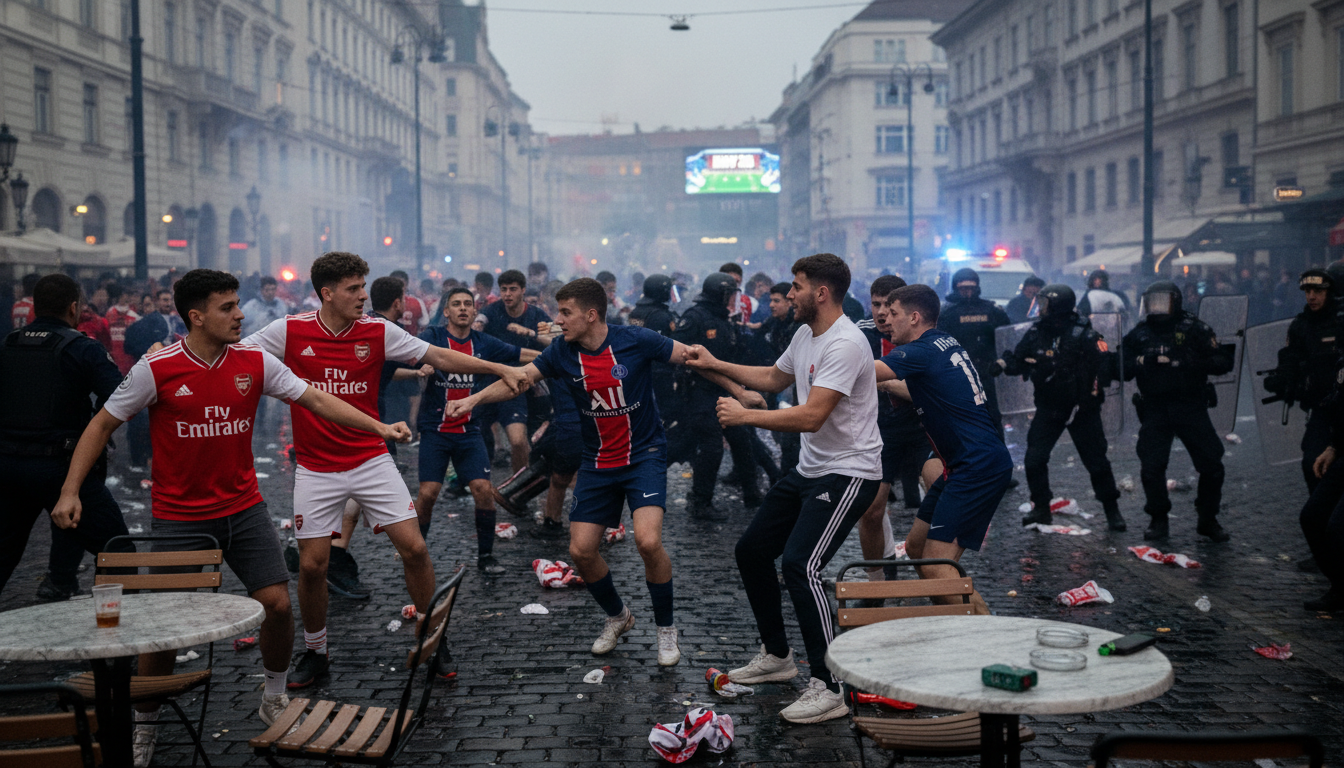
Several dozen supporters from each club were involved in the altercation that took place at about 00:20 on May 30, 2026, in Budapest’s 7th district, police statements said. Social media footage showed groups fighting in the street and the ignition of flares, an image that increased concern among local authorities and event organisers. The incident occurred during the hours when fans were gathering in the city centre, ahead of an evening when the Champions League final would bring tens of thousands of visitors to Budapest.
Police described the episode as an organised group confrontation and said investigators were treating it seriously. Officers at the scene secured the area and began collecting evidence, while later statements confirmed that camera recordings from nearby installations would be examined. The footage circulating online formed part of that evidence review and helped establish an initial timeline of the events.
Formal proceedings opened for gang violence
The BRFK 7th District Police Department has initiated criminal proceedings against unknown perpetrators on the charge of gang violence, a status that allows prosecutors and investigators to pursue multiple lines of inquiry. Under that framework the police have emphasised the importance of forensic review of CCTV and mobile phone recordings to identify individual participants. Officials have not yet named suspects publicly, saying identification and evidence-gathering remain ongoing.
Investigators will also consider witness statements and any property damage reported in the immediate area as part of the file. The public release of video clips on social platforms has complicated and aided the probe: while footage gives police leads, it also requires verification to ensure clips are not misleading or edited. Forensic teams will likely work through hours of material to match timestamps, camera angles and other corroborating details.
Large police deployment for the final
Authorities planned an unprecedented security operation for the Champions League final, deploying nearly 4,000 police officers across the Hungarian capital on match day. Hungary’s deputy national police chief, Zoltan Janos Kuczik, described the operation as the largest single‑day police deployment in the country’s history, reflecting the scale of the event and the volume of fans travelling to Budapest. Organisers and law enforcement have treated the fixture as a high‑risk event, with security preparations beginning more than a year in advance.
The concentration of officers was intended to manage large crowds, control access to fan zones and deter public disorder, particularly in parts of the city expected to see heavy foot traffic. Police emphasised that many supporters would arrive without tickets, increasing the potential for congestion and friction near official fan festival sites and transport hubs. The early‑morning incident underlined the operational challenges facing commanders tasked with keeping order across multiple locations.
Arrests at fan festival and surrounding incidents
Separate disturbances at the official fan festival site led to arrests on the Friday before the final, with two Portuguese nationals and one British man charged with disorderly conduct. Police also detained a British citizen who had climbed onto the roof of a parked car and caused damage, indicating a series of isolated but linked disorderly episodes in the lead‑up to the match. Authorities said these arrests reflected targeted responses to individual acts of criminal behaviour rather than the entire travelling fan base.
Officials did not disclose the full details of the charges against the arrested individuals but confirmed that public order offences and property damage were among the allegations. The detained people were handed over to prosecutors according to Hungarian procedure, and further legal steps will depend on the outcomes of the investigative and prosecutorial assessments. Police reiterated that arrests were part of a broader prevention and enforcement strategy implemented around the final.
CCTV and digital evidence shaping the investigation
Camera recordings from street units and private establishments are central to the police effort to identify participants in the Király Street confrontation. Investigators have said they are systematically analysing footage to trace movements, match clothing and confirm the presence of suspected individuals at specific moments. The growing volume of smartphone videos shared online creates parallel data streams that law enforcement must sift through, balancing rapid review with the need for rigorous verification.
Authorities expect that digital evidence will enable more precise identifications and help establish whether the brawl involved pre‑planned group clashes or spontaneous escalation. The processing of video evidence is resource‑intensive and often requires cross‑referencing with other investigative leads such as social media profiles, travel records and witness testimony. Police also cautioned that not every clip circulating online is reliable and invited the public to provide original files and context to assist inquiries.
Authorities urge restraint and outline next steps
In the wake of the disturbances, Hungarian police appealed to visiting supporters to behave responsibly and follow instructions from officers and event stewards. With tens of thousands of ticketless fans expected in the city, public safety messaging emphasised avoiding flashpoints and using authorised fan zones and transport corridors. Officials said they would maintain a high visible presence throughout the day and would prosecute criminal acts to deter further outbreaks of violence.
The investigative team will now prioritise identification, evidence preservation and coordination with foreign law enforcement where needed, given the international profile of the crowd. Prosecutors will review the collected material to decide on further charges or detentions as the case develops. Meanwhile, organisers of the Champions League final reiterated their commitment to ensuring the match proceeded safely while co‑operating with local authorities.
Police are also expected to issue periodic updates as inquiries progress, particularly where evidence leads to arrests or court proceedings. Local residents and businesses affected by the disturbances may be asked to supply surveillance footage and statements, and officials encouraged anyone with information to contact the investigating unit. The swift compilation and cross‑checking of evidence will be key to achieving timely and enforceable outcomes.
The early‑morning clash on Király Street added a volatile element to an already complex security operation surrounding the Champions League final, and investigators say they will use all available technical and human resources to identify those responsible. As the city moves into match day, the emphasis from authorities remains on preventing further disorder, holding offenders to account, and safeguarding both residents and visiting fans.