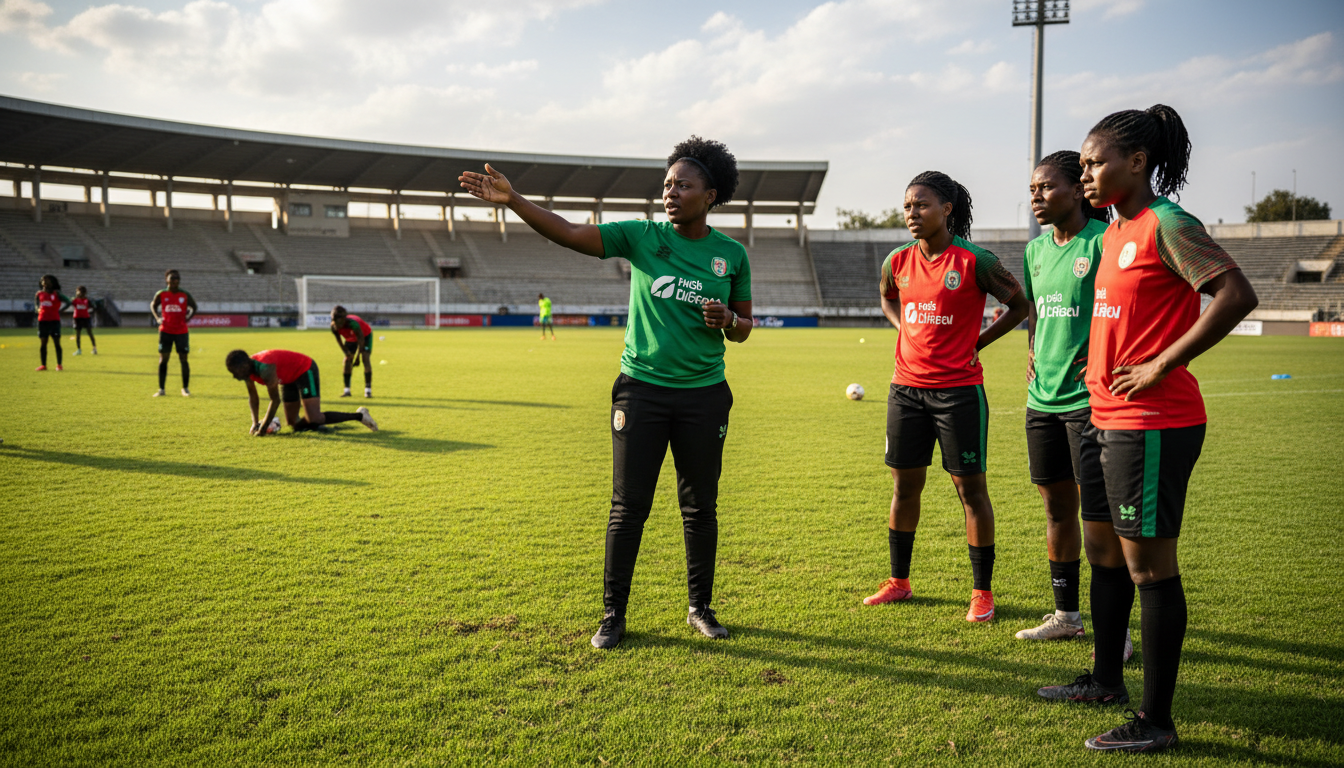
Harambee Starlets hit by late club releases and logistical snags ahead of Four Nations trip to Lusaka
Harambee Starlets face squad disruption as coach Beldine Odemba cites late club releases and logistics ahead of Four Nations in Lusaka on June 6 and 9, 2026.


The Harambee Starlets enter a crucial international window under pressure as head coach Beldine Odemba revealed a series of administrative and logistical obstacles that have left key players unavailable for the Four Nations Tournament in Lusaka. Odemba confirmed that several first-team members, including foreign-based stars Enez and Lillian, will miss the June 2026 FIFA international window because clubs delayed releases or cited conflicting commitments. With fixtures against strong opposition on June 6 and June 9, the tournament will double as a vital assessment before the final preparations for the Women’s Africa Cup of Nations.
Odemba outlines the scale of late releases and absences
Odemba told federation officials and staff that the technical bench is still awaiting the final contingent as domestic and regional clubs complete their player release procedures. She said foreign-based players were particularly affected by work and contractual permutations, leaving the camp without established options in key positions. The coach stressed that while the mood in the camp remained constructive, the shortfall in personnel narrowed training options and tactical rehearsals.
The coach specifically confirmed that Enez and Lillian will not be available for the Lusaka fixtures after clubs failed to clear them in time for the June window. Odemba said the team had pursued every administrative channel to secure releases but encountered delays that made it impossible to have those players report before departure. That absence forces the technical team to reconfigure match plans and evaluate alternative personnel under compressed timelines.
Tanzanian clubs accused of obstructing national team releases
Odemba singled out several Tanzanian Premier League outfits, naming Simba Queens in particular, as contributing to the release difficulties by issuing inconsistent communications to the federation. She said medical reports and formal letters have sometimes been used to justify holding players back, even when those same players remain active in league fixtures. The coach argued that such inconsistencies undermine transparent cooperation between clubs and national teams.
The situation has prompted calls within the Harambee Starlets camp for clearer mechanisms that govern cross-border club releases for international duty. Federation sources say they will seek to engage Tanzanian counterparts and regional administrators to reduce friction during official windows. Odemba cautioned that unresolved disputes over releases could hamper preparations not only for this Four Nations event but also for larger tournaments on the calendar.
Domestic season timing leaves local players short on match fitness
The end of the Football Kenya Federation Women’s Premier League has created a different problem at home, with many local stars lacking recent competitive minutes ahead of the international fixtures. Odemba noted that players returning straight from an offseason or post-season period require urgent conditioning and match simulation work to reach international standards. That lack of match fitness complicates intensive match planning and raises risk of injury if not managed carefully.
Some Kenyan clubs have also been slow to formalize release dates despite the league’s closure, leaving the national team camp with gaps as training schedules are set. Ulinzi, for example, had not reported players on time due to the club’s regional commitments, further constraining selection certainty. The technical team is now balancing a need to accelerate fitness work with preserving player welfare before competitive games in Lusaka.
Youth recalls and fringe players given fast-track opportunities
To mitigate absences, Odemba’s staff has acted quickly to recall promising youngsters and fringe players to the national setup, bringing in teenage forward Marion Serenge and attacker Violet Nanjala for assessment. The technical bench views these selections as both an immediate stopgap and a strategic investment in depth ahead of the Women’s Africa Cup of Nations. Both players will undergo fitness and tactical evaluations to determine their readiness for match minutes in Lusaka.
Coaches plan to use the Four Nations fixtures to test combinations and give younger players exposure to higher-intensity opposition than they have previously faced. The tournament presents a dual challenge of producing competitive results while also providing developmental minutes for those on the fringe. Odemba emphasized that every selection will be evaluated on current condition and the ability to execute game plans under pressure.
Lusaka fixtures to serve as a hard assessment before WAFCON
The matches scheduled for June 6 and June 9, 2026 in Lusaka are being treated as a final measuring stick on tactical coherence and player readiness before the WAFCON campaign. Odemba and her staff view the tournament as a rare opportunity to face solid opposition in a short, intense setting that mirrors later continental competition. Performance metrics from those games will shape the final preparation schedule and influence selection decisions ahead of continental qualifiers.
With only a narrow window of training days remaining after Lusaka, the technical staff must extract tactical clarity and match sharpness quickly. Odemba underlined that the team’s objectives in Zambia extend beyond results, focusing equally on systems of play, defensive organisation, and transition options. The outcomes will determine whether the team requires additional international friendlies or an overseas camp to address weaknesses.
Appeal for government support and an overseas training camp
Odemba has publicly urged the government and sport authorities to speed up funding and administrative backing to ensure the team can undertake an overseas training camp before WAFCON. She reiterated plans for a possible preparatory camp in France and said such a camp would provide the calibre of opposition and facilities necessary for high performance. The head coach stressed that timely financial support is essential to secure facilities, arrange friendlies, and guarantee uninterrupted training blocks.
Federation officials have acknowledged the appeal and say they are exploring funding avenues and diplomatic channels to facilitate travel and logistics for the squad. The technical staff is also seeking clearance for training matches at home to complement any overseas work. Odemba made clear that the ultimate aim remains unchanged: to prepare a competitive squad capable of progressing deep into continental competition and moving toward World Cup qualification.
The Harambee Starlets now face a sprint of preparation under constrained circumstances, with administrative wrangling, late club releases and limited match fitness shaping a testy buildup to the Lusaka Four Nations Tournament. How the technical bench manages these immediate challenges and whether timely support arrives from clubs, the federation and government will be decisive in shaping Kenya’s form heading into the Women’s Africa Cup of Nations and the wider qualification campaign.