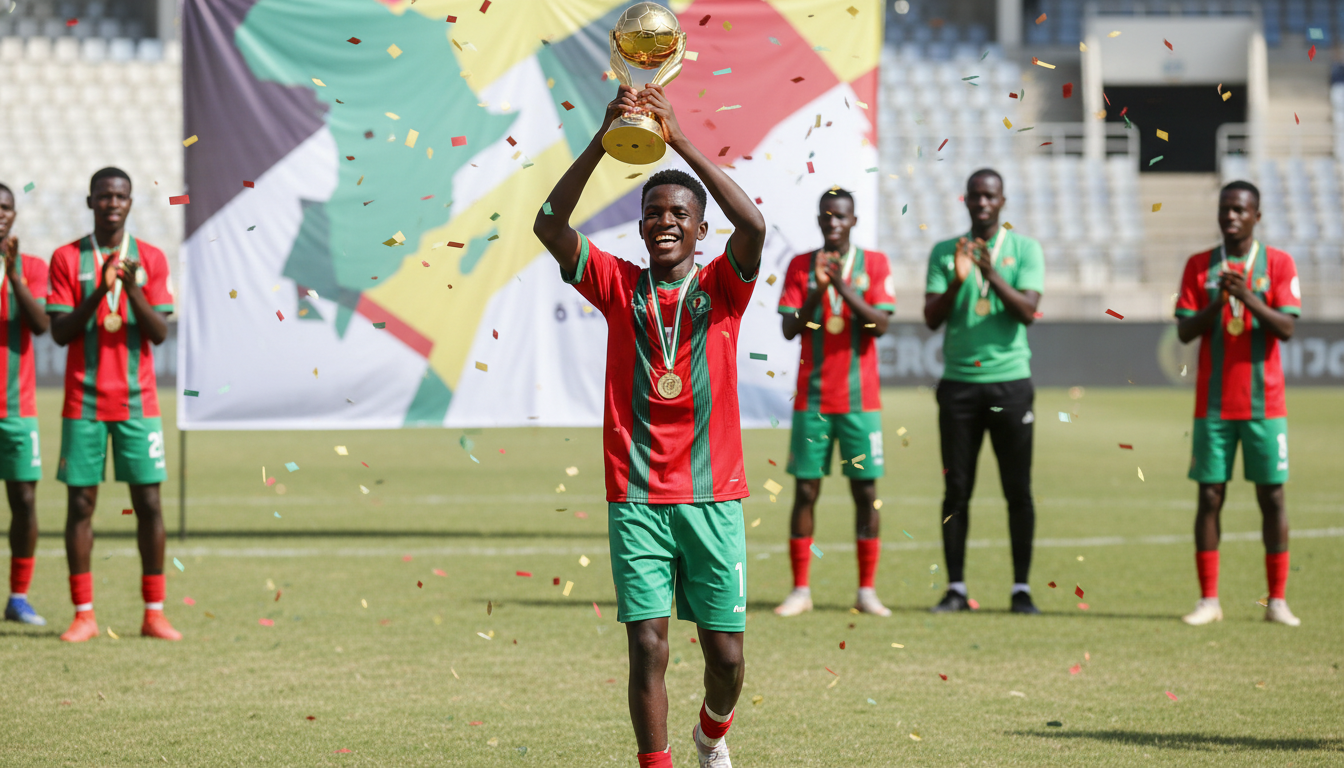
Issa Mussa Chole named TotalEnergies Man of the Competition after Tanzania’s run to CAF U-17 final
Issa Mussa Chole claimed the TotalEnergies Man of the Competition award after anchoring Tanzania’s surprising run to the CAF U-17 AFCON final in Morocco 2026, a campaign that also secured the Serengeti Boys a place at the FIFA U-17 World Cup. The midfielder’s steady presence, tactical awareness and composure under pressure were highlighted throughout the tournament and formed the backbone of a team that outperformed expectations. Chole’s recognition caps a broader breakthrough for Tanzanian youth football and spotlights a generation ready to challenge Africa’s established powers.


Chole awarded for consistency and influence
Issa Mussa Chole was singled out by the tournament technical committee for his round-to-round impact, combining defensive discipline with incisive distribution. Observers noted his ability to control tempo, shield the backline and initiate quick transitions that suited Tanzania’s counter-attacking approach. The Man of the Competition prize reflected not just a few standout moments but a sequence of mature performances across group and knockout stages.
The award also acknowledged Chole’s leadership on the pitch despite his youth, where he often organized teammates and maintained tactical shape under sustained pressure. His influence extended beyond statistics; coaches and analysts credited him with giving the Serengeti Boys a reliable midfield fulcrum. That reliability proved decisive in tightly contested matches where margins were small.
Tanzania reach their first CAF U-17 final
Tanzania’s progress to the final marked the first time the nation had advanced that far in the CAF U-17 African Cup of Nations, a historic achievement for the Serengeti Boys and East African football. The team topped its group, navigated a dramatic quarter-final against Algeria and then prevailed over Egypt on penalties in the semi-finals. Each step of the run illustrated the squad’s preparation, resilience and tactical discipline.
The run to the final was built on collective organisation rather than individual brilliance alone, but Chole emerged as the consistent engine of that collective effort. The final appearance also came with the tangible reward of qualification for the FIFA U-17 World Cup, adding international exposure to what was already a landmark continental campaign. Tanzania departed Morocco having reshaped perceptions of their youth pathway.
How Chole shaped Tanzania’s midfield identity
Chole’s game was defined by spatial awareness and the ability to link defence with attack, qualities that allowed Tanzania to defend compactly and strike quickly. He often dropped to collect the ball, solved pressure through short, safe passes and opened space for teammates to exploit on the break. That balance — measured defending and purposeful progression — became a template for how the Serengeti Boys controlled games despite often ceding possession.
His capacity to read opposition movement was matched by a disciplined work rate that helped preserve team shape in transition. In matches where Tanzania faced extended spells of defending, Chole’s positioning prevented opponents from gaining a clean numerical advantage through the middle. The cumulative effect of those contributions was a midfield unit capable of managing both tempo and risk.
Key matches: Algeria, Egypt and the final against Senegal
Tanzania’s quarter-final victory over Algeria was a defining moment that tested the team’s nerves and tactical maturity, setting up a pressure-filled semi-final with Egypt. Against Egypt, the match remained goalless through regular time, forcing a penalty shootout in which Tanzania prevailed 4-3. Chole’s composure in midfield was repeatedly cited as a factor that enabled the team to maintain defensive discipline through 120 minutes and into the shootout.
The final against Senegal was decided on penalties after a 1-1 draw, with Senegal winning the shootout 4-2 and lifting the title. While Tanzania fell short of the trophy, the team left Morocco with two major individual honours: Issa Mussa Chole’s Best Player award and Dismas Shida Athanasi’s Golden Boot as the tournament’s top scorer. Those recognitions underscored Tanzania’s dual strengths in midfield control and attacking potency.
Coach Elieneza Nsanganzelu’s preparation and structure
Coach Elieneza Nsanganzelu engineered a clear team identity centered on organisation, discipline and collective work ethic, elements that underpinned Tanzania’s surprising success. Training plans emphasized compact defensive lines, rapid transition patterns and clarity in role assignments, allowing young players to execute a coherent game model under pressure. That structure reduced the impact of occasional individual errors and allowed talents like Chole and Athanasi to flourish within defined responsibilities.
Nsanganzelu’s approach also prioritized mental preparation for high-stakes moments, which proved crucial in two penalty-decided knockout games. The coach’s insistence on routine and focus helped the team handle the tension of shootouts and late-game scenarios. The result was a young side that combined tactical intelligence with the temperament required for deep tournament runs.
Supporting cast and wider team contributions
Chole’s award did not come in isolation; a number of teammates provided the platform for his performances, most notably Dismas Shida Athanasi whose three goals earned the Golden Boot. Goalkeeper Haji Abdullahi produced key saves at crucial junctures, while captain Kassim Juma led by example in defence and midfield. Together, this core group exemplified a growing talent pool and a balanced squad capable of both defending resolutely and creating clear chances.
Beyond the starting eleven, squad depth and rotation offered by coaching staff allowed Tanzania to maintain intensity across multiple fixtures. Role players contributed defensive solidity and fresh legs at important moments, enabling the team to sustain its compact shape throughout the tournament. That collective effort amplified Chole’s influence and ensured the side could adapt to different opponents and game states.
Implications for development and the FIFA U-17 World Cup
Tanzania’s performance in Morocco 2026 has concrete implications for youth development in the country and the region, providing a model for how structured pathways can produce competitive teams at continental level. Qualification for the FIFA U-17 World Cup will offer players such as Issa Mussa Chole further exposure to diverse tactical systems and higher-calibre opposition, accelerating their development. National officials and academies are likely to use the Morocco campaign as evidence to increase investment in scouting, coaching and infrastructure.
The visibility gained by the Serengeti Boys should also enhance transfer and scholarship opportunities for standout performers, creating professional pathways that were previously harder to access. For Tanzanian football, sustained success at youth level could translate into improved senior squads in years to come, provided development systems are strengthened and best practices embedded. The immediate priority will be to consolidate gains and prepare the squad for global competition.
Issa Mussa Chole’s individual recognition at Morocco 2026 stands as a milestone for both the player and Tanzanian football, signaling the arrival of a cohort capable of challenging established continental powers while underscoring the value of structure and collective identity in youth development. The Serengeti Boys return home with historic achievements, a World Cup berth and a platform to build on as they transition from promising youth talents to the next generation of African professionals.