Germany names Assan Ouédraogo as World Cup replacement with Nagelsmann stressing fitness and form
Nagelsmann defends Assan Ouédraogo’s World Cup call-up after Lennart Karl’s injury, citing match rhythm and immediate fitness and club form over Said El Mala.

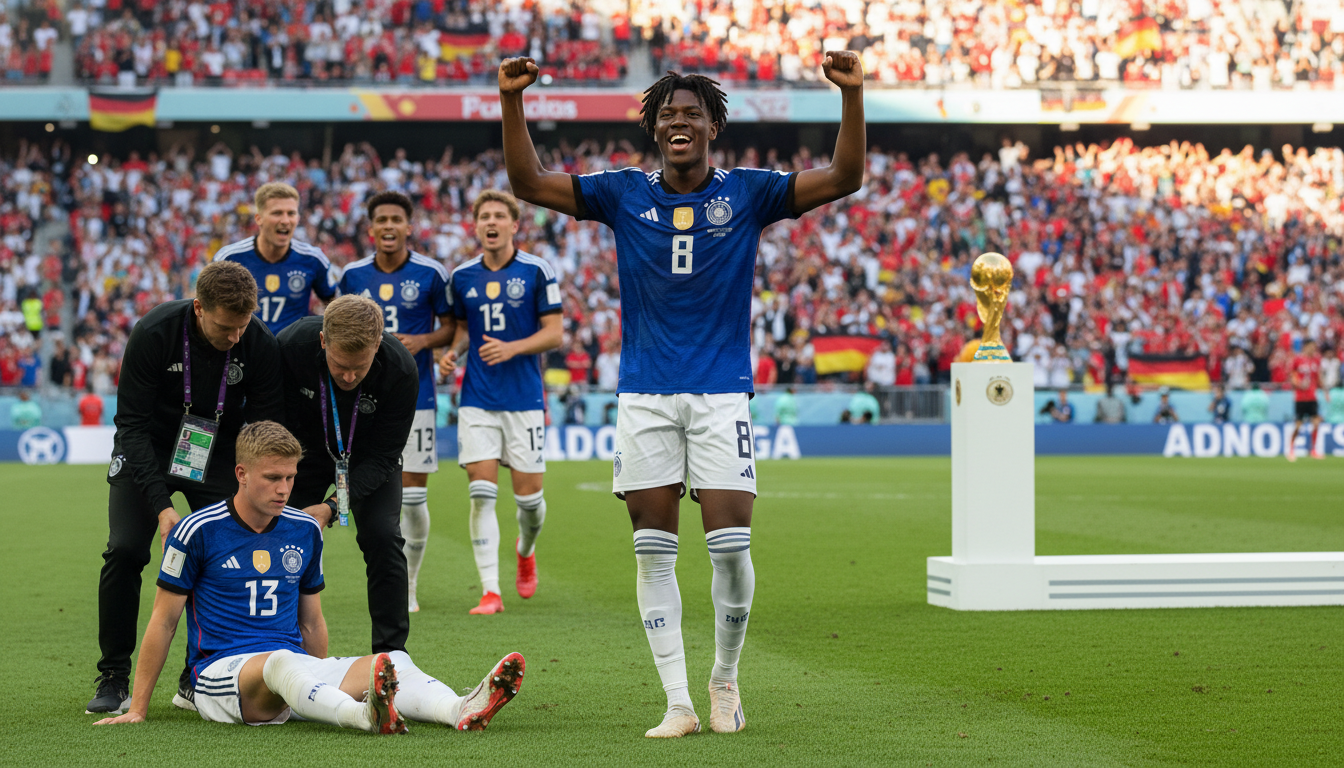
Germany has called up 20-year-old Assan Ouédraogo to replace the injured Lennart Karl in its World Cup squad, a move coach Julian Nagelsmann explained with an emphasis on fitness and recent playing rhythm. Ouédraogo, an RB Leipzig midfielder with a single senior cap, was selected over wider options amid concerns about match readiness. The decision comes less than a week before Germany’s final warm-up against the United States and ahead of the tournament kickoff.
Nagelsmann explains choice of Ouédraogo
Julian Nagelsmann said the coaching staff deliberately wanted to add another young player to the squad and ultimately picked the individual who had impressed them most during the training period. He stressed that evaluation extended beyond club form to include the player’s standing and reception within the national team environment. According to Nagelsmann, Ouédraogo earned uniformly positive feedback from teammates during camp, both for his personality and his technical attributes.
The coach highlighted that selection decisions must balance immediate utility and long-term potential, with the pressing priority being a player who can be deployed without delay. Nagelsmann made clear that readiness to step into the squad at tournament pace was a decisive factor. That assessment, he indicated, tipped the scales in favour of Ouédraogo.
Fitness and recent minutes weighed against Said El Mala
Nagelsmann was explicit about the physical considerations that ruled out other contenders, notably Said El Mala of 1. FC Köln. He noted that El Mala had not trained for roughly two and a half weeks and had not played since mid-May, a gap that would have required further time to remedy. The coach argued that a player who still needed extra preparation would be of limited use in the immediate term.
The Germany staff therefore prioritized a replacement already in competitive rhythm, able to integrate quickly into match plans and training intensity. That calculus reflected a wider squad assessment that Germany already possesses several players who can occupy wide positions. By focusing on match fitness and readiness, the coaching team sought to avoid adding a player who might arrive unprepared.
Ouédraogo’s reaction and perspective
Assan Ouédraogo described the call-up as an emotional and proud moment after initially needing time to absorb the news. He conveyed respect and sympathy for Lennart Karl, acknowledging the disappointment his teammate must feel after suffering a training injury so close to the tournament. Ouédraogo framed his selection as the culmination of sustained work and a childhood ambition coming within reach.
The young midfielder emphasized that, while excited, his outlook includes a sense of responsibility to the squad and to the injured player he replaces. He underlined his intent to be ready to contribute immediately and to support the team’s objectives at the World Cup. Ouédraogo also expressed hope for Karl’s recovery and a prompt return to action.
Implications for Germany’s squad balance
The addition of Ouédraogo adjusts Germany’s squad depth primarily in midfield options rather than expanding wide attacking variety. Nagelsmann pointed to the existing versatility of players such as Florian Wirtz, Maximilian Beier, Leroy Sané, Jamie Leweling, Kai Havertz and Jamal Musiala as reasoned coverage for wing roles. With those names available, the staff judged that adding a midfielder who brings energy and youth would better complement the group.
Tactically, Ouédraogo’s profile offers a blend of possession control and transitional pace that could be deployed centrally or in more advanced zones depending on match demands. His selection signals a continued leaning toward players who can cover multiple roles and contribute defensively as well as in build-up phases. The move preserves options for Nagelsmann while maintaining a balance between experience and emerging talent.
Ouédraogo’s club form and recent minutes
RB Leipzig used Ouédraogo during the closing stages of their season and included him on a late-May end-of-season tour to South Africa, which kept him in competitive condition. That recent playing time was a salient detail for Germany’s coaching team when assessing immediate readiness. By contrast, alternatives who had been inactive for weeks presented greater risk of lagging behind the squad’s tempo.
Ouédraogo’s club trajectory has been characterized by measured integration into senior action and promising displays at youth levels that caught the national selectors’ eye. At Leipzig he has benefited from coaching continuity and exposure to high-level training environments, factors that likely reassured the national staff about his ability to step up. His one senior cap suggests he is on the national team radar, and the call-up underscores management’s willingness to accelerate his development.
Preparation timeline before the United States friendly
Germany faces the United States in its final pre-World Cup friendly less than a week after the replacement was confirmed, compressing the time available for the newcomer to settle. Nagelsmann will have to manage training sessions carefully to integrate Ouédraogo without disrupting established patterns and relationships. The coaching team will assess which minutes the midfielder can take in the friendly while preserving his freshness for the tournament.
Match-day selections in the coming fixtures will reveal how quickly the staff is willing to deploy Ouédraogo in competitive minutes and whether he becomes a rotation option during the early stages of the World Cup. The staff’s priority, as stated, remains immediate readiness and tactical fit rather than long-term experimentation. That approach will shape how the final days of preparation are structured.
Germany’s wider World Cup plans will be tested by the need to adapt quickly to an injury-enforced change, but the staff has signalled confidence in the group’s ability to absorb the switch. The decision reflects a pragmatic assessment of form, fitness and squad chemistry in the run-up to the tournament.
The squad now moves forward with Ouédraogo integrated into preparations and with an eye on ensuring that all players are physically and mentally prepared for the demands of the World Cup.