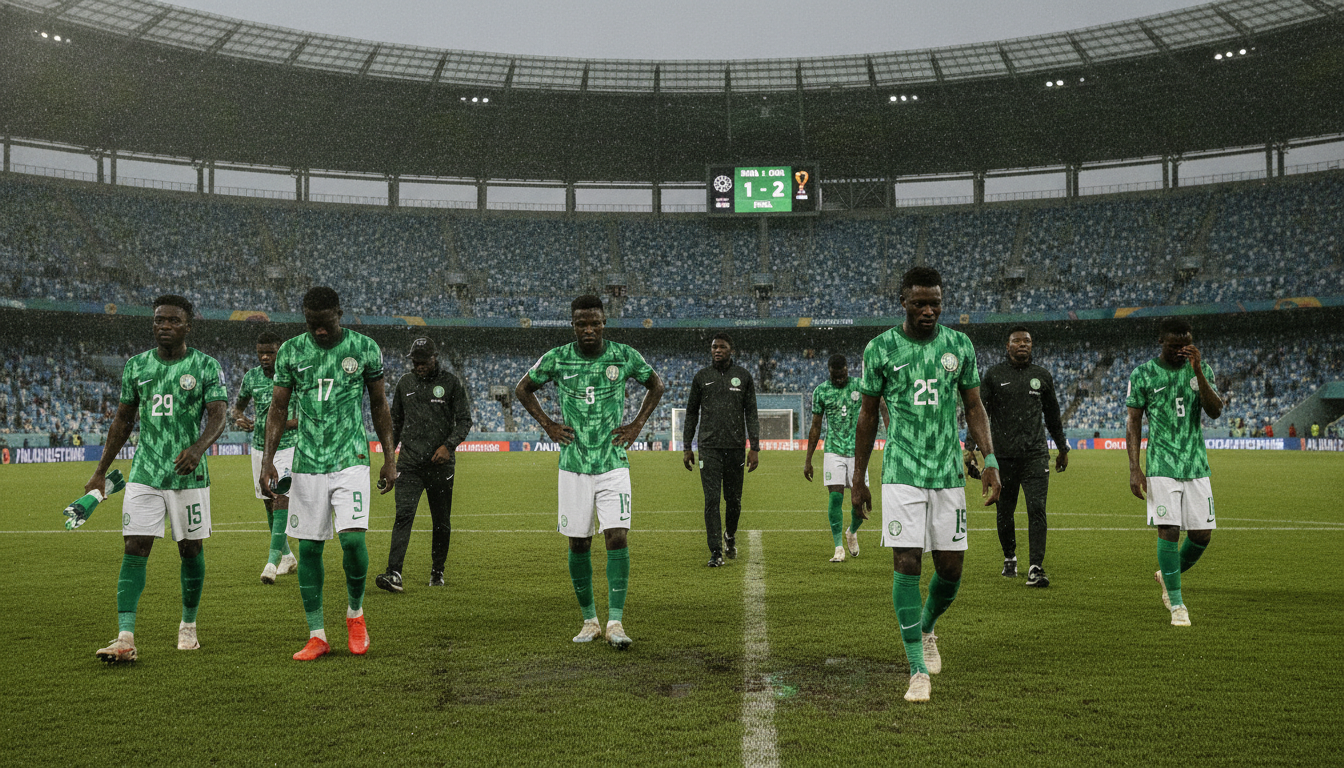
Nigeria World Cup absence underlines ranking paradox as Super Eagles sit 26th
Nigeria World Cup: FIFA ranks Super Eagles 26th — second-highest team to miss 2026. Rise under Éric Chelle contrasts with a failed qualifying campaign.

The Super Eagles find themselves in an unusual position as the 2026 FIFA World Cup kicks off across the United States, Mexico and Canada: ranked 26th in the world but watching the tournament from home. Nigeria World Cup absence has become a focal point for debate after the latest FIFA Men’s World Ranking placed the team among the highest-ranked nations that failed to qualify. The contrast between recent upward mobility in the rankings and the disappointing qualifying outcome frames a wider conversation about timing and consistency.
Super Eagles ranked 26th but miss 2026 World Cup
Nigeria’s 26th position in the most recent FIFA ranking makes it the second-highest-ranked nation not at the expanded 48-team World Cup. Only Denmark, at 21st, sits higher among non-qualifiers, underscoring how surprising Nigeria’s absence appears on paper. The ranking release on Thursday crystallized the disparity between current form and qualification results.
The placement reflects a year of mixed results that nevertheless pushed Nigeria up the table overall. Strong showings in regional competition and a string of invitational victories have bolstered the Super Eagles’ standing. Yet those improvements came too late to reverse the setbacks suffered during qualifying.
Chelle’s rebuild shows in recent results
Coach Éric Chelle presided over a visible resurgence that has lifted the team’s international profile. Under his guidance, Nigeria won the Unity Cup in London, recording a 2-0 win over Zimbabwe before a 3-0 victory against Jamaica in the final. Those performances, coupled with competitive fixtures in Europe, signaled a sharper, more cohesive squad.
The team followed the invitational success with a 2-2 draw against Poland in Warsaw, a result that highlighted attacking intent and adaptability on the road. A narrow 2-1 loss to Portugal in Leiria tempered immediate optimism but showcased the squad’s capacity to test top-tier opposition. Collectively, these results contributed directly to the upward movement in the FIFA rankings.
AFCON third place sparks jump in FIFA standings
A major factor in Nigeria’s climb was the Super Eagles’ third-place finish at the 2025 Africa Cup of Nations. That AFCON campaign produced a 12-place jump in the global standings as victories over notable African opponents strengthened Nigeria’s points total. The tournament performance served as proof of concept for Chelle’s tactical approach and player selection.
Despite the AFCON momentum, the timing of that resurgence proved decisive in the World Cup qualification context. Improvements in continental competition did not translate into the earlier qualifying fixtures that determined World Cup participants. The result is a team that looks stronger today than it did during the decisive matches that kept it out of the 2026 tournament.
Africa context: Morocco and Senegal remain ahead of Nigeria
On the continental leaderboard, Nigeria occupies the third-highest slot among African nations behind Morocco and Senegal. Morocco, ranked seventh globally, continues to lead African representation in the top tiers of the FIFA table. Senegal holds second place for the continent while Algeria and Egypt round out the top five in Africa.
The broader African landscape emphasizes how competitive the region has become, with several nations occupying comfortable positions inside the global top 30. Nigeria’s placement, while impressive regionally, nonetheless highlights missed opportunity given the country’s historical pedigree on the global stage.
Global ranking picture and the teams at the top
The latest rankings also reaffirmed the world order at the summit of the game, with defending champions Argentina occupying the top spot. Spain, France, England and Portugal follow closely behind in the top five, while Brazil sits sixth. Morocco, the Netherlands, Belgium and Germany complete the top ten, reflecting a mix of traditional powers and rising systems.
For Nigeria, being among the top 30 in such a competitive field underscores the team’s potential to compete internationally. The ranking snapshot offers context for what might have been if qualification results had aligned with the form shown in recent friendlies and tournaments.
Qualification failings and tactical lessons
Nigeria’s failure to secure a place at the World Cup remains a central issue for analysts, administrators and supporters alike. The qualifying campaign exposed inconsistencies in results and a lack of points at critical moments, which ultimately proved decisive. Tactical questions and squad management choices during those fixtures are now subject to scrutiny as stakeholders assess what went wrong.
There is also a clear line between rebuilding and delivering under pressure; the Super Eagles were able to recalibrate after AFCON and in preparatory friendlies, but not early enough to salvage the qualifying sequence. For technical staff and federation officials, the challenge is to convert sporadic improvements into sustained campaigns that deliver on major objectives.
Implications for players and the domestic game
Being ranked 26th while missing the World Cup has implications for player development, market value and international exposure. World Cup participation often serves as a showcase for talent, accelerating transfers and raising profiles for players and coaches. Nigeria’s absence will deny a number of emerging and established professionals that stage, with potential downstream effects on scouting and club interest.
Domestically, the result has intensified calls for long-term structural reforms in talent identification and the domestic league setup. Supporters and pundits have argued for improved pathways from youth levels to the senior side and for systemic changes that ensure the national team is prepared across all qualifying cycles. The federation will face pressure to present a coherent plan that translates ranking progress into tournament qualification.
Looking ahead: rebuilding and the road to 2030
The next FIFA World Ranking is scheduled for 20 July, the day after the World Cup final, offering another measurement of progress once summer fixtures conclude. For Nigeria, the intervening months provide an opportunity to consolidate gains, evaluate personnel, and prepare a strategic roadmap toward the next major qualifying cycle. That timeline will shape decisions on scheduling, player selection and the emphasis placed on youth integration.
International fixtures, training camps and targeted friendlies against strong opponents will be tools for testing tactical systems and maintaining momentum. The federation must balance short-term reputation management with long-term capacity building if the Super Eagles are to convert their ranking status into consistent World Cup appearances.
The Super Eagles’ current ranking and absence from this year’s World Cup form a paradox that will drive discussion inside Nigerian football for some time. Moving forward, officials, coaches and players will need to turn the statistical affirmation of progress into tangible success on the road to the next global tournament.