Felix Nmecha says group prayer with Curaçao players and Jonathan Tah was arranged before Germany’s 7-1 World Cup opener
Felix Nmecha says his post-match group prayer with Curaçao players and Jonathan Tah was arranged before Germany’s 7-1 World Cup opener, emphasizing faith.


Felix Nmecha has confirmed that the post-match group prayer he shared with Jonathan Tah and several Curaçao players was planned ahead of Germany’s 7-1 opening World Cup victory.
The Borussia Dortmund midfielder told Sky Germany the moment was agreed in advance with Curaçao’s squad, underlining that the gesture was meant to reflect shared faith rather than the scoreline.
Nmecha said the meeting after the final whistle was intended as a reminder that sport sits below deeper personal convictions for those involved.
Nmecha says prayer was arranged before the match
Nmecha described how the idea originated through a personal connection with Curaçao midfielder Kenji Gorré, with an understanding reached before kick-off.
He said the players resolved to gather after the game, win or lose, to pray together and to express the bonds that extend beyond national teams and competition.
That plan, he added, was motivated by faith and friendship rather than any desire to make a statement about the result on the pitch.
Nmecha emphasized gratitude for the Curaçao players’ willingness to follow through despite the heavy defeat.
He framed the circle as a moment of mutual respect, saying on-field rivalry gave way to shared beliefs in the dressing rooms and on the touchline.
How the post-match circle unfolded
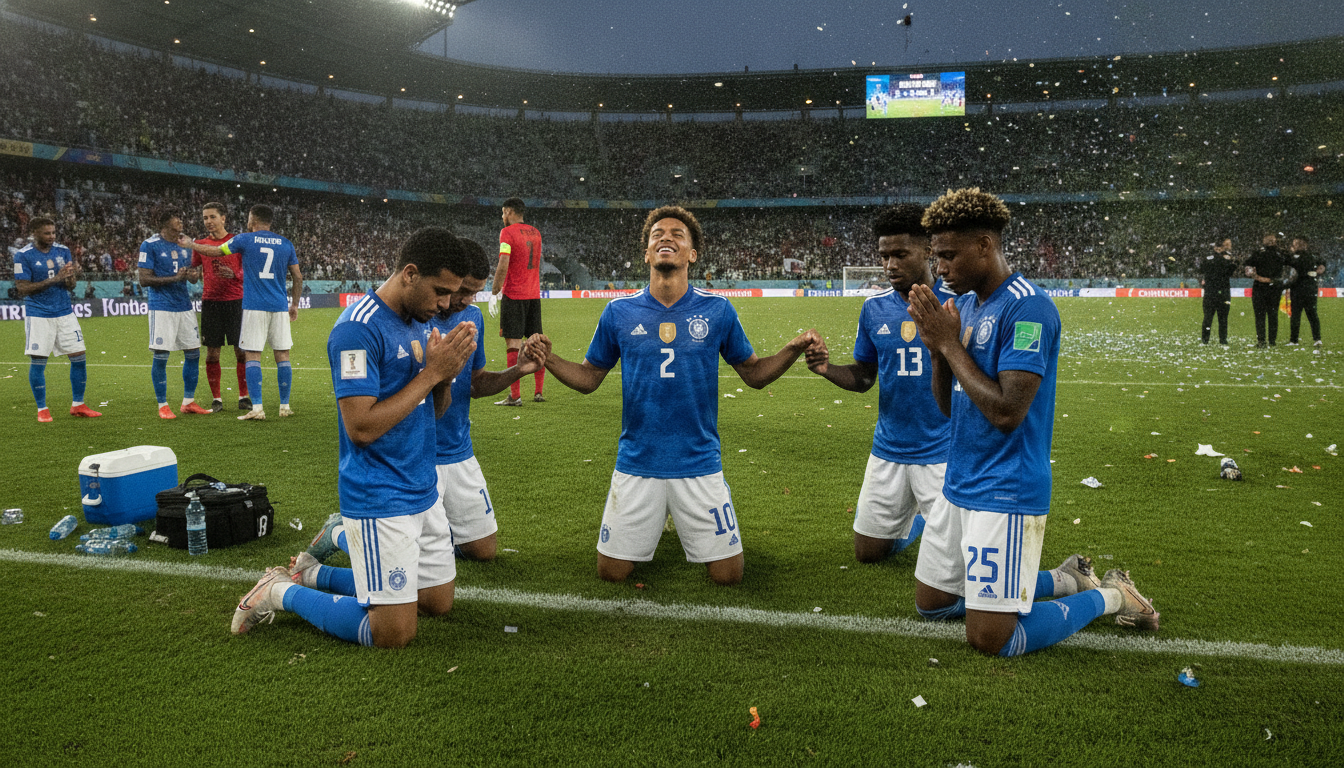
Immediately after the final whistle, several players from both sides formed a small circle on the pitch where the prayer took place.
Jonathan Tah, a senior figure in the German squad, was among those who joined Nmecha in the brief gathering that followed the rout.
Players from Curaçao, including those who had been opponents minutes earlier, stood together and took part in the prayer before leaving the stadium.
The scene lasted only a short time but carried emotional weight for participants and onlookers.
Photographs and footage from the exit showed the players in a calm, solemn huddle, a contrast to the jubilation and frustration that often follow lopsided scores.
Players involved and their connections
Nmecha and Kenji Gorré have a pre-existing relationship, which helped facilitate the pre-match agreement to meet afterwards.
Gorré, a long-serving member of the Curaçao setup, provided the link between the two teams that made the arrangement possible.
Jonathan Tah’s presence added seniority and visibility to the moment, with the Germany defender recognized for his leadership within the national squad.
Other Curaçao players who joined the circle did so as fellow believers and as athletes showing solidarity.
Their participation highlighted the personal dimensions that can cut across national allegiances in global tournaments.
Response from Curaçao and the German camp
Members of Curaçao’s delegation later described the gathering as a heartfelt display of unity after a tough result.
Curaçao staff and players accepted the invitation to pray, according to Nmecha, and appreciated the personal outreach from their opponents.
Within the German camp, reactions were measured, with the moment framed as an expression of faith and camaraderie rather than a strategic or political gesture.
Team officials on both sides have so far treated the incident as a private, voluntary act by the players involved.
There has been limited official commentary beyond acknowledgement of the exchange and the mutual respect it signified after the match.
Faith and football: how religion appears on the pitch
Religious observance by players is a familiar sight in international football, from brief gestures of thanks to pre-game rituals and post-match gatherings.
For many athletes, faith is a personal anchor that survives the highs and lows of competition and can shape their conduct during tournaments.
The Nmecha-led prayer is an example of how players sometimes use moments of visibility to express shared beliefs with opponents.
Such incidents often prompt debate about the role of religion in public sporting events, with perspectives ranging from praise for personal conviction to calls for clear boundaries.
In this case, participants framed the act as a private expression of faith, not a proselytizing effort or an attempt to send a message to fans or media.
Media reaction and public discussion
Social media and sports coverage reacted swiftly to images of the post-match gathering, with commentary reflecting a mix of admiration and curiosity.
Supporters and commentators praised the gesture as a humane response after a one-sided result, citing sportsmanship and the human side of elite competition.
Other voices asked questions about visibility and context, noting how moments like this can be interpreted differently depending on cultural and national perspectives.
Broadcasters and journalists covered the exchange without making it the central story of the match, which remained focused on Germany’s dominant performance.
Still, the image of rivals praying together provided a compelling human-interest angle that accompanied analysis of tactics and player performances.
Potential implications for team dynamics and tournament narrative
For Germany, the result and the post-match exchange may be folded into a larger narrative of a side asserting itself early in the competition while remaining grounded.
Nmecha’s actions, combined with his on-field contribution, could shape perceptions of him as both a performer and a figure of character within the squad.
For Curaçao, the moment offered a dignified response to a difficult scoreline and a demonstration of cohesion and faith among players.
Tournament observers will likely cite the episode as one example of how international competition can produce moments of mutual respect that transcend the scoreboard.
Whether it translates into any longer-term influence on team relations or public discourse will depend on how players, officials, and media continue to frame the incident.
The mutual decision to pray together after the match, Nmecha insisted, was a human moment chosen by the players themselves and rooted in personal conviction.
He thanked Kenji Gorré and the Curaçao players for following through on their pre-match agreement, noting that such gestures are not taken for granted in defeat.
As the tournament progresses, the episode will remain a reminder that football can produce both fierce competition and unexpected displays of unity.
Players and supporters alike will watch how similar moments are received and whether they become more common at high-profile events.
The gesture on the pitch between Germany and Curaçao illustrated that, for some athletes, belief and brotherhood are as important as the result recorded on the scoreboard.