Nagelsmann joins Tuchel in criticising photographers during national anthems at World Cup
Germany coach Julian Nagelsmann has joined Thomas Tuchel in publicly criticising the positioning of photographers during national anthems at the 2026 World Cup, saying the close proximity obstructs the emotional connection between coaches and players. (washingtonpost.com)


Opening summary of the complaints
Julian Nagelsmann and Thomas Tuchel have separately aired frustration about photographers standing directly in front of team benches during the playing of national anthems at the 2026 World Cup. The criticism centres on the claim that photographers’ placement prevents coaches from seeing and connecting with their players at a formal moment before kick-off. (washingtonpost.com)
Tuchel first raised the issue after England’s 4-2 win over Croatia, saying he was effectively blocked by a “wall” of photographers and could not see his squad during the anthem. Nagelsmann echoed that concern after Germany’s match, describing the positions as “very close” and noting they interrupted an important pre-game exchange. (washingtonpost.com)
Tuchel’s complaint after England’s World Cup opener
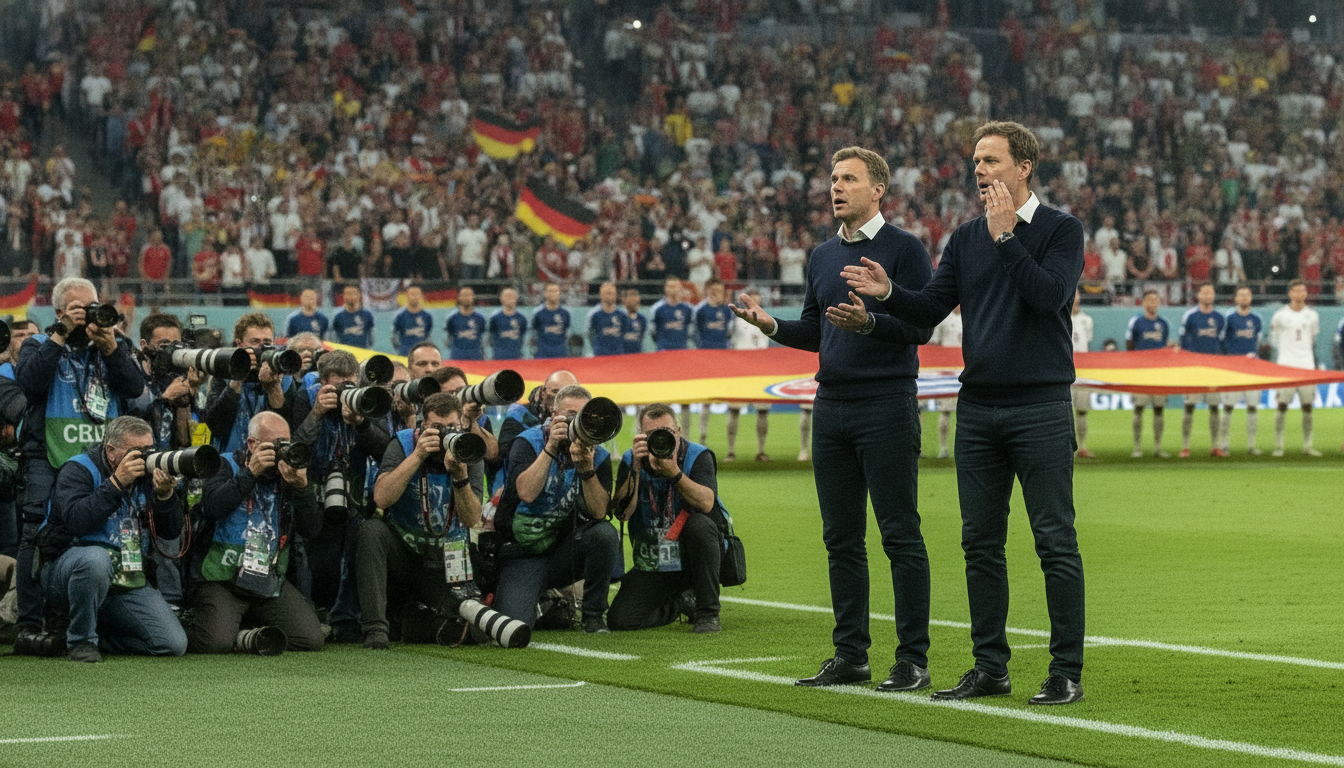
Thomas Tuchel, making his England World Cup debut, told reporters he was standing “in front of a wall of 50 photographers” during the playing of “God Save The King” and could not see a single player. He said the experience, which he had been anticipating, was “ruined a little bit” by the obstruction. (washingtonpost.com)
The incident occurred at the Arlington, Texas venue on June 17, 2026, and the images of the bench-area photographers drew immediate commentary on social media and in the press. Tuchel used his post-match press conference to urge FIFA to reconsider photographer positioning so coaches can observe their players at a significant ceremonial moment. (lequipe.fr)
Tuchel’s remarks were framed as a request rather than an ultimatum, but they nevertheless prompted tournament organisers and broadcasters to assess whether standard accreditation positions were unintentionally undermining pre-match protocol. Several outlets reported that officials were already considering adjustments. (newswav.com)
Nagelsmann echoes concern after Germany win
Julian Nagelsmann reinforced Tuchel’s criticism after Germany’s victory against Ivory Coast, saying he agreed that photographers were “super close” and that the arrangement reduced the opportunity for a meaningful coach-player moment. He quipped that large camera lenses felt so near they could be photographing the “nose hairs” of those on the touchline. (sport1.de)
Nagelsmann framed his complaint in the context of normal match routines, noting that photo positions in Bundesliga or Champions League fixtures are generally less intrusive, while the World Cup setup appeared to place photographers unusually close to technical areas. His comments reinforced a growing chorus of coaches and team staff raising concerns about dignity and decorum in the pre-match period. (sport1.de)
The German head coach explicitly connected the photographers’ placement to the loss of an “opportunity to connect” with the squad, a phrase that has resonated among managers for whom pre-game ritual is considered a brief but important leadership moment. (as.com)
FIFA’s protocol and the reported response
Reports emerging in the days after Tuchel’s complaint said FIFA had reviewed the accreditation and physical positioning of photographers for anthem and squad shots. Media accounts indicated that officials planned to reposition photographers nearer the halfway line or in a grouped “huddle” to avoid blocking the touchline view. Those changes were described as an attempt to preserve both photographers’ access and coaches’ sightlines. (newswav.com)
Tournament organisers have defended the purpose of the current arrangement, saying it is intended to give broadcasters and image agencies consistent access for official anthems and squad shots. At the same time, sources cited by several news outlets acknowledged that the proximity in some stadiums had exceeded what coaches expect during domestic competition. (washingtonpost.com)
Any formal protocol adjustment would need to reconcile competing demands: photographers require positions to capture wide squad presentations and crowd reactions, while teams and coaches seek an unobstructed line of sight for ceremonial moments. Officials told media that revisions were being discussed to find a middle ground without compromising credentialed media duties. (newswav.com)
Photographers’ role, accreditation and practical constraints
Photographers covering a World Cup are typically accredited and directed to specific locations by the tournament’s media operations team to ensure both safety and consistent coverage. Positions in front of benches have traditionally been used for close-up images of coaches and staff during ceremonial moments, as well as for capturing squad-wide frames from an advantageous angle. (washingtonpost.com)
The recent complaints underline a perennial tension in major events between the needs of visual media and the ceremonial discretion of teams. Photographers argue that compact placement in front of the technical area allows for efficient coverage of both anthems and pre-game formalities, while coaches say that such placement can intrude on the dignity of those moments. (washingtonpost.com)
Operational factors also complicate quick fixes. Stadium geometry, sightlines for television cameras, cable runs and safety zones constrain where photographers can stand. Any reconfiguration needs to be coordinated with broadcasters and host venue staff to maintain broadcast standards and to ensure that photographers do not endanger themselves or others. (washingtonpost.com)
Broadcast and tournament operational implications
Broadcasters require reliable, repeatable camera and photographer positions to meet production schedules and to fulfil contractual obligations for image delivery. Moving photographers substantially further from the benches could force broadcasters to adjust relay equipment, lens choices and shot compositions to maintain the same editorial coverage. Tournament organisers must weigh those technical demands against coaches’ and teams’ requests. (newswav.com)
Any sustained change to photographer placement may lead to modified accreditation zones and a fresh set of guidance for media on how to shoot anthems and team presentations without obstructing coaches. Venue-specific plans could be introduced so that stadiums with narrow touchlines adopt different configurations from those with more space. Such tailored arrangements were among the options discussed in media reports following the complaints. (newswav.com)
There is also a reputational element. Images of coaches visibly obstructed by photographers circulated widely on social platforms, prompting public debate about respect for ceremonial traditions at global tournaments. Organisers are mindful that perceived missteps during opening sequences can distract from on-field action and fan experience. (washingtonpost.com)
Responses and perspectives from stakeholders
Coaches have framed their objections as a call for modest procedural changes rather than broad restrictions on accredited media. Both Tuchel and Nagelsmann presented their concerns in the context of preserving ceremony and human connection at important moments, asking for adjustments that would not prevent photographers from doing their job. (washingtonpost.com)
Photographers and media agencies, for their part, point to the logistical challenges of obtaining the necessary angles for anthem coverage and to longstanding routines that maximise image output in tightly scheduled match build-ups. Some photographers have suggested that alternative lensing strategies or slightly staggered positions could accommodate both needs. (washingtonpost.com)
FIFA and tournament media operations face a practical decision: introduce a uniform change across all venues or allow venue-by-venue discretion. The former would create consistency for teams and media, while the latter might better reflect the variations in stadium design and broadcast setups. Early reports indicate officials are leaning toward pragmatic, stadium-specific adjustments. (newswav.com)
Final paragraph: The debate over photographers during national anthems at the 2026 World Cup has moved quickly from social-media commentary to official consideration, with leading managers publicly requesting a review and organisers reportedly exploring immediate changes to photographer positioning. The coming days are likely to show whether those adjustments will be universally applied or tailored to each venue, but the episode has already highlighted the careful balance tournament organisers must strike between media access and the ceremonial dignity of international football.