Bafana Bafana World Cup run celebrated as South Africa returns home after historic knockout appearance
Bafana Bafana World Cup: South Africa’s national team received a rapturous welcome at OR Tambo after reaching the World Cup knockout stage for the first time, then bowed out to Canada. The return sparks reflection and renewed ambition ahead of AFCON and 2030 qualifying.

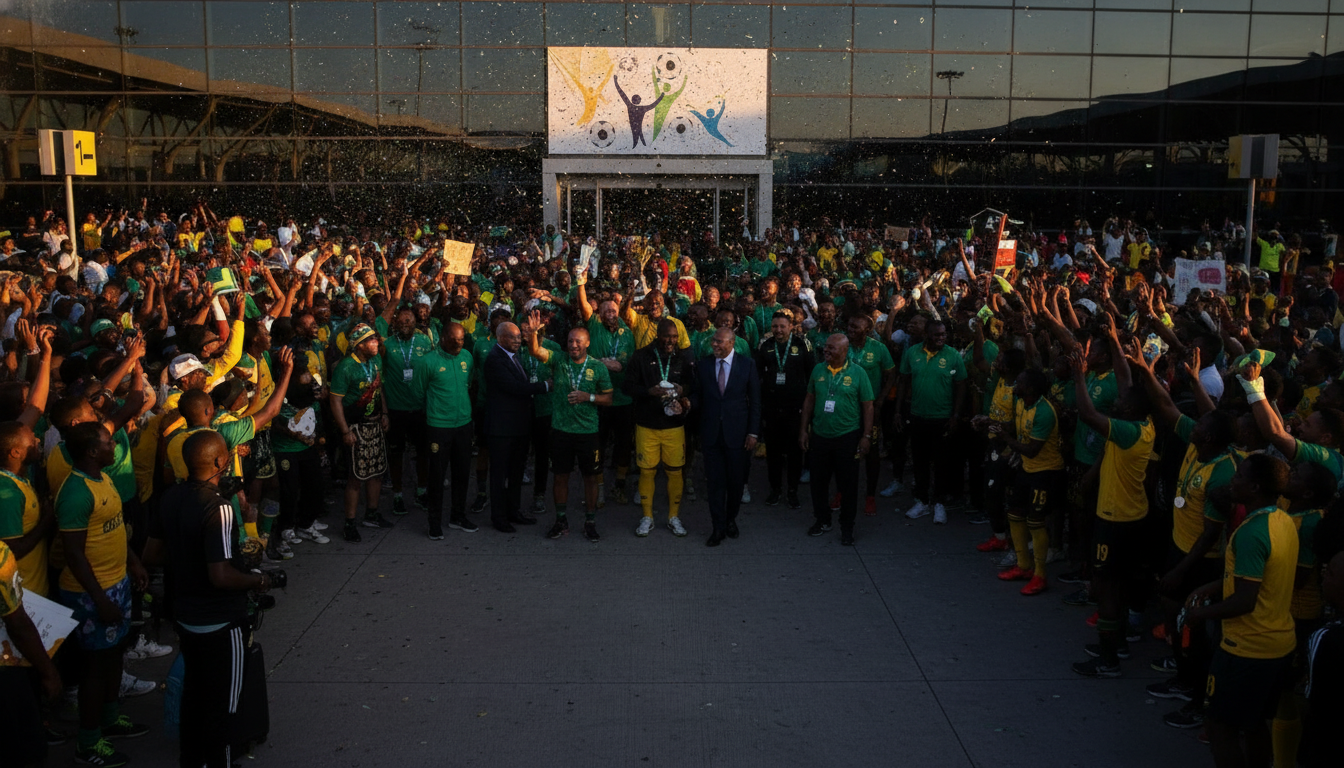
Bafana Bafana returned to Johannesburg to a celebratory reception at OR Tambo International Airport after the squad completed a historic run at the 2026 FIFA World Cup. The team advanced from the group stage into the tournament’s knockout phase for the first time in South African history, sparking nationwide celebrations. Their campaign ended with a 1-0 defeat to co-host Canada in the last-32 match at Los Angeles Stadium, but the visit home focused on the milestone rather than the exit.
Fans greet Bafana Bafana at OR Tambo International Airport
Hundreds of supporters turned out to meet the returning players and staff as flights arrived from the United States. Flags, chants and songs greeted the squad, reflecting widespread public enthusiasm for the team’s achievement. The scene underscored how deeply the World Cup run resonated across communities and generations.
Local media and photographers documented the arrival, while officials from the football association coordinated the team’s brief public appearances. Airport security facilitated a controlled but emotional meet-and-greet, allowing families and fans to briefly share in the moment. The reception provided a public closure to the tournament for many supporters who followed the campaign from home.
Captain Ronwen Williams praises nationwide support
Captain Ronwen Williams addressed journalists in Johannesburg and expressed gratitude for the public backing through the tournament. He said the players felt the nation’s encouragement every step of the way and that it buoyed their performances on the world stage. Williams reflected on unity and appreciation as central themes of the return.
Williams highlighted the emotional impact of the support rather than focusing solely on the defeat, emphasizing collective pride in reaching the knockout phase. He credited the team’s resilience and the fans’ faith for helping Bafana Bafana perform on a bigger stage. The captain framed the campaign as a milestone that belongs to the country and not just the players.
Hugo Broos hails historic World Cup progress
Head coach Hugo Broos described the World Cup outcome as a milestone for South African football and expressed satisfaction with the squad’s performance. He noted that achieving the second round had been an explicit goal and that reaching it validated long-term work within the program. Broos praised the squad’s discipline and the coaching staff’s preparations throughout the tournament.
Broos also emphasized the learning value of competing against high-caliber international opponents and said the experience should accelerate player development. He framed this World Cup as a stepping-stone rather than a peak, pointing to the benefits of exposure at elite level matches. The coach urged stakeholders to sustain momentum by investing in training, scouting and international fixtures.
Match summary: Canada ends South Africa’s run in last 32 at Los Angeles Stadium
Bafana Bafana’s World Cup journey concluded with a narrow 1-0 defeat to co-hosts Canada in the tournament’s round of 32. The match was tightly contested and decided by a single goal, reflecting fine margins that separated the teams at that stage. South Africa showed tactical organization, but Canada managed to convert a decisive moment and advance.
The encounter offered South Africa meaningful competition against a top-level opponent and revealed areas for tactical refinement. Defending set pieces, transition speed and final-third conversion were among elements identified for improvement after the loss. Despite the elimination, the performance against a strong Canadian side provided a clear benchmark for future international fixtures.
Experience to bolster AFCON bid and 2030 World Cup aim
Both captain and coach framed the World Cup experience as foundational for upcoming targets such as the Africa Cup of Nations and qualification for the 2030 World Cup. They signaled that the lessons learned in match preparation, squad rotation and in-game management will be applied to continental and qualifying campaigns. The tournament exposed young players and coaching staff to environments that accelerate maturity.
Officials and technical staff spoke about converting short-term experience into long-term planning, with a focus on talent pipelines and domestic league alignment. The coaching group wants to use the window after the World Cup to consolidate depth, especially in positions where international exposure proved essential. Qualification for 2030 was positioned as a realistic objective if the federation sustains investment and continuity over the next three to four years.
Domestic impact and next steps for South African football
Observers noted that Bafana Bafana’s World Cup breakthrough could catalyze broader attention to the domestic game, from grassroots academies to stadium infrastructure. Increased public interest may translate into higher attendance for league matches and stronger commercial opportunities for clubs and the national association. Administrators emphasized the need to convert goodwill into concrete measures that develop coaching standards and youth scouting.
The national federation plans to run targeted programs that harness the momentum, including training camps, international friendlies and scouting initiatives for underage national teams. Broos and his staff flagged the importance of continuity in coaching and clearer pathways for academy graduates to reach senior football. Stakeholders urged measured and sustainable investment to ensure the World Cup moment becomes a durable step forward rather than a transient celebration.
Building on the squad’s international exposure, technical directors aim to expand opportunities for South African players to compete abroad, which would raise standards when they return for national duty. The federation is expected to engage clubs, sponsors and government agencies in discussions about facilities, coaching accreditation and competitive scheduling. Success, they argue, will depend on coordinated action across the sport’s ecosystem.
The team’s return has already inspired young players across the country, with grassroots coaches reporting a surge in interest among boys and girls wanting to emulate the national side. That grassroots energy, if harnessed with structured coaching and pathways, could feed future national teams and help maintain South Africa’s presence on the global stage. For now, the nation’s attention is divided between celebration and pragmatic planning.
Bafana Bafana’s 2026 World Cup campaign delivered a defining national moment: a first advance to the knockout round and a profile boost for South African football. The welcome at OR Tambo and the messages from players and staff highlighted pride in the collective achievement while acknowledging where improvement is needed. Looking ahead, officials, coaches and fans share an appetite to translate this milestone into lasting progress on the continent and in global qualifying efforts.