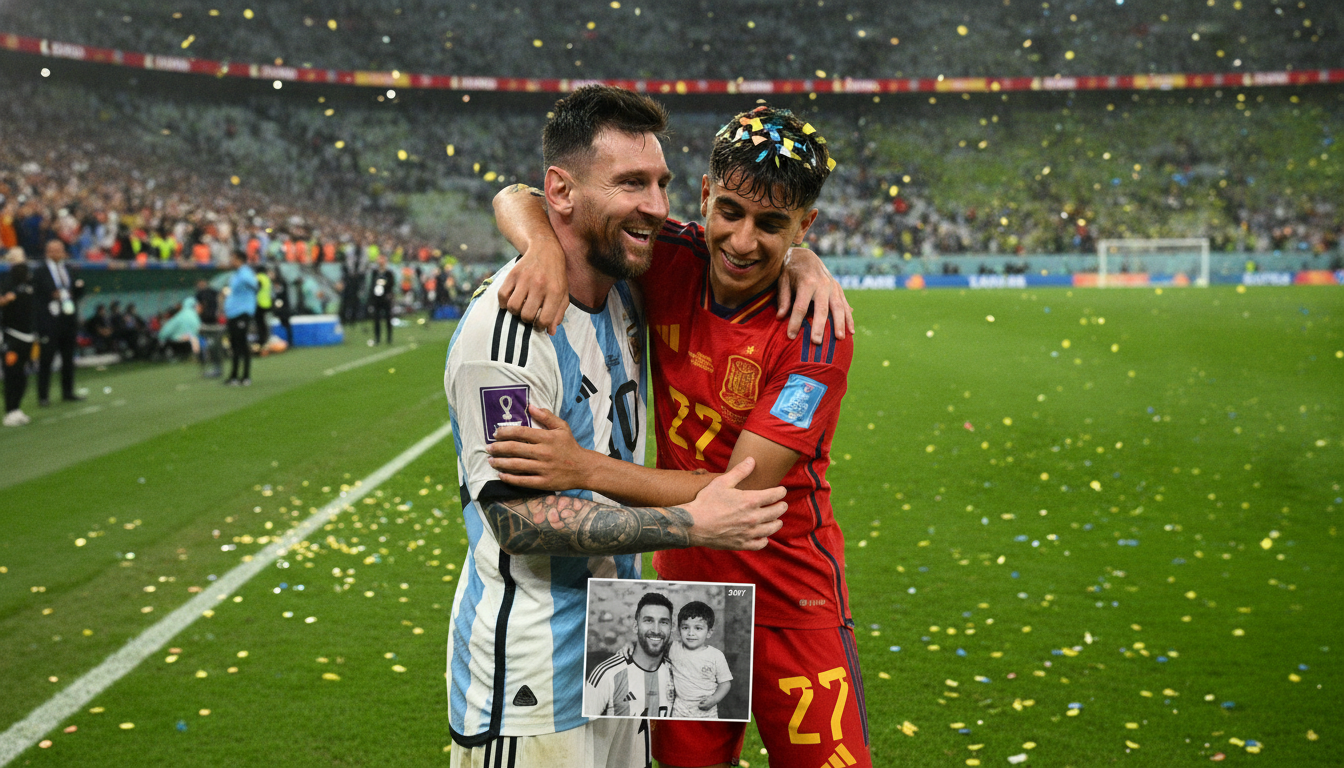
Messi and Lamine Yamal: From 2007 UNICEF Photo to First World Cup Final Meeting
A resurfaced 2007 UNICEF photoshoot of Lionel Messi cradling an infant Lamine Yamal has set the stage for a compelling narrative as Messi and Lamine Yamal prepare for their first meeting on the pitch in Sunday’s World Cup final. The image, taken during a Barcelona-organized calendar shoot, has been widely shared as the veteran Argentina forward faces the Spain teenager in a match that blends football history with a human-interest story.


The photograph and the moment it represents have captured attention beyond the pitch, adding a poignant backstory to what is already one of the most anticipated fixtures in international football this tournament. Fans, pundits and media outlets have highlighted the coincidence as emblematic of football’s intergenerational ties and Barcelona’s long shadow on world talent development.
A childhood photograph resurfaces ahead of the final
The image of a young Messi with the infant Yamal remained private for years before being posted publicly by Yamal’s father after his son’s international breakthrough at Euro 2024. That post propelled the picture into global circulation and added a fresh human angle to the narrative surrounding the World Cup final.
Photographer Joan Monfort, who shot the calendar for Barcelona and UNICEF, later reflected on the striking coincidence of the two careers converging on football’s biggest stage. The story has been framed in many outlets as a serendipitous linking of football generations and the long reach of club and charitable campaigns.
The resurfacing of the photograph has prompted renewed interest in Barcelona’s role in youth engagement and in the personal histories behind high-profile matches. For many supporters the image crystallizes a narrative of continuity, where childhood encounters can precede global sporting encounters years later.
How the Barcelona UNICEF shoot brought them together
The photo was taken as part of a charity calendar organized by Barcelona in partnership with UNICEF, a campaign that historically involved players meeting children and families connected to relief efforts. Invitations to participate were distributed through local outlets, and Yamal’s parents reportedly attended after winning a raffle organized by the Catalan sports paper Sport.
Barcelona’s outreach programs have long included promotional and philanthropic activities that create intimate moments between stars and the community. This particular shoot was one of those moments, captured by Monfort and stored away until recent events made it culturally resonant.
That the two figures captured in a casual, charitable moment would later become central figures in a World Cup final underscores how football’s institutional practices—club campaigns, youth engagement, and media—can produce lasting, unexpected narratives. The image now travels worldwide with a new symbolic charge.
From baby to breakthrough: Yamal’s rise to Euro 2024 stardom
Lamine Yamal’s ascent from a prodigious Barcelona academy prospect to a senior international breakthrough at Euro 2024 has been rapid and widely reported. His performances for club and country earned him a reputation as one of the most exciting young attackers in Europe, with a blend of pace, creativity and technical confidence.
Yamal’s presence in Spain’s squad for the World Cup and his minutes on the field have been framed as the latest chapter in a fast-moving career that many expect to mature into a long-term international presence. His trajectory has drawn comparisons to other teenage talents who quickly translated youth success into senior opportunity.
The re-emergence of the childhood photograph has intensified public scrutiny of Yamal’s every step, but coaching staff and teammates have emphasized preparation and collective focus ahead of the final. For Yamal, the narrative thread linking his infancy to this moment carries sentimental weight, but team sources stress that the contest will be decided by tactical discipline and form on the day.
Messi’s enduring career and veteran leadership
Lionel Messi arrives at the World Cup final as a veteran with a trophy-laden career and a global profile shaped over two decades. His status as a generational talent and an enduring presence in elite football has made any match involving him a high-stakes event on multiple levels, both sporting and symbolic.
Messi’s leadership for Argentina has combined individual brilliance with an ability to galvanize teammates in recent major tournaments. His approach to big matches marries meticulous preparation with a long habit of delivering decisive moments in finals and knockout contests.
Facing a bright young Spaniard whose earliest photos once captured him in Messi’s arms adds a poetic dimension, but Argentina’s tactical focus will remain on neutralizing Spain’s strengths and exploiting space. For Messi, the match is another opportunity to define legacy in sport’s most visible arena.
Tactical and emotional stakes for the World Cup final
On the field, the contest between Argentina and Spain presents a clash of styles and personnel that will test both teams’ adaptability. Spain’s possession-based approach and young attacking threats contrast with Argentina’s blend of experience, forward incisiveness and midfield invention.
Coaches on both sides will weigh how to handle key individual matchups, including how defenders and midfielders contain Yamal’s unpredictability while denying Messi the pockets of space he needs. Set pieces, transitional moments and squad depth will likely prove decisive over 90 or potentially 120 minutes.
Beyond tactics, there are emotional and narrative stakes tied to the photograph and the generational link it represents. For players, staff and viewers, the match carries a symbolic resonance that goes beyond the scoreboard, tapping into themes of continuity, mentorship and the global reach of club systems like Barcelona’s.
Fan reaction and the narrative of football generations
Social media and fan forums have amplified the story of the photograph, with supporters on both sides sharing images and reflections that tie personal memory to sporting spectacle. The narrative has given journalists and commentators an accessible human-interest angle to explore alongside tactical analysis.
Commentators have framed the meeting as a moment where football’s layered timelines intersect, highlighting how a simple charitable photoshoot can later appear historic in light of unfolding careers. The image has also prompted discussion about the role of clubs in shaping global narratives and about how early encounters can prefigure major events.
At the same time, analysts caution against turning a one-off photograph into deterministic meaning. Football remains driven by preparation, form and decision-making on match day, and while the story enhances public interest, it does not alter the practical realities coaches must address.
A closing reflection on the wider implications of the moment
The photograph of Lionel Messi and Lamine Yamal originally captured as a private, charitable encounter has been reinterpreted as a narrative bridge between football eras as the two meet for the first time on the World Cup final stage. That convergence—born from a Barcelona-UNICEF initiative, amplified by fortune and social media, and realized in a global final—illustrates how sport frequently binds personal histories to public spectacle.
Whatever the outcome on the scoreboard, the image will remain a lasting cultural touchpoint, offering an emblem of how careers and lives can intersect in unexpected ways. The match will be remembered not only for its result but also for the human story behind a photograph that quietly foretold a rare and poetic meeting.