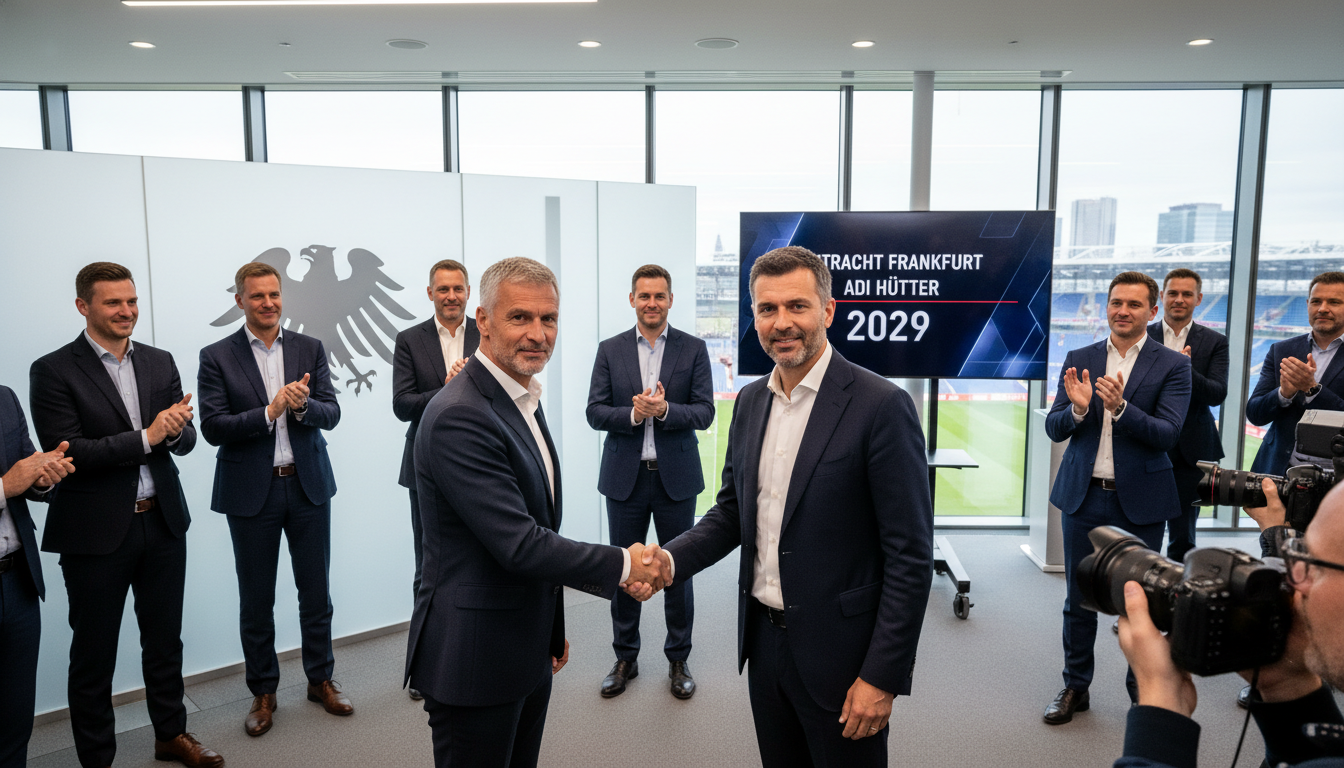
Adi Hütter return to Eintracht Frankfurt imminent as club prepares official announcement
Adi Hütter return to Eintracht Frankfurt is expected to be confirmed on May 31, 2026, with the Austrian poised to sign a multi-year contract to restore stability.


Eintracht Frankfurt look set to complete the deal to bring Adi Hütter back to the club on May 31, 2026, after talks accelerated over the weekend and both parties reached an agreement. The return of Hütter to Eintracht Frankfurt is being framed by the club as a move to re-establish calm and long-term leadership following a turbulent recent spell. The Austrian, who previously managed the Hessen side between 2018 and 2021, is reported to be signing a contract that would extend through 2029. The club aims to leverage Hütter’s familiarity with the organisation and the dressing room as it seeks to stabilize performance on and off the pitch.
Agreement reached after late-night talks
Sky Germany reported the breakthrough after intensive discussions on Saturday evening, with both sides said to have settled key terms and cleared the way for a formal announcement. The agreement reportedly covers sporting control, staff structure and a commitment to a longer-term project, indicating Eintracht’s desire to avoid another short-term managerial experiment. Sources within the club believe that Hütter’s knowledge of the club’s culture and internal dynamics was decisive in the final stages of negotiation.
Both the club hierarchy and Hütter are understood to have moved quickly to iron out contractual details once the principal agreement was made, leaving only formalities ahead of the expected signing. That timing has allowed Eintracht to present a clear succession plan to supporters after a period of uncertainty that followed the departure of the previous coach.
Contract terms and timeline
Reports indicate the contract offered to Hütter will run until 2029, a length that signals Eintracht’s intent to build continuity rather than seek immediate short-term fixes. The proposed agreement is said to cover broader sporting responsibilities, including input on recruitment and a mandate to stabilise the first team’s results. A multi-year deal fits the club’s stated aim of returning to a steadier footing both domestically and in European competition.
The timetable provided by club officials targeted May 31, 2026, for the public announcement and for Hütter to put pen to paper, marking a swift conclusion to a recruitment process that prioritized speed and decisiveness. Once formalities are complete, the transition is expected to be managed in close coordination with existing staff, and the club will outline its plan for preseason preparation under Hütter’s leadership.
Why Eintracht opted for a familiar figure
Eintracht’s decision to pursue Hütter reflects a preference for a candidate who already understands the club’s expectations and structure. During his previous tenure between 2018 and 2021, Hütter developed relationships across the organisation that the board believes will facilitate a smoother re-entry. That familiarity also reduces the acclimatisation period that a completely new appointment would require, an important consideration given the compressed timeline ahead of the new season.
Club officials have emphasised the need for authority and steady leadership after a period of instability, and Hütter’s reputation for decisive management and clear organisational principles was a central factor in the recruitment. The appointment is intended to bring coherence to the squad’s tactical identity and to provide a clear pathway for player development and recruitment aligned with Eintracht’s sporting objectives.
Context of Albert Riera’s departure
Albert Riera’s short spell as Eintracht coach concluded amid what the club described as unsatisfactory results and internal turbulence, creating the vacancy Hütter is set to fill. The club made the decision to part ways with Riera after a brief and challenging period, and the board moved quickly to secure a successor who could restore stability. Supporters and stakeholders had called for a settled presence to steady the team’s preparations for the coming campaign.
The change of coaches highlighted structural questions within the sporting department that Eintracht now aim to address through the Hütter appointment, including clearer lines of responsibility and greater stability around the first-team environment. The new agreement reportedly includes provisions to ensure better alignment between the coaching staff and the club’s recruitment and sporting directorate.
Immediate challenges and objectives for Hütter
Upon taking charge, Hütter will inherit a squad that requires consolidation and a clearer tactical identity, with the short-term task of steadying results and improving consistency. Preseason will be critical for assessing squad needs and implementing Hütter’s methods ahead of competitive fixtures, and the club will be judged on how quickly it can translate the appointment into on-field improvements. The mandate to stabilise performance includes setting standards in training, sharpening defensive organisation and ensuring the team is competitive in league and cup competitions.
Beyond immediate results, Hütter faces the task of influencing transfer strategy and integrating new signings to fit a coherent game model, all while managing supporter expectations that inevitably rise with the return of a familiar coach. The club’s hierarchy will watch early indicators closely, seeking evidence that the squad is responding to the renewed leadership and that the broader organisational adjustments are yielding results.
Supporter reaction and club messaging
Initial reaction among Eintracht supporters has been mixed but broadly anticipatory, with many welcoming the return of a coach who previously guided the club through significant moments. Club communications have emphasised stability, continuity and a long-term sporting plan as cornerstones of the decision to reappoint Hütter. The front office has also sought to stress the importance of unity and patience while the coach implements his approach.
Eintracht’s messaging aims to reassure fans and stakeholders that the appointment is a considered step toward rebuilding consistency, and that sporting decisions will be guided by a coherent strategy rather than short-term impulses. Supporter groups and former players will be watching closely as Hütter begins work, with early preseason results likely to shape public sentiment.
The club intends to stage a formal presentation following the completion of the agreement, at which time Hütter will outline his immediate priorities and staffing decisions. That event will be used to set expectations for the season ahead and to signal the start of a project aimed at restoring the club to a more stable competitive footing.
Looking ahead, Eintracht Frankfurt face a summer of decisions as they translate the managerial appointment into a concrete sporting plan. The club will need to coordinate recruitment, staff appointments and preseason programming quickly to maximise the benefits of Hütter’s return. Success will be measured not only in wins but in the re-establishment of a consistent identity and improved performance across competitions.
The coming weeks will show whether Adi Hütter’s return to Eintracht Frankfurt delivers the stability and direction the club seeks, as he prepares to take up a multi-year mandate starting May 31, 2026.