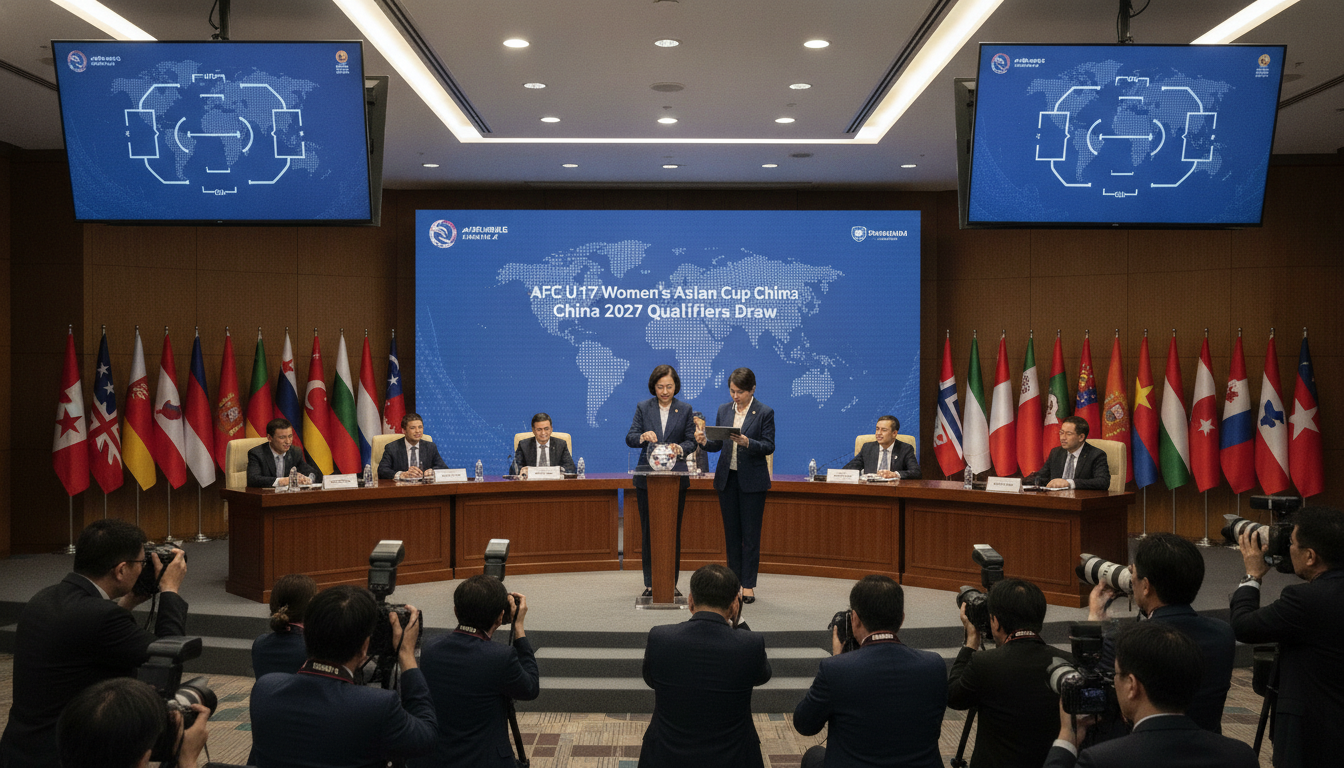
AFC U17 Women’s Asian Cup China 2027 Qualifiers draw sets stage as 30 teams divided into eight groups
AFC U17 Women’s Asian Cup China 2027 Qualifiers draw in Kuala Lumpur divides 30 teams into eight groups; group winners advance to join four direct qualifiers in the Finals.


The draw for the AFC U17 Women’s Asian Cup China 2027 Qualifiers on 17 July 2026 put the competition on a clear path, with 30 teams placed into eight groups to contest centralised single round-robin mini-tournaments from October 5–11, 2026. The AFC U17 Women’s Asian Cup China 2027 Qualifiers will see each group winner qualify for the Finals, where they will join DPR Korea, Japan, Australia and China PR, the four teams that secured direct berths via the 2026 tournament. The draw, conducted at AFC House in Kuala Lumpur, marks the start of the official qualifying calendar for Asia’s top under-17 women’s national teams.
Draw splits 30 teams into eight groups
The Qualifiers draw produced six groups of four teams and two groups of three, balancing the field across a mix of regions and seeding pots. Each group will be contested as a single round-robin centralised mini-tournament, with all teams meeting once and three points awarded for a win. The compact format means teams will face intense schedules across the window of October 5–11, 2026, placing a premium on squad depth and recovery.
Tournament organisers opted for centralised hosting for each group rather than home-and-away fixtures, a format designed to reduce travel variables and create consistent match conditions. Centralised groups also simplify logistics for smaller associations and allow the AFC to enforce uniform medical, broadcast and competition protocols. The configuration of six four-team groups and two three-team groups reflects both the record entry of 30 nations and the need to finish qualifying within a single international window.
The distribution of teams through seeding pots aimed to spread higher-ranked sides across different groups and avoid early clustering of favourites. While the draw mechanics were procedural, several matchups immediately stood out on paper as potential highlights for scouts and supporters. For many smaller associations, the draw offers an accessible route to high-level competition and exposure for emerging players.
Schedule confirmed for October window
The AFC confirmed that all group matches will be played between October 5 and October 11, 2026, providing a clear international window for federations to prepare. The one-week schedule compresses fixtures into a tight timeframe, requiring teams to manage rotation carefully and to prepare for quick turnarounds between games. Matchdays will likely be spaced to allow at least 48 hours recovery where possible, but federations will need to factor travel and acclimatisation for centralised hosts.
Staging the Qualifiers within a single week aligns the tournament with youth development calendars and minimizes disruption to domestic competitions. It also fits the AFC’s broader objective of delivering consistent competitive opportunities for female players at youth level. National associations will now move to finalise squad selections, training camps and logistics in the coming weeks.
With the draw announced on 17 July 2026 at AFC House in Kuala Lumpur, confederations have a short lead-in to finalise venues for each centralised group. The AFC will work with member associations and national associations to confirm hosts and match schedules, subject to stadium availability, travel considerations and health protocols. Official confirmation of group hosts and kick-off times is expected in the weeks ahead.
Group winners to join four direct qualifiers in China 2027 Finals
Each of the eight group winners will secure a place in the AFC U17 Women’s Asian Cup China 2027 Finals, joining the four teams that gained direct entry through their performance at the previous tournament. Defending champions DPR Korea, runners-up Japan, and semi-finalists Australia and China PR automatically qualified as the top four finishers from the 2026 campaign. With those four already confirmed, the qualifiers will decide the remaining eight spots for the Finals in China 2027.
The arrival of eight new teams will reshape the competitive landscape in China, where emerging nations could face established powers. For teams advancing from October’s mini-tournaments, the Finals will represent a valuable stage for players to gain international experience and for coaches to test tactical approaches against higher-ranked opponents. The Finals themselves will determine Asia’s representatives at future global youth competitions and will carry significant developmental and scouting implications.
Qualifying through the group winners’ route places a premium on consistency across three or four matches, depending on group size. A single slip in a four-team group can be decisive, while groups of three introduce a different strategic calculus where goal difference and head-to-head records can be decisive. Coaches will have to manage risk, balancing attacking ambition with the need to protect results.
Implications for regional development and competitive balance
The record entry of 30 teams underscores growing interest and investment in women’s youth football across Asia. More federations entering the race reflects expanded grassroots programmes and federations prioritising competitive pathways for female players. This growth also tests the AFC’s ability to provide competitive and logistical support across varied environments and infrastructure levels.
Regional confederations and sub-regional bodies may view the qualifiers as an opportunity to benchmark development against neighbouring nations. For Southeast Asian, Central Asian and South Asian federations in particular, the compact centralised format can level the playing field by reducing excessive travel and bringing teams together in controlled tournament environments. Exposure to international fixtures at under-17 level is widely regarded as pivotal for player progression to U20 and senior national teams.
At the same time, the structure keeps pressure on smaller federations to invest in squad preparation, sports science and coaching education. Success in October’s qualifying window will likely correlate with the quality of domestic youth development systems, talent identification and the ability to prepare a team for high-frequency competition. For a number of nations, qualifying would represent a historic achievement and provide momentum for wider development agendas.
Logistics and next steps for participating associations
Following the draw, federations must finalise administrative and sporting preparations, including confirming travel arrangements and securing match venues for centralised groups. The AFC’s calendar gives member associations a clear deadline to assemble squads, obtain clearances and complete any required pre-tournament compliance measures. National associations are also expected to coordinate medical protocols, accreditation plans and broadcast arrangements to meet AFC standards.
Coaching staffs will use the intervening weeks for talent evaluation and training camps, balancing domestic league commitments with the need to field competitive squads. Player welfare considerations — including workload management, injury prevention and accommodation logistics — will be central to team planning. The compressed tournament window demands meticulous scheduling of training sessions and recovery strategies once teams arrive at their host locations.
The AFC will provide further technical guidance and confirm the host venues for each group. Member associations that wish to host a centralised group will submit bids or proposals, which the confederation will evaluate against criteria such as stadium quality, accommodation, medical facilities and travel accessibility. Once hosts are finalised, detailed match schedules and kick-off times will be released to stakeholders.
Competitive narratives to follow into China 2027
With 30 teams vying for eight places, the qualifying phase promises tight contests and potential surprises. Observers will track standout performers, emerging goal scorers and tactical trends that could influence youth football across the region. For national programmes, the qualifiers are a proving ground for coaching approaches and a chance to test player pathways under competitive pressure.
The presence of direct qualifiers DPR Korea, Japan, Australia and China PR sets a high bar for the Finals, but October’s group winners may arrive in China with momentum and match-sharpness gained from the centralised format. Talent scouts and academies will be watching closely, and success at under-17 level can accelerate player opportunities at club and national levels. The tournament’s outcome will also inform federation decisions on investment and long-term planning for women’s football development.
The qualifiers draw in Kuala Lumpur on 17 July 2026 has provided structure and timetable for the next phase of Asia’s under-17 women’s cycle. National associations now face the practical task of turning squad lists into competitive teams capable of negotiating a short, intense tournament window. The journey from the October mini-tournaments to the China 2027 Finals will test planning, preparation and performance across the continent.
The qualifiers begin in October and will determine which eight teams join DPR Korea, Japan, Australia and China PR in the AFC U17 Women’s Asian Cup China 2027 Finals, setting the stage for a renewed push to discover Asia’s next generation of women’s football talent.